Contents
A Primer of Social Credit
Social Credit is not a political party
God or Mammon? by Father Peter Coffey
Present taxes are a robbery
An economic system to fight and
replace
To whom do material goods belong?
by
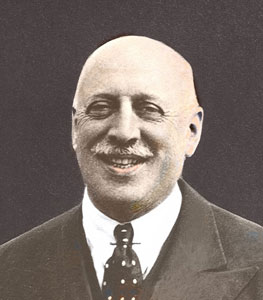
Louis Even
Contrary
to too widespread an idea in Canada, Social Credit is not at all a
political party.
Social
Credit is a doctrine, a series of principles expressed for the first
time by Major and engineer C. H. Douglas in 1918. The implementation of
these principles would make the social and economic organism effectively
reach its proper end, which is the service of human needs.
Social
Credit would neither create the goods nor the needs, but it would
eliminate any artificial obstacle between the two of them, between
production and consumption, between the wheat in elevators and the bread
on the table. The obstacle today — at least in the developed countries
— is purely of financial order, a money obstacle. Now, the financial
system neither proceeds from God nor nature. Established by men, it can
be adjusted to serve men and no more to cause them problems.
To
this end, Social Credit presents concrete propositions. Though very
simple, these propositions nevertheless imply a real revolution. Social
Credit brings the vision of a new civilization, if by civilization one
can mean man's relationship with his fellow men and the conditions of
life making easier for each one the blossoming of his personality.
Under
a Social Credit system, we would no longer be struggling with problems
that are strictly financial, which constantly plague public
administrations, institutions, families, and which poison relationships
between individuals. Finance would be nothing but an accounting system,
expressing in figures the relative values of goods and services, making
easier the mobilization and coordination of the energies required for
the different levels of production towards the finished good, and
distributing to ALL consumers the means to choose freely and
individually what is suitable to them among the goods offered or
immediately realizable.
For
the first time in history, absolute economic security, without
restrictive conditions, would be guaranteed to each and everyone.
Material poverty would be a thing of the past. Material anxiety about
tomorrow would disappear. Bread would be ensured to all, as long as
there is enough wheat to make enough bread for all. Similarly for the
other goods that are necessary for life.
Each
citizen would be presented with this economic security as a birthright,
as a member of the community, usufructuary throughout one's life of an
immense community capital, that has become a dominant factor of modern
production. This capital is made up of, among other things, the natural
resources, which are a collective good; life in society, with the
increment that ensues from it; the sum of the discoveries, inventions,
technological progress, which are an ever-increasing heritage from
generations.
This
community capital, which is so productive, would bring each of its
co-owners, each citizen, a periodical dividend, from the cradle to the
grave. And seeing the volume of production attributable to the common
capital, the dividend to each one ought to be at least sufficient to
cover the basic necessities of life. This dividend would be given in
addition to those who personally take part in production, without
prejudice to wages, salaries or other forms of reward.
An
income thus attached to the individual, and no longer only attached to
his status of employee, would shield him from exploitation by other
human beings. With the basic necessities of life guaranteed, a man can
better resist being pushed about and can better take up the career of
his own choosing.
Freed
from urgent material worries, men could apply themselves to free
activities, which are more creative than commanded work, and strive
towards their own development by the exercise of human functions
superior to the purely economic function. Getting the daily bread would
no more be the absorbing occupation of their lives.
But,
however logical, social and respectful of the human person the Social
Credit propositions are, they radically break off with notions generally
received and considered as tangible and intangible.
That
is why Social Credit cannot result from a simple change of party in
power. One does not impose a new civilization by an election. One must
first make it known, make it wanted, make it sought after by the
population. And since this is a question of a Social Credit
civilization, let us say that one must first develop a Social Credit
mentality, win people over to a standpoint favourable to the vision
presented by Social Credit.
Therefore
the problem is not of boosting a political party, but of making Social
Credit known, loved and wanted.
Besides,
the very conception of a party is at variance with the philosophy of
Social Credit. Political parties exist to try to take power, and are on
the move only when the race for power is opened. As for Social Credit,
it would distribute power as widely as possible among all members of
society: economic power, by a purchasing power guaranteed to each
individual; political power, by making the Members of Parliament the
real representatives of their constituents, and no more the servants of
a party.
It
is a must for the electorate to learn to express their common will at
all times. The decisions affecting the lives of the citizens are made
between elections. To content oneself with voting for a party candidate,
then to passively accept anything which is decided upon without the
advice from those who must bear the cost of decisions, is political
childishness.
The
party creates a wall
(The
“Vers Demain” Journal,, January 1, 1957)
It
would be in the interest of any group or movement that deals with the
social question to know and assimilate the Social Credit principles.
If
any representative of the people, taken individually, of whatever
political party, really wants to promote the common good, he must not
hesitate to call for an appropriate distribution of the wealth,
respecting personal freedom, private property and private enterprise,
which is something he can do while staying in the party that he
considers more capable of running the country.
But
we cannot see a masterful idea like Social Credit - which transcends
political parties and would enrich them all - being in some way confined
in a political party. Social Credit is a universal. A political party is
a part, a piece. To call a party "Social Credit" is to want to
enslave a universal into a limitative.
As
soon as you use the words Social Credit to name a political party, you
exclude the possibility for the member of another party to declare
himself in favour of Social Credit : it would be to declare himself for
an opposing party. He will object to you that he cannot be at the same
time for his party and the Social Credit Party.
And
if the population is accustomed to thinking of a political party when it
hears the words "Social Credit", you carry a very great chance
of finding many with only half an ear, if not already blocked up, when
you want to introduce Social Credit to an audience of another party.
The
aim of a political party is to stay in power if it already holds it, or
try to take power if it does not already hold it. Therefore there is
necessarily a struggle between political parties. Each party is an
opponent of the other or others. To call "Social Credit" a
party is to turn the members of all other parties against anything that
bears the name Social Credit.
And
besides, a truth cannot be submitted to a vote. To subject Social Credit
to a vote is to be bound to be told, after a failure : "You can see
that it is not as good as you say, since the people voted in majority
against it."
Perhaps
some will ask: "How will you get a Social Credit legislation passed
if the party in power is not a Social Credit Party?"
We
believe that Social Credit will prevail everywhere, even in the
political parties, the one in power as well as those in the opposition,
when it will have been sufficiently accepted in the minds and claimed by
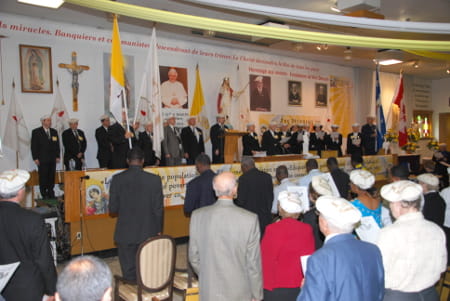
the population itself. This is what the Pilgrims of Saint Michael apply
themselves to. And it is precisely so as not to put up walls between
Social Credit and minds, which are still too much accustomed to thinking
about politics only in terms of parties, that we do not want to see the
idea of Social Credit linked to the idea of a party.
*
* *
Perhaps
some will ask: “How will you get a Social Credit legislation passed if
the party in power is not a Social Credit Party?”
We
believe that Social Credit will prevail everywhere, even in the
political parties, the one in power as well as those in the opposition,
when it will have been sufficiently accepted in the minds and claimed by
the population itself. This is what the Pilgrims of St. Michael apply
themselves to. And it is precisely so as not to put up walls between
Social Credit and minds, which are still too much accustomed to thinking
about politics only in terms of parties, that we do not want to see the
idea of Social Credit linked to the idea of a party.