The Social Credit proposals
explained in 10 lessons
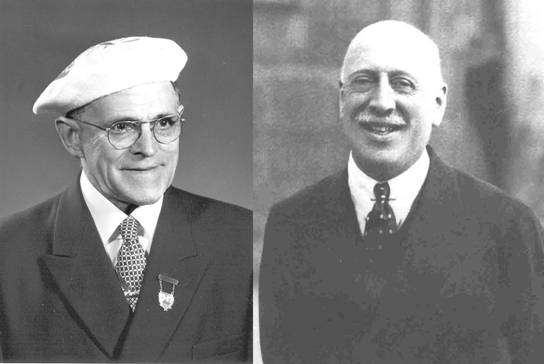
Louis Even
and C. H. Douglas
and
viewed in the light of
the social doctrine of the Church
A study prepared by Alain Pilote
on the occasion of the week of study
that followed the Congress of the Pilgrims of Saint Michael
in Rougemont, September 5-11, 2006
Published by the Louis Even Institute for Social Justice
1101 Principale St., Rougemont,
QC, Canada J0L 1M0 — www.michaeljournal.org
The Social Credit proposals
explained in 10 lessons
Lesson
1 : Le goal of economics: to bring goods to those who need them
Lesson 2 : Poverty amidst plenty, the birth of money
Lesson 3 :
Banks create money as a debt
Lesson 4 :
The solution: debt-free money created by society
Lesson 5 : The chronic shortage of purchasing power
— The dividend
Lesson 6 : Money and prices — The compensated
discount
Lesson 7 :
The history of the banking control in the United States
Lesson 8 : Social Credit is not a political party
Lesson 9 : Social Credit and the social doctrine of
the Church (Part I)
Lesson 10 : Social Credit and the social doctrine
of the Church (Part II)
Introduction
Social Credit is a doctrine, a series of principles
set down for the first time by Major and engineer C. H. Douglas in 1918. The
implementation of these principles would make the social and economic organism
effectively serve its proper purpose or end, that is, to meet human needs.
Social Credit would create neither the goods nor the needs; what it would do is
to eliminate the present artificial obstacle between goods and needs, between
production and consumption, between the wheat in elevators and the bread on the
table. The obstacle today — at least in the developed countries — is purely of
financial order, a money obstacle. The financial system does not proceed from
God, and nor does it come from nature. Established by man, it can be adjusted
to serve man and cease to enslave him.
Social Credit presents concrete propositions for
exactly this purpose. Though very simple, these propositions embody a real
revolution. Within it, Social Credit holds the vision of a new civilization, if
civilization means man's relationship with his fellow man and the conditions of
life that foster for each one the blossoming of his personality.
Under a Social Credit system, we would no longer
struggle with problems that are strictly financial, problems that constantly
plague public administrations, institutions and families, problems which poison
relationships between individuals. Finance would be nothing more than an
accounting system which expresses in figures the relative values of goods and
services. This system would serve to mobilize and coordinate the energies and
effort involved in the different levels and stages of production that lead to the
finished goods. It would distribute to ALL consumers the means to choose freely
and individually, what is suitable to them from among the goods offered or
immediately realizable.
For the first time in history, absolute economic
security, without restrictive conditions, would be guaranteed to each and every
one. Material poverty would be a thing of the past. Material anxiety about
tomorrow would disappear. Bread would be ensured to all, while there is enough
wheat to make enough bread for all. Similarly for the other goods that are
necessary for life.
Each citizen would be presented with this economic
security as a birthright, as a member of the community, enjoying throughout
one’s life an immense community capital, that has become a dominant factor of
modern production. This capital is made up of, among other things, natural
resources, which are a collective good; life in society, with the benefit that
ensues from it; the sum of the discoveries, inventions, technological progress,
which are an ever-growing heritage from previous generations.
This
community capital, which is so productive, would bring to its co-owners, each
citizen, a periodical dividend, from the cradle to the grave. With the volume
of production coming from the common capital, the dividend to each ought to be
at least sufficient to cover the basic necessities of life. This dividend would
be distributed equally, in equal amount, to all. It would also be given to
those who personally take part in production, independently of wages, salaries,
or other forms of reward received.
An income like this attached to the individual, and no
longer only attached to his status of employee, would protect him from
exploitation by other human beings. With the basic necessities of life guaranteed,
a man can better resist being pushed about and can better take up the career of
his own choosing. Freed from urgent material worries, people could apply
themselves to activities which are more creative than compulsory and routine
work, and strive towards their own development by the exercise of human
capabilities superior to the purely economic function. Getting the daily bread
would no more be the all-absorbing occupation of their lives.
 Note: The text of the following 10 lessons is
 essentially taken from Louis Even’s
writings :
essentially taken from Louis Even’s
writings :
In This Age of Plenty,
What Do We Mean by Real Social Credit?
A Sound and Efficient Financial System
LESSON 1 — THE GOAL OF ECONOMICS:
TO BRING GOODS
TO THOSE WHO NEED THEM
Ends and means
In talking of economics, it is important to
distinguish between ends and means. It is also very important to make the means
serve the end, and not the other way around.
The end is the goal aimed at, the objective pursued.
The means is the processes, the methods, the acts that achieve the end or goal.
I want to make a table. That is my goal. I get planks,
I measure, I saw, I plane, I adjust, I nail the wood. These are the means, the
methods, which go into making the table.
All this is elementary. Yet, in the running of public
affairs, means are mistaken for the end, and the resulting chaos can be
amazing. For example, according to you, what is the goal, the end of economics:
A. To create jobs?
B. To reach a favourable balance of trade?
C. To distribute money to people?
D. To produce the goods that people need?
The correct answer is D. Yet, for practically all
politicians, the business of economics is to create jobs: but jobs are just a
means to produce goods, and goods are the real “end”. Today, thanks to the
heritage of progress, goods can be produced with ever-diminishing input of
human labour, and this leaves people ever-increasing free time to engage in
other activities, like looking after their families, or taking care of other
social duties. What would really be the point of continuing to produce
something when the need for it has already been satisfied? This would be just a
useless waste of resources. Now what about all those who cannot be employed in
the production system? The disabled, old people, children, housewives? Should
they starve to death? Not every human being is strictly a producer, but all
have needs, and are consumers.
 To have a
favourable balance of trade means that you export to other countries more
products than you import from abroad, so you end up with less of your home
product, and are poorer in real wealth.
To have a
favourable balance of trade means that you export to other countries more
products than you import from abroad, so you end up with less of your home
product, and are poorer in real wealth.
To the question above, you might be tempted to answer
C, for is it not obvious that money is necessary to live today? Unless, that
is, if you produce all that you need yourself, but that is the exception in
today’s society, with the division of work where one person is the baker,
another one the carpenter, and so on, each one accomplishing a specific task
and producing specific goods.
Money is a means to obtain what is produced by others.
Note carefully, it is a means, not an end! You cannot eat money, wear it, or
put it on your feet. Money is there to buy food and clothing. First, these
things have to be produced and put on
sale in the market: money is not good if there is nothing you can buy with it.
What would be the use of having a million dollars in the North Pole or the
Let us not confuse “ends” with “means”; the same thing
applies to systems. The systems were invented and established to serve man, not
man created to serve systems. If a system is harmful to the mass of men, must
we let it continue, or do we not alter it to make serve the multitude? Another
question: since money is put there to oil the wheels of production and
distribution, must production and distribution be limited by the flow of money,
or, must money be made to flow in step with production and distribution?
Can you see now the error of
mistaking the ends for the means, and the means for the ends? Is this not a
silly, stupid and widespread error which causes much disorder in our society?
The purpose of economics
The word “economy” is derived from two Greek roots: Oikia, house; nomos,
rule.
Economy is therefore about the good regulation of a
house, of order in the use of the goods of the house.
Domestic economy is good management of domestic
affairs, and political economy is good management in the affairs of the large
communal home, the nation.
Management of the affairs of the small or large home, the
family or the nation, can be called “good” when it serves its purpose.
Man engages in different activities and pursues
different ends.
Man’s moral activities concern his final end.
Cultural activities affect the development of his
intellect, the ornamentation of his intellect, and the formation of his
character.
In participating in the general well-being of society,
man engages in social activities.
Economic activities deal with temporal wealth. In his
economic activities, man seeks to satisfy his temporal needs.
The goal, the purpose or end of economic activities,
is then the use of earthly goods to satisfy man’s temporal needs. Economics
serves its purpose when earthly goods serve human needs.
The temporal needs of man accompany him from the cradle
to the grave. Some needs are essential, others less so.
Hunger, thirst, bad weather, weariness, illness,
ignorance, create for man the need to eat, drink, clothe himself, find warmth,
shelter, refresh himself, rest, take care of his health, and to educate
himself.
These are all human needs.
Food, drink, clothing, shelter, wood, coal, water,
bed, remedies, the school teacher’s teaching books — all these things must be
present to meet man’s needs.
To have goods meet needs — this is the goal, the
purpose and end of economic life.
If it does this, economic life serves its end or
purpose. If it does not do this, or does it badly or incompletely, economic
life fails its purpose, or only meets that purpose imperfectly.
The goal is to join goods to needs, not only just to
bring them close together.
In straight terms, it may be said that economics is
good, that it serves its end, when it is sufficiently well-regulated for food
to enter the hungry stomach, for clothes to cover the naked body, for shoes to
protect the bare feet, for a good fire to warm the house in winter, for the
sick to receive the doctor’s visit, for teacher and the students to meet.
The purpose of economics is not only to produce goods;
these goods must be useful for people, answer their needs. Goods are not
produced to stay on the shelf, but to be consumed by the people who need them.
And for this to happen, people must have money to buy the goods that are on the
shelf in the store.
Economics has a purpose of its own: to satisfy man’s
needs. To eat when one is hungry is not the final goal, or end, of man; no, it
is only a means the better to aim towards his final goal, that is, to see God
face to face in Heaven for eternity.
If economics is only a means to the final end, if it
is only an intermediate end in the general order, it is nevertheless a very
distinctive end.
When economics join goods to needs, it is perfect. Let
us not ask more of it. But let us ask this of it. It is the purpose of
economics to achieve this perfect end, or goal.
Morality and economics
Let us not ask of economics to serve a moral purpose,
nor of morality to serve an economic purpose. This would be as disorderly as to
attempt to travel from
A starving man will not appease his hunger by reciting
his Rosary, but by eating food. This is in order. It is the Creator who wanted
it this way, and He turns from it only by departing from the established order,
through a miracle. He alone has the right to break this order. To satiate man’s
hunger, it is economics therefore that must intervene, not morality.
Similarly, a man who has a sullied conscience cannot
purify it by eating a good meal, or by drinking bucket loads of water. What he
needs is the confessional. In that case, it is religion’s place to intervene;
it is a moral activity, not an economic activity.
There is no doubt that morality must accompany all of
man’s actions, even in the domain of economics, but morality does not replace
economics. It guides in the choice of objectives, and it watches over the
legitimacy of the means, but it does not do what economics must do.
So, when economics does not meet its purpose, when
things stay in the stores or are not produced, and needs continue in the homes,
let us look for the cause in the economic order.
Let us blame, of course, those who disorganize the
economic order, or those who, having the mission to govern it, leave it in
anarchy. By not fulfilling their duties, they are certainly morally
responsible, and fall under the sanction of ethics.
If moral and ethics are truly distinct, both at the
same time concern the same man, and if the rules of one are broken, the other suffers.
Man has the moral duty to make sure that the economic order, the social
temporal order, serves its proper purpose.
Also, although economics is responsible only for the
satisfaction of man's temporal needs, the importance of good economic practices
has time and time again been stressed by those in charge of souls, because it
normally takes a minimum of temporal goods to encourage the practice of virtue,
as Saint Thomas Aquinas put it. We have a body and a soul, spiritual and
material needs. As the saying goes, “words are wasted on a starving man”, and
even the missionaries in poor countries know this. It is they who have to feed
the hungry before preaching to them. Man needs a minimum of goods to live his
short pilgrimage on earth and save his soul, but a money shortage can cause
terrible and inhuman situations. This is what brought Pope Benedict XV to
write, “It is in the economic field that the salvation of souls is at
stake.”
And Pius XI: “It may be said with all truth that
nowadays the conditions of social and economic life are such that vast
multitudes of men can only with great difficulty pay attention to that one
thing necessary, namely their eternal salvation.” (Encyclical Letter Quadragesimo Anno,
May 15, 1931.)
The social and very human end of
the economic organism is summed up in this sentence of Quadragesimo
Anno:
“Only
will the economic and social organism be soundly established and attain its
end, when it secures for each and all those goods which the wealth and
resources of nature, technical achievement, and the social organization of
economic affairs can give.”
EACH and ALL must be secured with all the goods that
nature and industry can provide.
The end and purpose of economics is therefore the
satisfaction of ALL of the consumers’ needs. The purpose is consumption;
production is only a means.
To make economics stop at production is to cripple it.
Economics must not finance production only; it must also finance consumption.
Production is the means, consumption is the end.
In an order where the end governs the means, it is man
as consumer who is in charge of all of the economy. And since every man is a
consumer, it is every man who contributes to ordering the production and
distribution of goods.
A really human economy is social, as we said; it must
satisfy ALL men. So EACH and ALL must be able to make their demands on the
production of goods — at least to satisfy their basic needs, as long as
production is in a position to respond to these demands.
The policy of a philosophy
Social Credit is not a utopia, but is based on a right
understanding of reality, on the just relationship between man and the society
in which he lives. As Clifford Hugh Douglas said, Social Credit is the policy
of a philosophy.
A policy is the action that we take, and it is based
on a conception of reality or, in other words, a philosophy.
Social Credit proclaims a philosophy which has existed
as long as men have lived in society, but which is terribly ignored in practice
— more than ever in this day and age.
This philosophy, as old as society itself — therefore
as old as the human race — is the philosophy of association. The social
teaching of the Church cal it: the common good.
The philosophy of association is therefore the joining
together of all associates for the good of the associates, of each associate.
Social Credit is the philosophy of association applied to general society, the
province, the nation. Society exists for the benefit of all the members of
society, for each and every one.
It is for this reason that Social
Credit is, by definition, the opposite of any monopoly: economic monopoly,
political monopoly, prestige monopoly, brutal-force monopoly.
Let us define Social Credit as a system of society at
the service of each and every one of its members, in which politics is at the
service of each and every one of the citizens, and economics is at the service
of each and every consumer.
Now let us define monopoly: the exploitation of the
social organization for the benefit of a few privileged individuals, where
politics is in the service of clans called parties, and economics works in the
service of a few financiers, a few ambitious and unscrupulous entrepreneurs.
Too often, those who condemn monopolies stop at
specified industrial monopolies: the electric monopoly, the coal monopoly, the
oil monopoly, the sugar monopoly, etc. They ignore the most pernicious of all
monopolies in the field of economics: the monopoly of money and credit; the
monopoly that transforms and subverts a country’s progress into public debts; a
monopoly which, by controlling the volume of money, regulates the human
standard of living, out of all relation to the realities of production and the
needs of families.
The aim of Social Credit is to “bind back to reality”
or “express in practical terms” in the current world, especially the world of
politics and economics, those beliefs about the nature of God and man and the
Universe which constitute the Christian Faith, as delivered to us from our
forefathers, and NOT as distorted and perverted to suit current politics or
economics, which stem from a non-Christian source.
Man lives in society, in a world subject to God’s
laws: the laws of nature (the physical laws of creation), and God’s moral law
(the Ten Commandments). The acceptance and knowledge of these laws implies
recognizing the consequences of violating them.
To accept Natural Law is to recognize that it is
inescapable reality, and that all people, as individuals or collectively in
society, are subject to Natural Law. Every event which occurs on the physical
plane is an abundant illustration of the laws of the physical universe. For
example, if a man jumps out of an aeroplane, he does not break the law of
gravity… he just illustrates, proves it. That observation is applicable to all
natural laws.
These laws are beyond the abrogation of man — they
cannot be disobeyed — the sanctions which enforce them are irresistible.
The chains (agreement associations — man made laws)
which individuals in society have forged for themselves — are optional, whereas
the Natural Law and its consequences are inescapable.
For example, money is a man-made system, not a system
created by God or by nature: it can be changed by man. The equilibrium of the
environment, however, has been created by God, and cannot be broken without
consequences. If we produce goods without respecting the environment, if we
pollute and waste the resources given to us by God, we have to suffer the
consequences.
The social credit: the confidence
that binds society together

 In his booklet What is Social Credit?, Geoffrey
Dobbs wrote: “The social credit (without capital letters) is the name of
something, which exists in all societies but which never had a name before
because it was taken for granted. We become aware of it only as we lose it.
In his booklet What is Social Credit?, Geoffrey
Dobbs wrote: “The social credit (without capital letters) is the name of
something, which exists in all societies but which never had a name before
because it was taken for granted. We become aware of it only as we lose it.
“‘Credit’ is another word for ‘faith’ or ‘confidence’,
so we can also call it the Faith or Confidence which binds any society together
— the mutual trust or belief in each other without which fear is substituted
for trust as the “cement” of society... Though no society can exist without
some social credit, it is at its maximum where the Christian faith is
practised, and at its minimum where it is denied and derided.
“The social credit is thus a result, or practical
expression, of real Christianity in society, one of its most recognisable
fruits; and it is the aim and policy of social crediters
to increase it, and to strive to prevent its decrease. There are innumerable
commonplace examples of it which we take for granted every day of our lives.
How can we live in any sort of peace or comfort if we cannot trust our
neighbours? How could we use the roads if we could not trust others to observe
the rule of the road? (And what happens when they don’t!)
“What would be the use of growing anything in gardens,
farms or nurseries if other people were to grab it? How could any economic
activity go forward — whether producing, selling or buying — if people cannot,
in general, rely upon honesty and fair dealing? And what happens when the
concept of the Christian marriage, and the Christian family and upbringing, is
abandoned? We see, do we not? — that Christianity is something real with
desperately vital practical consequences, and by no means a mere set of
opinions which are ‘optional’ for those to whom they happen to appeal.”
 You could add that without this respect for the social
credit, for the laws ruling society, any life in society would become
impossible, even though you put a police officer on every street corner, since
you could not trust anybody.
You could add that without this respect for the social
credit, for the laws ruling society, any life in society would become
impossible, even though you put a police officer on every street corner, since
you could not trust anybody.
Social Discredit
Mr. Dobbs continues:
“Just as there are social crediters, conscious
and unconscious, trying to build up the social credit (the confidence that we
can live together in society and benefit from it), so there are others — social
discrediters — trying to destroy it and break it
down, at present, with all too much success. The conscious ones include the
communists and other revolutionaries, who quite openly seek to smash all the
links of trust and confidence which enable our society to function until the
Day of the Revolution dawns... But it is the unconscious social discrediters who are responsible, in the West, for the
present success of the conscious ones....
“Why do shops and manufacturers foist upon us so many
shoddy, rubbishy, throw-away things, at outrageous prices, and trick us into
buying them with clever packaging and advertising? Why are most repair services
so scandalously slow, expensive and inefficient, and so many small services
which made life easier now unobtainable? And above all, why do millions of
decent working people of all classes take part in strikes deliberately designed
to damage services to their fellow men? What on earth can make normal decent
people descend to this spiritual level? We all know what it is. There is one
common factor running through all this destructive and discreditable action:
the compulsive need for more money to meet the ever-rising cost of living.
“So now at last I have come to the
question of money, which is what some people think that Social Credit is all
about; but it isn’t! Social Credit is an attempt to apply Christianity in
social affairs; but if money stands in the way, then we, and every Christian,
must concern ourselves with the nature of money, and just why it stands in the
way, as it surely does. There is a dire need for more people to look deeply
into the operation of our monetary system, though that is not everyone's job.
But when the consequences are so desperate, everyone can at least grasp the
outline of what is wrong, and could be put right, which will enable them to act
accordingly...”
LESSON 2 —
POVERTY AMIDST PLENTY
THE BIRTH AND DEATH OF MONEY
Do goods exist? Do they exist in sufficient quantity to
satisfy all of the consumers' basic needs?
Are we short of anything in our country to satisfy the
temporal needs of the citizens? Are we short of food for everybody to eat one’s
fill? Are we short of shoes, clothes? Can we not make as much as is required?
Are we short of railroads and other means of transportation? Are we short of
wood or stones to build good houses for all families? Are we short of builders,
manufacturers, or other workers? Are we short of machines?
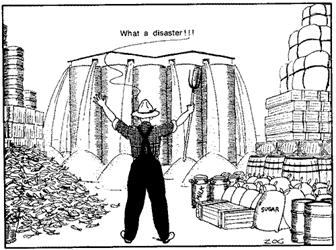
No, we have all these things, in plenty. Never do the
retailers complain that they cannot find enough goods to meet the demand. Grain
elevators are bulging. Numerous are the able-bodied men waiting for work.
Numerous also are the machines which are at a standstill.
Yet, a great many people suffer! Goods are simply not
finding their way into homes.
Of what use is it to tell people that their country is
rich, that it exports a lot of goods, that it ranks third of fourth among the
world’s exporting countries?
What goes out of the country does not go into the
homes of the citizens. What sits idle in the stores does not appear on their
tables.
A mother does not feed her children or provide them
with shoes and garments, by going window-shopping, by reading the advertisements
of goods in newspapers, by listening to the description of good products on the
radio, or listening to the sales talk of countless salesmen of all kinds.
 What is lacking is the effective means of laying hands
on these goods. You cannot steal them. To get them, you must pay for them: you
need money.
What is lacking is the effective means of laying hands
on these goods. You cannot steal them. To get them, you must pay for them: you
need money.
There are a lot of good things in our country, but
many individuals and families who need these goods lack the right to have them,
the permission to get them.
Is there anything lacking but money? What is lacking,
apart from the purchasing power to make the products go from stores to homes?
 Mankind has gone through periods
of food shortage; famines covered big countries, and there was no appropriate
means of transportation to bring to these countries the wealth from other
sections of the planet. It is no longer the case today. There is an
overabundance of everything. It is abundance — no longer scarcity — that
creates the problem.
Mankind has gone through periods
of food shortage; famines covered big countries, and there was no appropriate
means of transportation to bring to these countries the wealth from other
sections of the planet. It is no longer the case today. There is an
overabundance of everything. It is abundance — no longer scarcity — that
creates the problem.
It is not at all necessary to go into detail to
demonstrate this fact. There are thousands of cases of voluntary destruction on
a large scale “to stabilize markets”, by making stocks disappear. Let us give
just a few examples:
The
“The very same week this operation was taking place,
6,000 barrels of 200 pounds (90 kg) of herrings were dumped into the
Abundance is not confined to
“Public outrage has erupted over the European
Community’s (EC) plan to burn or dump in the ocean the huge surplus mountains
of butter, milk powder, beef and wheat piling up across EC nations. A report
from the EC’s
Why all this waste? Why don’t the products join the
needs? It is because people have no money. Wealth, goods are laughing in your
face and you starve in front of lofts full to overflowing, if you have got no
money. No money, no products: humans starve to death, and products are thrown
away.
Are we smarter than monkeys?
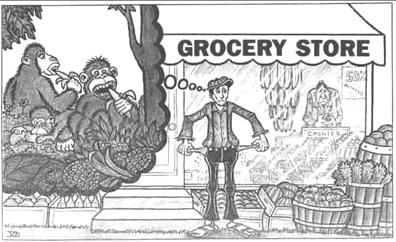 Look at the opposite cartoon: Here is a grocer's store
filled with good products in abundance; in front of this store, there is a
penniless starving man. Good products are made to be consumed. The grocer
displays them to sell them. The consumer would like to purchase them, but he
lacks the ticket to purchase them: he has got no money. The result: the good
products will not be consumed, and they will rot on the shelves. Yet, everybody
would be happier if the situation was different — the grocer would be happy to
sell, and the consumer would be happy to buy.
Look at the opposite cartoon: Here is a grocer's store
filled with good products in abundance; in front of this store, there is a
penniless starving man. Good products are made to be consumed. The grocer
displays them to sell them. The consumer would like to purchase them, but he
lacks the ticket to purchase them: he has got no money. The result: the good
products will not be consumed, and they will rot on the shelves. Yet, everybody
would be happier if the situation was different — the grocer would be happy to
sell, and the consumer would be happy to buy.
Why is it that something that would make everyone
happy cannot take place among human beings?
Let us have a
look at the monkeys. They see plenty of bananas on the banana trees. Since they
need to eat bananas to live, they simply pick the bananas and eat them.
Monkeys never worked out complicated economic systems
in their universities. In their heads of monkeys, they never examined the law
of supply and demand, nor the difference between socialism and neo-liberalism.
They simply saw good things in front of them, and they were smart enough to
pick them in order not to starve.
But a monkey is a monkey, and a man is a man. A monkey
has no mind, but a man can misuse his mind.
A monkey is led by its instinct, which does not
mislead it. Man is led by his mind, which is often misled by pride. In such a
case, man quibbles, uses dialectics, but forgets simple and pure reasoning
based on common sense.
This foolish situation of a multitude of starving
people amidst plenty of wealth is caused by the greed of those who base their
power on the bondage of the masses. You can say also that this foolish
situation is supported and maintained by people allegedly learned in economics,
who lead minds to the most stupid conclusions, under the pretence of reasoning
with science and wisdom.
This whole situation can also be summed up in the form
of a joke, although the conclusion is very serious: A group of monkeys in the
jungle were arguing whether men were more intelligent than monkeys. Some said
“yes”; others said “no”. One of the monkeys said: “To be clear in my own mind,
I will go to the city of the humans, and find out if they are really smarter
than us.” All the monkeys agreed that it was a good idea. So the monkey went,
and saw a penniless man starving in front of a grocery store filled with
bananas. The monkey came back to the jungle, and said to the other monkeys:
“Don't worry, men are not smarter than us; they starve to death in front of
bananas that rot on the shelves for lack of money.”
Conclusion: Let's be smarter than the monkeys, and let
us devise a money system that will allow us to eat the bananas and all the
other products that are provided in plenty by God for all His children. This
smart money system exists; it is Social Credit.
Money and
wealth
We have just shown that what is lacking is not
products, but money. This does not mean that money itself is wealth. Money is
not an earthly good capable of satisfying a temporal need. As we said in the
previous lesson, money is a means, the end is the products.
You cannot keep yourself alive by eating money. To get
dressed, you cannot sew together dollar bills to make a dress or a pair of
stockings. You cannot rest by lying down on money. You cannot cure a sickness
by putting money on the seat of the malady. You cannot educate yourself by
crowning your head with money.
Money is not real wealth. Real wealth consists of all
the useful things which satisfy human needs.
Bread, meat, fish, cotton, wood, coal, a car on a good
road, a doctor visiting the sick, the knowledge of a science — these are real
wealth.
In our modern world, each individual does not produce
all things. People must buy from one another. Money is the symbol or token that
you get in return for a thing sold; it is the symbol that you must give in
return for a thing that you want from another.
Wealth is the thing; money is the symbol of that
thing. The symbol should reflect the thing.
If there are a lot of things for sale in a country,
there must be a great deal of money to dispose of them. The more people and
goods, the more money in circulation is required, otherwise everything stops.
It is precisely this balance that is lacking today. We
have at our disposal almost as great a quantity of goods as we could possibly
wish, thanks to applied science, to new discoveries, and to the perfecting of
machinery. We even have a lot of people without occupations, who represent a potential
source of goods. We have loads of useless, even pernicious, occupations. We
have activities of which the sole end is destruction.
Money was created for the purpose of keeping goods
moving. Why, then, does it not find its way into the hands of the people in the
same measure as the flow of goods from the production line?
Money
begins somewhere
 Everything, except God, has a beginning. Money is not
God, therefore it has a beginning. Money begins somewhere.
Everything, except God, has a beginning. Money is not
God, therefore it has a beginning. Money begins somewhere.
We know the origin of such useful commodities as food,
clothing, shoes, books. Workers, machines, plus the country’s natural
resources, produce the wealth, the goods we need and which we do not lack.
But then where does money begin, the money that we
lack in order to buy the goods that are not lacking?
The first idea that we keep alive in our minds,
without really realizing it, is that there is one fixed quantity of money, and
that it cannot be changed; as if it was the sun, or the rain, or the weather.
This idea is utterly wrong; if there is money, it is because it was made
somewhere. If there is not more, it is because those who made it did not make
more.
Another prevalent belief about the origin of money is
that the Government makes it. This is also incorrect. The Government today does
not create money, and complains continuously about not having any. If the
Government were the source of money, it would not have sat around idly for ten
years in front of the lack of money. (And for example, in
Now, we will explain where money begins and ends.
Those who control the birth and death of money also regulate its volume. If
they make much money and destroy little, there is more. If the destruction of
money goes faster than its creation, its quantity decreases.
Our standard of living, in a country where money is
lacking, is not regulated by the volume of goods produced, but by the amount of
money at our disposal to buy these goods. So those who control the volume of
money, control our standard of living. “Those who control money and credit
have become the masters of our lives... No one dare breathe against their
will.” (Pope Pius XI, Encyclical Letter Quadragesimo
Anno).
Two kinds of
money
Money is whatever serves to pay, to buy; whatever is
accepted in exchange for goods or services.
The material substance of which money is made is of no
importance. In the past, money has at times been made of shells, shark teeth,
leather, wood, iron, silver, gold, copper, paper, etc.
Examples
of money in the past


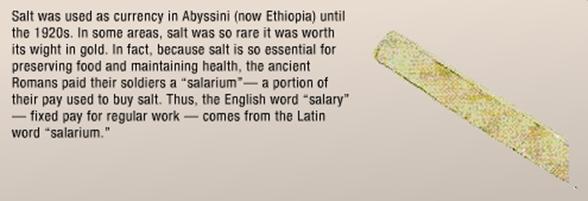

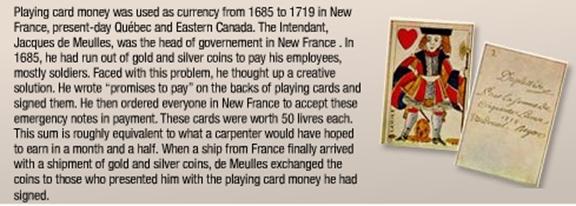
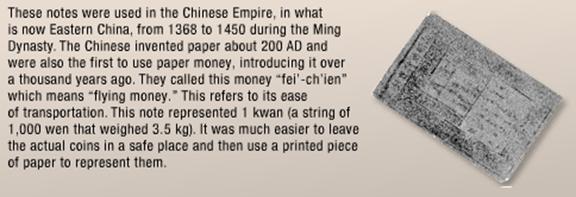
Source:
http://www.currencymuseum.ca/eng/learning/digit.php
There are at present two kinds of money in
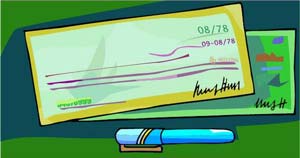 Book money is the bank account. Business operates
through bank accounts. Whether pocket money circulates or not depends on the
state of business. But business does not depend upon pocket money; it is kept
going by the bank accounts of businessmen.
Book money is the bank account. Business operates
through bank accounts. Whether pocket money circulates or not depends on the
state of business. But business does not depend upon pocket money; it is kept
going by the bank accounts of businessmen.
With a bank account, payments or purchases are made
without using metal or paper money. Buying is done only with figures.
Let us suppose I have a bank account of $40,000. I buy
a car worth $10,000. I make my payment by writing a cheque. The car dealer
endorses the cheque, and deposits it at his bank.
The banker then makes changes in two accounts: first,
that of the car dealer, which he increases by $10,000; then mine, which he
decreases by $10,000. The car dealer had $500,000 — he now has $510,000 written
in his bank account. I had $40,000 in mine — my bank account now shows $30,000.
Paper money did not move in the country because of
this deal. I simply gave some figures to the car dealer. I paid with figures.
More than nine-tenths of all business is done this way.
It is book money, the money made of figures, which is modern money; it is the
most abundant money; its volume is ten times that of paper or metal money. It
is a superior type of money, since it gives wings to the other. It is the
safest kind of money, the one that no one can steal.
Savings and borrowing
 Book money, like the other type of money, has a
beginning. Since book money is a bank account, it comes into existence when a
bank account is opened without money decreasing anywhere, neither in another
bank account nor in anyone's pocket.
Book money, like the other type of money, has a
beginning. Since book money is a bank account, it comes into existence when a
bank account is opened without money decreasing anywhere, neither in another
bank account nor in anyone's pocket.
The amount in a bank account can be increased in two
ways: by saving and by borrowing. There are other ways, but they can be
classified under borrowing.
The savings account is a transformation of money. I
bring along some pocket money to the banker; he increases my account by this
amount. I no longer have that pocket money; I have book money at my disposal. I
can get back pocket money by decreasing the amount of book money in my account.
It is a simple transformation of money.
But since we are trying to find out how money comes
into existence, the savings account, being a simple transformation of money, is
of no interest to us here.
 Money
begins in the banks
Money
begins in the banks
The borrowing (or loan) account is the account lent by
the banker to a borrower. Let us suppose I am a businessman. I want to set up a
new factory. All I need is money. I go to a bank and borrow $100,000 under
security. The banker makes me sign a promise to pay back the amount with
interest. Then he lends me the $100,000.
Is he going to hand me the $100,000 in paper money? I
do not want it. First, it is too risky. Furthermore, I am a businessman who
buys things at different and widely far-flung places, through the medium of
cheques. What I want is a bank account of $100,000 which will make it easier
for me to carry on business.
The banker will therefore lend me an account of
$100,000. He will credit my account with $100,000, just as if I had brought
that amount to the bank. But I did not bring it; I came to get it.
Is it a savings account, set up by me? No, it is a
borrowing account made by the banker himself, for me.
 Money
creators
Money
creators
This account of $100,000 was made, not by me, but by
the banker. How did he make it? Did the amount of money in the bank decrease
when the banker lent me $100,000? Well, let us ask the banker:
— Mr. Banker, have you any less money in your vault
after having lent me $100,000?
— I haven't gone into my vault.
— Have other people's accounts been reduced?
— They remain exactly as they were.
— Then what was decreased in the bank?
— Nothing was decreased.
— Yet my account has been increased. From where did
the money you lent me come?
— It didn't come from anywhere.
— Where was it when I came into the bank?
— It didn't exist.
— And now that it is in my account, it exists. So we
can say that it was created.
— Certainly.
— Who created it, and how?
— I did, with my pen and a drop of ink when I
inscribed $100,000 to your credit, at your request.
— Then you create money?
— The banks create book money, the money of figures.
That's the modern money that puts into circulation the other type of money by
keeping business on the move.
The banker manufactures money, ledger money, when he
lends accounts to borrowers, individuals, or governments. When I leave the
bank, there will exist in this country a new source of cheques, one that did
not exist before. The total amount of all accounts in the country was increased
by $100,000. With this new money, I will pay the workers, buy materials and
machinery — in short, build my new factory. Who, then, creates money? — The
bankers!
LESSON 3 — BANKS CREATE MONEY AS A
DEBT
Fractional banking system — The
goldsmith who became a banker
In the example of the previous lesson, when I was
granted a $100,000 loan, the banker actually created $100,000 of new money in
the form of credit, in the form of bookkeeping money, which is just as good as
coins and paper money.
The banker is not afraid to do this. My cheques to
payees will give them the right to draw money from the bank. But the banker
knows very well that nine-tenths of these cheques will simply have the effect
of decreasing the money in my account, and of increasing it in other people's
accounts. He knows very well that a ratio of bank reserves to deposits of 1/10
is enough for him to meet the requests of those who want pocket money. In other
words, the banker knows very well that if he has $10,000 in cash reserves, he
can lend $100,000 (ten times the sum) in bookkeeping money.
In technical terms, the capacity for a bank to lend 10
times the amount of paper money it has in its safe is called fractional banking
system. The origin of this system goes back to the Middle Ages. It is the true
story of the goldsmiths who became bankers, as told now by Louis Even:
If you have some imagination, go back a few centuries
to a  purchase foreign products.
However, the wars between lords or nations, and armed
robberies, were causing the gold and the diamonds of the wealthy to fall into
the hands of pillagers. So the owners of gold, who had become very nervous,
made it a habit to entrust their treasures for safekeeping to the goldsmiths
who, because of the precious metal they worked with, had very well protected
vaults. The goldsmith received the gold, gave a receipt to the depositor, and
took care of the gold, charging a fee for this service. Of course, the owner
claimed his gold, all or in part, whenever he felt like it.
The merchant leaving for Paris or Marseille, or
travelling from
It also happened that the supplier, in
Instead of the gold, it was the goldsmith's receipts
which were changing hands. For as long as there were only a limited number of
sellers and buyers, it was not a bad system. It was easy to follow the journey
of the receipts.
The gold lender
The goldsmith soon made a discovery, which was to
affect mankind far more than the memorable journey of Christopher Columbus
himself. He learned, through experience, that nearly all of the gold that was
left with him for safekeeping remained untouched in his vault. Barely more than
one-in-ten of the owners of this gold ever took it out of the vault to conduct
their business transactions, using their receipts instead for the purpose.
 The thirst for gain, the longing to become rich faster
than by means of the jeweller’s tools, sharpened the mind of our man, and he
made a daring gesture. “Why,” he said to himself, “would I not become a gold
lender!” A lender, mind you, of gold which did not belong to him. And since he
did not possess a righteous soul like that of Saint Eligius
(or St. Eloi, the master of the mint of French kings Clotaire II and Dagobert I, in
the seventh century), he hatched and nurtured the idea. He refined the idea
even more: “To lend gold which does not belong to me, at interest, needless to
say! Better still, my dear master (was he talking to Satan?), instead of the
gold, I will lend a receipt, and demand payment of interest in gold; that gold
will be mine, and my clients' gold will remain in my vaults to back up new
loans.”
The thirst for gain, the longing to become rich faster
than by means of the jeweller’s tools, sharpened the mind of our man, and he
made a daring gesture. “Why,” he said to himself, “would I not become a gold
lender!” A lender, mind you, of gold which did not belong to him. And since he
did not possess a righteous soul like that of Saint Eligius
(or St. Eloi, the master of the mint of French kings Clotaire II and Dagobert I, in
the seventh century), he hatched and nurtured the idea. He refined the idea
even more: “To lend gold which does not belong to me, at interest, needless to
say! Better still, my dear master (was he talking to Satan?), instead of the
gold, I will lend a receipt, and demand payment of interest in gold; that gold
will be mine, and my clients' gold will remain in my vaults to back up new
loans.”
He kept the secret of his discovery to himself, not
even talking about it to his wife, who wondered why he often rubbed his hands
in great glee. The opportunity to put his plans into operation did not take
long in coming, even though he did not have “The Globe and Mail” or “The
Toronto Star” in which to advertise.
One morning, a friend of the goldsmith actually came
to see him and asked for a favour. This man was not without goods — a home, or
a farm with arable land — but he needed gold to settle a transaction. If he
could only borrow some, he would pay it back with an added surplus; if he did
not, the goldsmith would seize his property, which far exceeded the value of
the loan.
The goldsmith got him to fill out a form, and then
explained to his friend, with a disinterested attitude, that it would be
dangerous for him to leave with a lot of money in his pockets: “I will give you
a receipt; it is just as if I were lending you the gold that I keep in reserve
in my vault. You will then give this receipt to your creditor, and if he brings
the receipt to me, I will in turn give him gold. You will owe me so much
interest.”
The creditor generally never showed up. He rather
exchanged the receipt with someone else for something that he required. In the
meantime, the reputation of the gold lender began to spread. People came to
him. Thanks to other similar loans by the goldsmith, soon there were many times
more receipts in circulation than real gold in the vaults.
The goldsmith himself had really created a monetary
circulation, at a great profit to himself. He quickly lost the original
nervousness he had when he had worried about a simultaneous demand for gold
from a great number of people holding receipts. He could, to a certain extent,
continue with his game in all safety. What a windfall; to lend what he did not
have and get interest from it, thanks to the confidence that people had in him
— a confidence that he took great care to cultivate! He risked nothing, as long
as he had, to back up his loans, a reserve that his experience told him was
enough. If, on the other hand, a borrower did not meet his obligations and did
not pay back the loan when due, the goldsmith acquired the property given as
collateral. His conscience quickly became dulled, and his initial scruples no
longer bothered him.
The creation of credit
Moreover, the goldsmith thought it wise to change the
way his receipts were set out when he made loans; instead of writing, “Receipt
of John Smith...” he wrote, “I promise to pay to the bearer...”. This promise
circulated just like gold money. Unbelievable, you will say? Come on now, look
at your dollar bills of today. Read what is written on them. Are they so
different, and do they not circulate as money?
A fertile fig tree — the private banking system, the
creator and master of money — had therefore grown out of the goldsmith's
vaults. His loans, without moving gold, had become the banker's creations of
credit. The form of the primitive receipts had changed, becoming that of simple
promises to pay on demand. The credits paid by the banker were called deposits,
which caused the general public to believe that the banker loaned only the
amounts coming from the depositors. These credits entered into circulation by
means of cheques issued on these credits. They displaced, in volume and in
importance, the legal money of the Government which only had a secondary role
to play. The banker created ten times as much paper money as did the State.
The goldsmith who became a banker
The goldsmith, transformed into a banker, made another
discovery: he realized that putting plenty of receipts (credits) into
circulation would accelerate business, industry, construction; whereas
restriction of credits, which he practised at first in circumstances in which
he worried about a run on the bank for gold, paralyzed business development.
There seemed to be, in the latter case, an overproduction, when privations were
actually great; it is because the products were not selling, due to a lack of
purchasing power. Prices went down, bankruptcies increased, the banker's
debtors could not meet their obligations, and the lenders were seizing the
properties given as collateral. The banker, very clear-sighted and very skillful when it came to gain, saw his opportunities, his
marvellous opportunities. He could monetize the wealth of others for his own
profit: by doing it liberally, causing a rise in prices, or parsimoniously,
causing a decrease in prices. He could then manipulate the wealth of others as
he wished, exploiting the buyer in times of inflation, and exploiting the
seller in times of recession.
The banker, the universal master
The banker thus became the universal master, keeping
the world at his mercy. Periods of prosperity and of depression followed one
another. Humanity bowed down before what it thought were natural and inevitable
cycles.
Meanwhile, scholars and technicians tried desperately
to triumph over the forces of nature, and to develop the means of production.
The printing press was invented, education became widespread, cities and better
housing developed. The sources of food, clothing, and comforts increased and were
improved. Man overcame the forces of nature, and harnessed steam and
electricity. Transformation and developments occurred everywhere — except in
the monetary system.
And the banker surrounded himself with mystery,
keeping alive the confidence that the captive world had in him, even being so
audacious as to advertise in the media, of which he controlled the finances;
that the bankers had taken the world out of barbarism, that they had opened and
civilized the continents. The scholars and wage-earners were considered but
secondary in the march of progress. For the masses, there was misery and
contempt; for the exploiting financiers, wealth and  honours!
The ratio of cash versus loans in Canadian banks was
about one for ten in the 1940s. This ratio (a 10% cash reserve requirement) has
changed since then. In 1967, the Canadian Bank Act allowed the chartered banks
to create sixteen times (in bookkeeping money) the sum of their cash reserves.
Beginning in 1980, the minimum reserve required in cash (bank notes and coins)
was 5 per cent, which meant that the banker needed only one dollar out of
twenty to answer the needs of those who wanted pocket money. The banker knew
very well that if he had $10,000 in cash, he could lend twenty times the sum,
or $200,000, in bookkeeping money.
In practice, the banks could lend out even more than
that, since they could increase their cash reserves at will by simply
purchasing bank notes from the central bank (the Bank of Canada) with the
bookkeeping money they create out of thin air, with a pen. For example, it was
established in 1982, before a parliamentary committee on bank profits, that in
1981, the Canadian chartered banks, as a whole, made loans 32 times in excess
of their combined capital. A few banks even lent sums equal to 40 times their
capital. Moreover, in 1990 in the
Subsection 457(1) of the most recent version of the
Canadian Bank Act, enacted on
Money destroyers
So we have just seen that banks create money when they
make a loan, as it was explained at the end of the previous lesson: The banker
manufactures money, ledger money, when he lends accounts to borrowers,
individuals, or governments. When I leave the bank, there will exist in this
country a new source of cheques, one that did not exist before. The total
amount of all accounts in the country was increased by $100,000. With this new
money, I will pay the workers, buy materials and machinery — in short, build my
new factory. Who, then, creates money? — The bankers!
The bankers, and the bankers alone, make this kind of
money: bank money, the money that keeps business moving. But they do not give
away the money they create. They lend it. They lend it for a certain period of
time, after which it must be returned to them. The bankers must be repaid.
The bankers claim interest on this money that they
have created. In the case mentioned in the previous lesson, with a
$100,000-loan, the banker will probably demand $10,000 from me in interest, at
once. He will withhold it from the loan, and I will leave the bank with $90,000
in my account, having signed a promise to repay $100,000 in one year's time.
In building my factory, I will pay my men, buy things,
and thus spread my bank account of $90,000 throughout the country. But within a
year, I must, through the profits I make selling my goods for more than they
cost me, build my account up to not less than $100,000.
At the end of the year, I will pay back the loan by
making out a cheque for $100,000 on my account. The banker will then debit my
account by $100,000, therefore taking from me this $100,000 I have drawn from
the country by selling my goods. He will not put this money into the account of
anyone. No one will be able to draw cheques on this $100,000. It is dead money.
 Borrowing
gives birth to money. Repayment brings about its extinction. The bankers bring
money into existence when they make a loan. The bankers send money to the grave
when they are repaid. The bankers are therefore also destroyers of money.
Borrowing
gives birth to money. Repayment brings about its extinction. The bankers bring
money into existence when they make a loan. The bankers send money to the grave
when they are repaid. The bankers are therefore also destroyers of money.
As a distinguished British banker, the Right
Honourable Reginald McKenna, one-time British Chancellor of the Exchequer, and
Chairman of the Midland Bank, one of the Big Five (five largest banks of
England), said: “Every loan, overdraft, or bank purchase creates a deposit, and
every repayment of a loan, overdraft, or bank sale destroys a deposit.”
 And the system so operates that the repayment must be
greater than the original loan; the death figures must exceed the birth
figures; the destruction must exceed the creation.
And the system so operates that the repayment must be
greater than the original loan; the death figures must exceed the birth
figures; the destruction must exceed the creation.
This seems impossible, and collectively, it is impossible. If I succeed,
someone else must go bankrupt, because, all together, we are not able to repay more
money than has been made. The bankers create nothing but the capital sum. No
one creates what is necessary to make up the interest, because no one else
creates money. And yet, the bankers demand both capital and interest. Such a
system cannot hold out except for a continuous and ever-increasing flow of
loans. Hence the system of debts, and the strengthening of the dominating power
of the banks.
The national debt
The Government does not create money. When the
Government can no longer tax nor borrow from individuals, due to the scarcity
of money, it borrows from the banks.
The operation takes place exactly like mine. As a
guarantee, it pledges the whole country. The promise to pay back is the
debenture. The loan of the money is an account made by a pen and some ink.
Thus, in October, 1939, the federal government, in
order to cover the initial expenses of the war, asked some $80,000,000 from the
banks. The banks lent the government an account of $80 million without taking a
cent from anyone, thus giving the government a new base for cheques of $80
million. But, in October, 1941, the government had to repay $83,200,000 to the
banks, including both capital and the interest.
Through taxes, the government had to remove from the
country as much money as it had spent, $80 million, but, in addition, it had to
draw from the country a further $3 million, money it had not put into the
country, which had neither been made by the bankers nor by anyone else.
Even conceding at the most that the government can
find the money that exists, how can it find the money that has never been
created? The plain fact is, the government does not find it. It is simply added
to the national debt. This explains why the national debt increases in the same
measure as the country’s development requires more money. All new money comes
into existence as a debt, through the banker, who claims more money than he has
actually issued.
And the country's population finds itself collectively
indebted for a production that, collectively, it made itself! It is the case
for war production. It is the case also for peacetime production: roads,
bridges, waterworks, schools, churches, etc.
The
monetary defect
The situation comes down to this inconceivable thing:
all the money in circulation comes only from the banks. Even metal and paper
money comes into circulation only if it has been released by the banks.
Now the banks put money into circulation only by
lending it out at interest. This means that all the money in circulation comes
from the banks, and must someday be returned to the banks, increased with the
interest.
The banks remain the owners of the money. We are only
the borrowers. If some manage to hang on to their money for a long period of
time, or even permanently, others are necessarily incapable of fulfilling their
financial commitments.
A multiplicity of bankruptcies, both for individuals
and companies, mortgage upon mortgage, and an ever-increasing public debt, are
the natural fruits of such a system.
Claiming an interest on money as it comes into
existence is both illegitimate and absurd, antisocial and contrary to good
arithmetic. The monetary defect is therefore as much a technical defect as a
social defect.
As the country is developed, in production as well as
in population, more money is needed. But it is impossible to get new money
without contracting a debt which, collectively, cannot be paid.
So we are left with the alternatives of either
stopping developments or getting into debt; of either plunging into mass
unemployment or into an unrepayable debt. And it is
precisely this dilemma that is being debated in every country.
Aristotle, and after him, Saint Thomas Aquinas, wrote
that money does not breed more money, but the banker brings money into
existence only on the condition that it breeds more money. Since neither
governments nor individuals create money, no one creates the interest claimed
by the banker. Even if legalized, this form of issue remains vicious and
insulting.
Decline
and degradation
This way of making the country's money, by forcing
governments and individuals into debt, establishes a real dictatorship over
governments and individuals alike.
The sovereign Government has become a signatory of
debts to a small group of profiteers. A minister, who represents millions of
men, women and children, signs unpayable debts. The
bankers, who represent a clique interested only in profit and power,
manufacture the country's money.
 Without blood, humans cannot survive; so it is fair to
compare money with the economic lifeblood of the nation. Pope Pius XI wrote in
1931, in his encyclical letter Quadragesimo
Anno: “This power becomes particularly
irresistible when exercised by those who, because they hold and control money,
are able also to govern credit and determine its allotment, for that reason
supplying, so to speak, the lifeblood to the entire economic body, and
grasping, as it were, in their hands the very soul of production, so that no
one dare breathe against their will.”
Without blood, humans cannot survive; so it is fair to
compare money with the economic lifeblood of the nation. Pope Pius XI wrote in
1931, in his encyclical letter Quadragesimo
Anno: “This power becomes particularly
irresistible when exercised by those who, because they hold and control money,
are able also to govern credit and determine its allotment, for that reason
supplying, so to speak, the lifeblood to the entire economic body, and
grasping, as it were, in their hands the very soul of production, so that no
one dare breathe against their will.”
A few lines further, the Pope spoke of the
degeneration of power that ensues, saying that governments have surrendered
their noble functions, and have become the servants of private interests.
The government, instead of guiding the State, has
become a mere tax collector; and a great slice from tax revenues, the most
sacred slice, kept above all discussion, is purely and solely for the interest
on the national debt.
Furthermore, the legislation consists, above all, in
taxing people and setting up, everywhere, restrictions on freedom.
There are laws to ensure that the money creators are
repaid. There are no laws to prevent a human being from dying of extreme
poverty.
As for individuals, the scarcity of money develops a
mentality of wolves. In the face of plenty, only those who have money — the too
scarce symbol of goods — are given the right to draw on that plenty. Hence the
counterproductive competition, the tyranny of the “boss”, domestic strife, etc.
A small number preys on all the others. The great mass
of the people groan, many in the most degrading poverty.
The sick remain without care; children are poorly or
insufficiently nourished; talents go undeveloped; youths can neither find a job
nor start a home or family; farmers lose their farms; industrialists go
bankrupt; families struggle along with difficulty — all this without any other
justification than the lack of money. The banker’s pen imposes privations on
the people, servitude on the governments.
With all this said, a striking point must be
emphasized: It is production that gives value to money. A pile of money without
corresponding products does not keep anyone alive, and is absolutely worthless.
Thus, it is the farmers, the industrialists, the workers, the professionals,
the organized citizenry, who make products, goods and services. But it is the
bankers who create the money, based on these products. And the bankers
appropriate this money, which draws its value from the products, and lend it to
those who make the products.
 A debt-money system: The Money Myth
Exploded
A debt-money system: The Money Myth
Exploded
The way money is created by private banks as a debt is
well explained in Louis Even’s parable, The Money
Myth Exploded, in which the economic system is clearly divided into two parts:
the producing system and the financial system. So, on the one side, there are
five shipwrecked people on an island, who produce all the necessities of life,
and on the other side, a banker, who lends them money. To simplify this
example, let us say there is only one borrower on behalf of the community;
we'll call him Paul.
Paul decides, on behalf of the community, to borrow a
certain amount of money from the banker, an amount sufficient for business in
the little community, say $100, at 6% interest. At the end of the year, Paul
must pay the bank an interest of 6%, that is to say, $6. 100 minus 6 = 94, so
there is $94 left in circulation on the island. But the $100-debt remains. The
$100-loan is therefore renewed for another year, and another $6 of interest is
due at the end of the second year. 94 minus 6, leaves $88 in circulation. If
Paul continues to pay $6 in interest each year, by the seventeenth year there
will be no more money left in circulation on the island. But the debt will
still be $100, and the banker will be authorized to seize all the properties of
the island's inhabitants.
Production has increased on the island, but not the
money supply. It is not products that the banker wants, but money. The island's
inhabitants were making products, but not money. Only the banker has the right
to create money. So, it seems that Paul wasn't wise to pay the interest yearly.
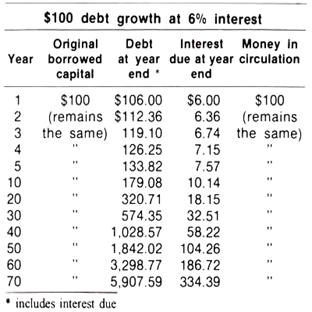 Let us go back to the beginning of our example. At the
end of the first year, Paul chooses not to pay the interest, but to borrow it
from the banker, thereby increasing the loan principal to $106. “No problem,”
says the banker, “the interest on the additional $6 is only 36 cents; it is
peanuts in comparison with the $106 loan!” So the debt at the end of the second
year is: $106 plus the interest at 6% of $106, $6.36, for a total debt of
$112.36 after two years. At the end of the fifth year, the debt is $133.82 and
the interest is $7.57. “It is not so bad,” thinks Paul, “the interest has only
increased by $1.57 in five years. We can handle that.” But what will the
situation be like after 50 years?
Let us go back to the beginning of our example. At the
end of the first year, Paul chooses not to pay the interest, but to borrow it
from the banker, thereby increasing the loan principal to $106. “No problem,”
says the banker, “the interest on the additional $6 is only 36 cents; it is
peanuts in comparison with the $106 loan!” So the debt at the end of the second
year is: $106 plus the interest at 6% of $106, $6.36, for a total debt of
$112.36 after two years. At the end of the fifth year, the debt is $133.82 and
the interest is $7.57. “It is not so bad,” thinks Paul, “the interest has only
increased by $1.57 in five years. We can handle that.” But what will the
situation be like after 50 years?
The debt increase is moderate in the early years, but
the debt increases very fast with time to unbelievably big numbers. And note,
the debt increases each year, but the original borrowed principal (amount of
money in circulation) always remains the same. At no time can the debt be paid
off with the money that exists in circulation, not even at the end of the first
year: there is only $100 in circulation, and a debt of $106 remains. And at the
end of the fiftieth year, all the money in circulation ($100) won't even pay
the interest due on the debt: $104.26.
All money in circulation is a loan and must be
returned to the bank, increased with interest. The banker creates money and
lends it, but he has the borrower's pledge to bring all this money back, plus
other money he did not create. Only the banker can create money: he creates the
principal, but not the interest. And he demands that we pay him back, in
addition to the principal that he created, the interest that he did not create,
and that nobody else created either. As it is impossible to pay back money that
does not exist, debts accrue. The public debt is made up of money that does not
exist, that has never been created, but that governments nevertheless have
committed themselves to paying back. An impossible contract, represented by the
bankers as a “sacrosanct contract”, to be abided by, even though human beings
die because of it.
Compound interest
The sudden increase in the debt after a certain number
of years can be explained by the effect of what is called compound interest.
Contrary to simple interest, which is paid only on the original borrowed
capital, compound interest is paid on both the principal plus the accumulated
unpaid interest. Thus, with simple interest, a $100-loan at 6% interest would
give, at the end of 5 years, a debt of $100 plus 5 times 6% of $100 ($30.00),
for a total debt of $130. But with compound interest, the debt at the end of
the fifth year is the sum of the debt of the previous year ($126.35) plus 6%
interest of this amount, for a total debt of $133.82.
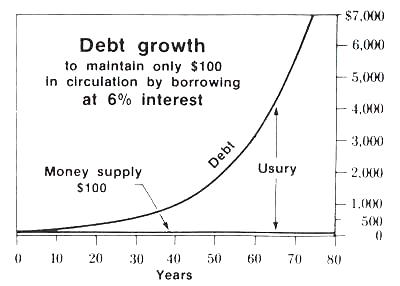 Put all these results on a chart: the horizontal line
across the bottom of the chart is marked off in years, and the vertical line is
marked off in dollars. Connect all these points by a line we trace a curve, and
you see the effect of compound interest and the growth of the debt:
Put all these results on a chart: the horizontal line
across the bottom of the chart is marked off in years, and the vertical line is
marked off in dollars. Connect all these points by a line we trace a curve, and
you see the effect of compound interest and the growth of the debt:
The curve is quite flat at the beginning, but then
becomes steeper as time goes on. The debts of all countries follow the same
pattern, and are increasing in the same way. Let us study, for example,
Canada
Each year, the Canadian Government draws up a budget
wherein are estimated the expenditures and the revenues for the year. If the
Government takes in more money than it spends, there is a surplus; if it spends
more than it takes in, there is a deficit. Thus, for the fiscal year 1985/86
(the Government's fiscal year runs from April 1 to March 31), the Federal
Government had expenditures of $105 billion and revenues of $71.2 billion,
leaving a deficit of $33.8 billion. This deficit represents a deficiency in
revenues. (The Federal Debt has managed to balance its budget over the recent
years, but it is simply because it downloaded its deficit on provinces and
municipalities, forcing them to make cuts in health and other basic services.
This does not prevent the overall debt of all public administrations from
continuing to increase.) The national debt is the total accumulation of all
budgetary deficits since
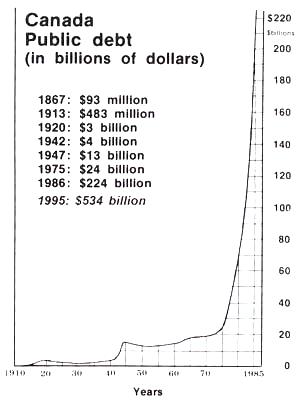 When
When
But how can be explained the phenomenal increase of
these last years, when the debt almost increased ten times, passing from $24
billion in 1975 to $224 billion in 1986, in peacetime, when
It is the effect of compound interest, like in
the example of the island in The Money Myth Exploded. The debt increases slowly
in the early years, but grows extremely fast in the following years. And
Here is another explanation for
There is a big difference between interest rates of
6%, 10%, or 20%, when you speak of compound interest. The following are the
sums that $1.00 will amount to in 100 years, loaned at the rates of interest
shown and compounded annually:
at
1%............................$2.75
at 2%..........................$19.25
at 3%........................$340.00
at 10%..................$13,809.00
at 12%............ $1,174,406.00
at 18%............$15,145,207.00
at 24%..........$251,799,494.00
And at 50%, it would eat up the world! There is a
formula to calculate approximately the amount of time it will take for an
amount, at compound interest, to double; it is the “Rule of 72”: You divide 72
by the interest rate. It gives you the number of years it will take for the
amount to double. Thus, an interest rate of 10% will cause a loan to double in
7.2 years (72 divided by 10).
All this is to show that any interest demanded on money created out of
nothing, even at a rate of 1%, is usury. In his November 1993 report,
The public
debt of the United
States
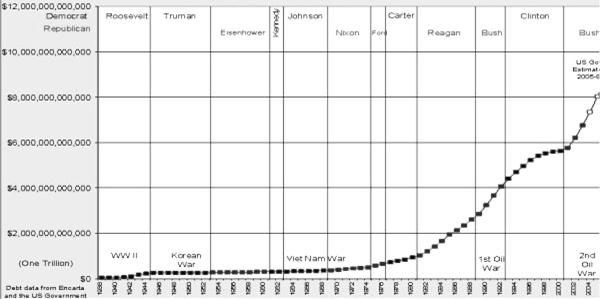
The public debt of the
 In October 2005, the federal debt reached the $8
trillion mark ($26,672 for each
In October 2005, the federal debt reached the $8
trillion mark ($26,672 for each
LESSON
4 — THE SOLUTION: DEBT-FREE MONEY
CREATED BY SOCIETY
The
cost of servicing the public debt increases proportionally to the debt, since
it is a percentage of this same debt. To finance its debt, the Federal
Government sells Treasury Bills and other bonds, most of them being bought by
chartered banks.
As
regards the sale of Treasury bonds, the Government is a stupid seller: it does
not sell its bonds to the banks; it gives these bonds away to them, since these
bonds cost the banks nothing: the banks do not lend the money; they create it.
Not only do banks get something  for nothing, but they also get interest on
it.
for nothing, but they also get interest on
it.
 On September 30, 1941, a revealing exchange took place
between Mr. Wright Patman (left), Chairman of
the U.S. House of Representatives Banking and Currency Committee, and Mr. Marriner Eccles (right), Chairman of the Federal
Reserve Board (the central bank of the U.S.A.) concerning a $2 billion monetary
issue which the Bank created:
On September 30, 1941, a revealing exchange took place
between Mr. Wright Patman (left), Chairman of
the U.S. House of Representatives Banking and Currency Committee, and Mr. Marriner Eccles (right), Chairman of the Federal
Reserve Board (the central bank of the U.S.A.) concerning a $2 billion monetary
issue which the Bank created:
Mr.
Patman: “How did you get the money to buy those $2
billion of Government securities?”
Mr.
Eccles: “We created it.”
Mr.
Patman: “Out of what?”
Mr.
Eccles: “Out of the right to issue money, credit.”
Mr.
Patman: “And there is nothing behind it, except the
Government's credit?”
Mr.
Eccles: “We have the Government bonds.”
Mr.
Patman: “That's right, the Government's credit.”
This puts us on the right track for a solution to the
debt problem: if these bonds are based on the Government's credit, why would
the Government have to go through the banks to use its own credit?
It is not the banker who gives value to money, but the
credit of the Government, of society. The only thing the banker does in this transaction
is to make an entry in a ledger, writing figures which allow the country to
make use of its own production capacity, its own wealth.
Money is nothing else but that: a figure — a figure which
is a claim on products. Money is only a symbol, a creation of the law,
according to Aristotle's words. Money is not wealth, but the symbol that gives
rights to wealth. Without products, money is worthless. So, why pay for
figures? Why pay for something which costs nothing to make?
And since this money is based on the production
capacity of society, this money also belongs to society. Then, why should
society pay the bankers for the use of its own money? Why pay for the use of
our own goods? Why doesn't the Government issue its own money directly, without
going through the banks?
 Even the first
Governor of the Bank of Canada admitted that the Federal Government had the right
to issue its own money.
Even the first
Governor of the Bank of Canada admitted that the Federal Government had the right
to issue its own money.
 Question: “Will you tell me why a
government with the power to create money should give that power away to a
private monopoly and then borrow that which parliament can create itself, back
at interest, to the point of national bankruptcy?”
Question: “Will you tell me why a
government with the power to create money should give that power away to a
private monopoly and then borrow that which parliament can create itself, back
at interest, to the point of national bankruptcy?”
Towers’ answer: “Now, if parliament wants to change
the form of operating the banking system, that is certainly within the power of
parliament.”

 “It is absurd to say that our country can issue $30
million in bonds and not $30 million in currency. Both are promises to pay, but
one fattens the usurers and the other helps the people. If the currency issued
by the Government was no good, then the bonds would be no good either. It is a
terrible situation when the Government, to increase the national wealth, must
go into debt and submit to ruinous interest charges at the hands of men who
control the fictitious value of gold.”
“It is absurd to say that our country can issue $30
million in bonds and not $30 million in currency. Both are promises to pay, but
one fattens the usurers and the other helps the people. If the currency issued
by the Government was no good, then the bonds would be no good either. It is a
terrible situation when the Government, to increase the national wealth, must
go into debt and submit to ruinous interest charges at the hands of men who
control the fictitious value of gold.”
Here are some questions the Social Crediters
are often asked:
Question:
Does the Government have the power to create money? Would this money be as good
as that of the banks?
Answer: The Government has indeed
the power to create, issue the money of our country, since it is itself, the
Federal Government, that has given this power to the chartered banks. For the
Government to refuse to itself a privilege it has granted to the banks, is the
height of imbecility! Moreover, it is actually the first duty of any sovereign
government to issue its own currency, but all the countries today have unjustly
given up this power to private corporations, the chartered banks. The first
nation that thus surrendered to private corporations its power to create money
was
No danger of inflation
Question:
Is there not any danger that the Government might misuse this power and issue
too much money, which would result in runaway inflation? Is it not preferable
for the Government to leave this power to the bankers, in order to keep it away
from the whims of the politicians?
Answer: The money issued by the
Government would be no more inflationary than the money created by the banks:
it would be the same figures, based on the same production of the country. The
only difference is that the Government would not have to get into debt, or to
pay interest, in order to obtain these figures.
On the contrary, the first cause
of inflation is precisely the money created as a debt by the banks: inflation
means increasing prices. The obligation for the corporations and governments
that are borrowing to bring back to the banks more money than the banks
created, forces the corporations to increase the prices of their products, and
the governments to increase their taxes.
What is the means used by the
present Governor of the Bank of Canada to fight inflation? Precisely what
actually increases it, that is to say, to increase the interest rates! As many
Premiers put it, “It is like trying to extinguish a fire by pouring gasoline
over it.”
It is obvious that if the
Canadian Government decided to create or print money anyhow, without any
limits, according to the whims of the men in office, without any relation with
the existing production, there would definitely be runaway inflation. This is
not at all what is proposed here by the Social Crediters.
Accurate bookkeeping
What the Social Crediters advocate, when they speak of money created by the
Government, is that money must be brought back to its proper function, which is
to be a figure, a ticket, that represents products, which in fact is nothing
but simple bookkeeping. And since money is nothing but a bookkeeping system,
the only necessary thing to do would be to establish accurate bookkeeping:
The Government would appoint a
commission of accountants, an independent organism called the “National Credit
Office” (in
In practice, here is how it would
work: the new money would be issued by the National Credit Office as new
products are made, and would be withdrawn from circulation as these products
are consumed (purchased). (Louis Even's booklet, A
Sound and Effective Financial System, explains this mechanism in detail.)
Thus there would be no danger of having more money than products: there would
be a constant balance between money and products, money would always keep the
same value, and any inflation would be impossible. Money would not be issued
according to the whims of the Government nor of the accountants, since the
commission of accountants, appointed by the Government, would act only
according to the facts, according to what the Canadians produce and consume.
The
best way to prevent any price increase is to lower prices. And Social Credit
does also propose a mechanism to lower retail prices, called the “compensated
discount”, which would allow the consumers to purchase all of the available
production for sale with the purchasing power they have at their disposal, by
lowering retail prices (a discount) by a certain percentage, so that the total
retail prices of all the goods for sale would equal the available total
purchasing power of the consumer. This discount would then be refunded to the
retailers by the National Credit Office. (This will be explained in further
lessons.)
No more financial problems
If the Government issued its own
money for the needs of society, it would be automatically able to pay for all
that can be produced in the country, and would no longer be obliged to borrow
from foreign or domestic financial institutions. The only taxes people would
pay would be for the services they consume. One would no longer have to pay
three or four times the actual price of public developments because of the
interest charges.
So, when the Government would
discuss a new project, it would not ask: “Do we have the money?”, but: “Do we
have the materials and the workers to realize it?”. If it is so, new money
would be automatically issued to finance this new production. Then the Canadians
could really live in accordance with their real means, the physical means, the
possibilities of production. In other words, all that is physically possible
would be made financially possible. There would be no more financial problems.
The only limit would be that of the producing capacity of the nation. The
Government would be able to finance all the developments and social programs
demanded by the population that are physically feasible.
Under the present debt-money system, if the debt were
to be paid off to the bankers, there would be no money left in circulation,
creating a depression infinitely worse than any of the past. Let us quote again
the exchange between Messrs. Patman and Eccles before
the House Banking and Currency Committee, on
Mr. Patman: “You have made
the statement that people should get out of debt instead of spending their
money. You recall the statement, I presume?”
Mr. Eccles: “That was in connection with installment credit.”
Mr. Patman: “Do you believe
that people should pay their debts generally when they can?”
Mr. Eccles: “I think it depends a good deal upon the
individual; but of course, if there were no debt in our money system...”
Mr. Patman: “That is the
point I wanted to ask you about.”
Mr. Eccles: “There wouldn't be any money.”
Mr. Patman: “Suppose
everybody paid their debts, would we have any money to do business on?”
Mr. Eccles: “That is correct.”
Mr. Patman: “In other words,
our system is based entirely on debt.”
How can we ever hope to get out of debt when all the money to pay off
the debt is created by creating a debt? Balancing the budget is an absurd
straight jacket. What must be balanced is the capacity to pay, in accordance
with the capacity to produce, and not in accordance with the capacity to tax.
Since it is the capacity to produce that is the reality, it is the capacity to
pay that must be modeled on the capacity to produce, to make financially
possible what is physically feasible.
Repayment of the debt
Paying off one's debt is simple justice if this debt
is just. But if it is not the case, paying this debt would be an act of
weakness. As regards the public debt, justice is making no debts at all, while
developing the country. First, let us stop building new debts. For the existing
debt, the only bonds to be acknowledged would be those of the savers; they who
do not have the power to create money. The debt would thus be reduced year
after year, as bonds come to maturity.
The Government would honour in full only the debts
which, at their origins, represented a real expense on the part of the
creditor: the bonds purchased by individuals, and not the bonds purchased with
the money created by the banker, which are fictitious debts, created by the
stroke of a pen. As regards Third-World countries' debts, they are essentially
owed to banks, which created all the money loaned to these countries. These
same countries would therefore have no interest charges to pay back, and their
debts would be, virtually, written off. Banks would lose nothing, since it is
they that had created this money, which did not exist before.
 Now we see how right are those who call for a reform
of the financial system and the cancellation of debts, starting with Pope John
Paul II, who wrote in his Apostolic Letter Tertio
Millennio Adveniente,
for the celebration of the Jubilee of the Year 2000:
Now we see how right are those who call for a reform
of the financial system and the cancellation of debts, starting with Pope John
Paul II, who wrote in his Apostolic Letter Tertio
Millennio Adveniente,
for the celebration of the Jubilee of the Year 2000:
“Thus, in the spirit of the Book of Leviticus
(25:8-12), Christians will have to raise their voice on behalf of all the poor
of the world, proposing the Jubilee as an appropriate time to give thought,
among other things, to reducing substantially, if not cancelling outright, the
international debt which seriously threatens the future of many nations.”
The social control of money
It is Saint Louis IX, King of France, who said: “The
first duty of a king is to coin money when it is necessary for the sound
economic life of his subjects.”
It is not at all necessary, nor to be recommended, that
banks be abolished or nationalized. The banker is an expert in accounting and
investing; he may well continue to receive and invest savings with profit,
taking his share of profits. But the creation of money is an act of sovereignty
which should not be left in the hands of a bank. Sovereignty must be taken out
of the hands of the banks and returned to the nation.
Book money is a good modern invention that should be
retained. But instead of it proceeding from a private pen, in the form of a
debt, those figures, which serve as money, should come from the pen of a
national organism, in the form of money destined to serve the people.
Therefore nothing is to be turned upside down in the
field of ownership or investment. There is no need to abolish the current money
and replace it with other kinds of money. All that is needed is that a social
monetary organism add enough of the same kind of money to the money that
already exists, according to the country’s possibilities and the population’s
needs.
We must stop suffering from privations when there is
everything needed in the country to bring comfort into every home. The amount
of money in circulation must be measured according to the demand of the
consumers for possible and useful goods.
It is therefore the producers and consumers as a
whole, the whole of society, which, in producing goods to meet needs, should
determine the amount of new money that an organism, acting in the name of
society, should put into circulation from time to time, in accordance with the
country's developments.
Thus the people would recover their right to live full
lives, in accordance with the country's resources and the great possibilities
of modern production.
Who owns the new money?
Money should therefore be put into circulation according
to the rate of production and as the needs of distribution dictate.
But to whom does this new money belong when it comes
into circulation in the country? — This money belongs to the citizens
themselves. It does not belong to the Government, which is not the owner of the
country, but only the protector of the common good; nor does it belong to the
accountants of the national monetary organism: like judges, they carry out a
social function and are paid, according to law, by society for their services.
To which citizens? — To all. This money is not a
salary. It is new money injected into the public, so that the people, as
consumers, may obtain goods already made or easily realizable, which are
awaiting only sufficient purchasing power for them to be produced.
One cannot imagine for one moment that the new money,
which comes gratuitously from a social organism, only belongs to one or a few
individuals in particular.
There is no other way, in all fairness, of putting
this new money into circulation than by distributing it equally among all
citizens without exception. Such a sharing also makes it possible to derive the
maximum benefit from the money, since it reaches into every corner of the land.
Let us suppose that the accountant who acts in the
name of the nation finds it necessary to issue another $1 million in order to
meet the latest needs of the country. This issuance could take the form of book
money, the inscription of figures in ledgers, as the banker does today.
Since there are 31 million Canadians and 1 billion
dollars to share, each citizen will get $32.25. So the accountant will inscribe
$32.25 in each citizen’s account. Such individual accounts could easily be
looked after by the local post offices, or by branches or a bank owned by the nation.
This is the national dividend. Each citizen would have an extra $32.25
to his own credit, in an account bringing money into existence. This money
would have been created and put into circulation by a national monetary
organism, an institution especially established for this end by a law of
Parliament.
To each the dividend
Whenever it might become necessary to increase the
amount of money in a country, each man, woman and child, regardless of age,
would thus get his or her share of the new stage of progress that makes the new
money necessary.
This is not payment for a job done, but a dividend to
each one for his share in a common capital. If there is private property, there
is also community property that all possess in the same way.
Here is a man who has nothing but the rags he is
covered with. Not a meal in front of him, not a penny in his pocket. I can say
to him:
“My dear fellow, you think you are poor, but you are a
capitalist who possesses a great deal of things in the same way I and the Prime
Minister do. The province's waterfalls, the crown forests, are yours as well as
mine, and they can easily bring you in an annual income.
“The social organization, which makes it possible for
our community to produce a hundred times more and better than if we lived in
isolation, is yours as well as mine, and must be worth something to you as it
is to me.
“Science, which makes industry able to multiply
production almost without human labour, is a heritage passed on to each
generation, a heritage that is continuously growing; and you, who are a member
of this generation just as I am, should have a share in this legacy, just as I
do.
“If you are poor and naked, my friend, it is because
your share has been stolen from you and put under lock and key. When you have
no food, it is not because the rich eat all the grain in the land, it is
because your share is still lying in the grain elevators. You have been
deprived of the means of getting that grain.
“The Social Credit dividend will ensure that you get
your share, or at least a major portion of it. A better administration, freed
from the financiers' influence and able to cope with these exploiters of men,
will see to it that you get the rest.
“It is also this dividend that will recognize you as a
member of the human species, in virtue of which you are entitled to a share of
this world's goods, at least the necessary share to exercise your right to
live.”
Should money claim interest?
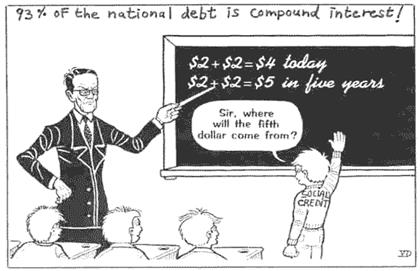 We believe that there is not one thing in the world
which lends itself to so much abuse as money. This is not because money in
itself is a bad thing. On the contrary, money is probably one of man's most
brilliant inventions, making trade flexible, favouring the sale of goods as
required by needs, and making life in society easier.
We believe that there is not one thing in the world
which lends itself to so much abuse as money. This is not because money in
itself is a bad thing. On the contrary, money is probably one of man's most
brilliant inventions, making trade flexible, favouring the sale of goods as
required by needs, and making life in society easier.
But, to place money on an altar is idolatry. To make
of money a living thing, which gives birth to other money, is unnatural.
Money does not breed money, as the Greek philosopher
Aristotle said. Yet, how many contracts are entered into — contracts between
individuals, contracts between governments and creditors, which stipulate that
money must breed money, or else properties or freedoms are forfeited?
Little by little, everybody has sided behind the
theory, and especially behind the practice, that money must produce interest.
And in spite of all the Christian teaching to the contrary, the practice has
made so much headway that, so as not to lose in the furious competition around
the fertility of money, everybody must behave today as if it was natural for
money to breed money. The Church has not abrogated her old laws, but it has
become impossible for her to insist on their application.
The methods used to finance World War II, in which we were Churchill,
Roosevelt, and Stalin's acolytes to defend Christianity, solemnly consecrated
the rule that money, even money thrown into the sea or into the burning flames
of cities, must bear interest. We refer here to the Victory Bonds, which
finance destruction, which do not produce anything, and which must bear
interest just the same.
Interest
and dividends
So that our readers do not pass out thinking about
their savings put into industry or loan institutions, let us hastily make a few
distinctions.
If money cannot increase by itself, there are things
that money buys which logically produce developments. Thus
I set aside
$5,000 to purchase a farm, or animals, seeds, trees, machinery. With
intelligent work, I will make these things produce others.
The $5,000 was an investment. By itself it has not
produced anything; but thanks to this $5,000, I have been able to get things
that have produced.
Let us suppose that I did not have this $5,000. But my
neighbour had it, and he did not need it for a couple of weeks. He loaned it to
me. I think it would be proper for me to show my gratitude by letting him have
a small portion of the products which I get, thanks to the productive capital
which I have thus been able to obtain.
It is my work which has made his capital profitable.
But this capital itself represents accumulated work. We are then two, whose
activities — gone by for him, present for me — cause some production to appear.
The fact that he waited to draw on the country's production with the money he
received as a reward for his work, allowed me to get the means of production
that I would not have had without it.
We are therefore able to divide the fruits of this
collaboration between us. There remains to determine, by agreement and equity,
the part of production that is owed to the capital.
What my lender will get in this case is, strictly
speaking, a dividend. (We divided the fruits of production.)
The dividend is perfectly justifiable, when production
is fruitful.
* *
*
This is not exactly the idea that is generally
attached to the word “interest”. Interest is a claim made by money, in function
of time only, and independently of the results of the loan.
Here is $1,000.
I invest it in federal, provincial, or municipal bonds. If I purchase
bonds that bear 4% interest, I ought to get $40 in interest every year, just as
truly as the earth will make one revolution around the sun during this period
of time. Even if the capital is used up without any profit, I must get my $40.
That is interest.
We cannot see anything that justifies this claim, save
that it is customary. It does not rest upon any principle.
There is therefore justification for a dividend,
because it is subordinated to production growth. There is no justification for
interest in itself, because it is dissociated from realities; it is based on
the erroneous idea of a natural and periodical generation of money.
Indirect investments
In practice, he who brings his money to the bank
indirectly puts it into a productive industry. The bankers are professional
lenders, and the depositor passes his money to them, because they are capable
of making it thrive better than he can, without having to look after it
himself.
The small interest that the banker enters to the
depositor's credit from time to time, even at fixed rates, is in fact a
dividend, a share from the income that the banker, with the help of the
borrowers, has obtained from productive activities.
Anonymous investments
In passing, let us say a word on the morality of
investments. Many people are not preoccupied in the least with the usefulness
or the noxiousness of activities that their money will finance. As long as it
yields profits, they say, it is good. And the more profit it yields, the better
the investment is. A pagan would not reason differently.
If a house-owner does not have the right to rent his
house to serve as a brothel, even though it would be very profitable, the owner
of savings does not have any more right to put them into enterprises which ruin
souls, even if the enterprises fill pockets.
Moreover, it would be much preferable for the backer and the
entrepreneur to be less dissociated. The smaller industry of old was much more
sound: The financier and the entrepreneur were the same person. The corner
storekeeper is still in the same situation. The chain stores are not. The
co-operative, the association of people, keeps the relation between the use of
money and its owner, and has the advantage of making possible enterprises which
exceed the resources of one sole individual.
The growth of money
Let us go back to the beginning question: Should money
claim interest? We are therefore inclined to answer: Money can claim dividends
when there are fruits. Otherwise, no.
If contracts are drafted differently, if the farmer
must pay back interest, even though he did not receive any crop that year; if
the farmers of Western Canada must honour liabilities at 7%, when the
Financiers who lead the world cause prices to fall to one-third of what they
were, this does not change anything about the principle. The only thing this proves
is that reality has been exchanged for trickery.
But if money can claim dividends, when there is a
production increase, this production increase must automatically create an
increase in money. Otherwise, the dividend, while being perfectly justifiable,
becomes impossible to provide without dealing a blow to the public from which
it was extracted.
I was saying a few lines above: If, thanks to the
$5,000 which allowed me to buy ploughing implements, I have increased my
production, the lender is entitled to a share of these good results. This is
very easy to do if I let him have a share of these increased products. But if
it is money that I must give to him, it is quite another story. If there is no
increase of money in the public, my increased production creates a problem:
more offered goods, but no increase of money in step with them. I may be
successful at displacing another seller, but he will be the victim.
You can tell me that the $5,000 must have contributed
to increasing money in circulation. Yes, but I must pump back the $5,000, plus
what I call the dividend, what others call interest.
Then the problem is not settled. And in our economic
system, it cannot be. For money to increase, it is necessary that the bank—the
only place where the increase is created—lends some somewhere. But in lending
it, the bank exacts a repayment that is also increased. The problem snowballs.
The Social Credit system would settle that problem, as
well as settle many other problems.
The dividend is a legitimate, normal, logical thing.
But the present system does not allow anyone to pay it without making it hurt
somewhere.
Our Lord drives the money changers out of the Temple
 As a matter of fact, the only passage in the Gospel
where it is mentioned that Jesus used force, is when He drove the money
changers out of the Temple with a scourge of cords, and overthrew their tables
(as reported in Matthew 21:12-13 and Mark 11:15-19), precisely because they
were lending money at interest.
As a matter of fact, the only passage in the Gospel
where it is mentioned that Jesus used force, is when He drove the money
changers out of the Temple with a scourge of cords, and overthrew their tables
(as reported in Matthew 21:12-13 and Mark 11:15-19), precisely because they
were lending money at interest.
There was, at that time, a law that the tithes or
taxes of the Temple could be paid only in one certain coin called the “half
shekel of the sanctuary”, of which the money changers had managed to obtain the
monopoly. There were several different coins at that time, but the people had
to obtain this particular coin with which to pay their Temple Tax. Moreover,
the doves and the animals that the people bought for sacrifice also could only
be bought with this same special coin that the money changers exchanged to the
pilgrims, but at a cost of twice or more times its actual worth, when it was
used to buy commodities. So Jesus overthrew their tables and said: “My house
shall be called a house of prayer; but you have made it a den of thieves.”
The teaching of the Church
The Bible contains several texts that clearly condemn
the lending of money at interest. Moreover, more than 300 years before Jesus
Christ, the great Greek philosopher Aristotle also condemned lending at
interest, pointing out that “money, being naturally barren, to make it breed money
is preposterous.” Furthermore, the Fathers of the Church, since the remotest
times, always unequivocally denounced usury. Saint Thomas Aquinas, in his Summa
Theologica (2, 2, Q. 78), thus summarized the
teaching of the Church on lending money at interest:
“It is written in the Book of Exodus (22, 24): `If you
lend money to any of my people who are poor, that dwells with you, you shall
not be hard upon them as an extortioner, nor oppress
them with usury.' He who takes usury for a loan of money acts unjustly, for he
sells what does not exist, and such an action evidently constitutes an
inequality and, consequently, an injustice... It follows then that it is wrong
in itself to take a price (usury) for the use of money lent, and as in the case
of other offenses against justice, one is bound to
make restitution of his unjustly acquired money.”

 In reply to the
text of the Gospel on the parable of the talents (Matthew 25:14-30 and Luke
19:12-27) which, at first sight, seems to justify interest (“Wicked and
slothful servant... why did you not put my money into the bank, so that I might
have recovered it with interest when I came?”), Saint Thomas Aquinas wrote:
In reply to the
text of the Gospel on the parable of the talents (Matthew 25:14-30 and Luke
19:12-27) which, at first sight, seems to justify interest (“Wicked and
slothful servant... why did you not put my money into the bank, so that I might
have recovered it with interest when I came?”), Saint Thomas Aquinas wrote:
“The
interest mentioned in the Gospel must be taken in a figurative sense; it means
the additional spiritual goods asked of us by God, who wants us to always make
better use of the goods He entrusted us with, but this is for our benefit and
not His.”
So this text of the Gospel cannot justify interest
since, as Saint Thomas says, “an argument cannot be based on figurative
expressions.”
Another passage of the Bible that presents
difficulties is Deuteronomy 23:20-21: “You shall not demand interest from your
brother on a loan of money or food or of anything else. You may demand interest
from a foreigner, but not from your brother.” Saint Thomas explains:
“The Jews were forbidden to take interest from `their
brothers', that is to say, from other Jews; this means that demanding interest
on a loan from anyone is wrong, strictly speaking, for one must consider every
man as `one's neighbour and brother', especially according to the evangelical
law that must rule mankind. So the Psalmist, talking about the just man, says
unreservedly: `he who lends not his money at usury' (14:4) and Ezekiel (18:17):
`a son who accepts no interest or usury'.”
If the Jews were allowed to demand interest from a
foreigner, Saint Thomas wrote, it was tolerated in order to avoid a greater
evil, for fear that they might charge interest to other Jews, the worshippers
of the true God. Saint Ambrose, commenting on the same text, gives to the word
“foreigners” the meaning of “enemies”, and concludes: “One may seek interest
from the one he legitimately wants to harm, from the one whom it is lawful to
wage war with.”
Saint Ambrose also said: “What is usury, if not
killing a man?”
Saint John Chrysostom:
“Nothing is more shameful or cruel than usury.”
Saint Leo: “The avarice that claims to do its
neighbour a good turn while it deceives him is unjust and insolent... He who,
among the other rules of a pious conduct, will not have lent his money at
usury, will enjoy eternal rest... whereas he who gets richer to the detriment
of others deserves, in return, eternal damnation.”
In 1311, at the Council of Vienna, Pope Clement V
declared null and void all secular legislation in favour of usury, and “all who
fall into the error of obstinately, maintaining that the exaction of usury is
not sinful, shall be punished as heretics.”
Vix Pervenit
 On November
1, 1745, Pope Benedict XIV issued the encyclical letter Vix
Pervenit, addressed to the Bishops of Italy,
about contracts, and in which usury, or money-lending at interest, is clearly
condemned. On July 29, 1836, Pope Gregory XVI extended this encyclical to the
whole Church. It says:
On November
1, 1745, Pope Benedict XIV issued the encyclical letter Vix
Pervenit, addressed to the Bishops of Italy,
about contracts, and in which usury, or money-lending at interest, is clearly
condemned. On July 29, 1836, Pope Gregory XVI extended this encyclical to the
whole Church. It says:
 “The kind of
sin called usury, which lies in the loan, consists in the fact that someone,
using as an excuse the loan itself — which by nature requires one to give back
only as much as one has received — demands to receive more than is due to him,
and consequently maintains that, besides the capital, a profit is due to him,
because of the loan itself. It is for this reason that any profit of this kind
that exceeds the capital is illicit and usurious.
“The kind of
sin called usury, which lies in the loan, consists in the fact that someone,
using as an excuse the loan itself — which by nature requires one to give back
only as much as one has received — demands to receive more than is due to him,
and consequently maintains that, besides the capital, a profit is due to him,
because of the loan itself. It is for this reason that any profit of this kind
that exceeds the capital is illicit and usurious.
“And in order not to bring upon oneself this infamous
note, it would be useless to say that this profit is not excessive but
moderate; that it is not large, but small... For the object of the law of
lending is necessarily the equality between what is lent and what is given
back... Consequently, if someone receives more than he lent, he is bound in
commutative justice to restitution...”
In 1891, Pope Leo XIII wrote in his Encyclical Letter Rerum Novarum: “The
mischief has been increased by rapacious usury, which, although more than once
condemned by the Church, is nevertheless, under a different guise, but with
like injustice, still practiced by covetous and grasping men. ”
On this matter, it is interesting to consider the
experience of the Islamic banks: the Koran — the holy book of the Moslems —
forbids usury, as the Bible of the Christians does. But the Moslems took these
words seriously and have set up, since 1979, a banking system that conforms
with the rules of the Koran: Islamic banks charge no interest on either current
or deposit accounts. They invest in business, and pay a share of any profits to
their depositors. This is not the Social Credit system implemented in its
entirety yet but, at least, it is a more than worthy attempt at putting the
banking system in keeping with moral laws.

LESSON 5 — THE CHRONIC SHORTAGE OF
PURCHASING POWER — THE DIVIDEND
Financing production is not enough. Goods and
services must also reach those who need them. In fact, the only reason for the
existence of production is to meet needs and wants. Production must be
distributed. How is it distributed today, and how would it be distributed under
a Social Credit system?
Today, goods are put up for sale at certain prices.
People who have money buy these goods by passing over the counter the required
sum. This method allows those who have money to buy those goods which they want
and need.
Now, Social Credit would in no way change this method
of distributing goods. The method is flexible and good — provided, of course,
that individuals who have needs also have the purchasing power to choose and
buy the goods which would fill these needs.
Purchasing power in the hands of those who have needs
and wants: it is precisely here that the present system is defective, and it is
this defect that Social Credit would correct.
The money distributed in the form of wages, profits,
and industrial dividends constitutes purchasing power for those who receive
these various allotments. But there are a few flaws in the present system:
1.
Industry never distributes
purchasing power at the same rate that it generates prices.
2.
The production system does
not distribute purchasing power to everyone. It distributes it only to those
who are employed in production.
Even if the banks charged no interest, nevertheless,
at any given moment the amount of money available to the community as
purchasing power is never sufficient to buy back the total production made by
industry.
The
economists maintain that production automatically finances consumption; that is
to say, that the wages and salaries distributed to the consumers are sufficient
to buy all the available goods and services. But facts are proving just the
opposite. Scottish engineer Clifford Hugh Douglas was the first to demonstrate
this chronic shortage of purchasing power. He explained it this way:
A cannot buy A+B
The producer must include all his production costs in
the price of his product. The wages distributed to the employees (which for
convenience's sake can be labeled “A” payments) are
only one part of the cost price of the product. The producer has also other
costs besides wages costs (which are labeled “B”
payments), that are not distributed in wages and salaries, such as the payments
for raw materials, taxes, banking charges, depreciation charges (to replace
machinery), etc.
The retail price of the product must include all the
costs: wages (A) and other payments (B). So the retail price of the product
must be at least A + B. Then, it is obvious that the wages (A) cannot buy the
sum of all the costs (A + B). So there is a chronic shortage of purchasing
power in the present system.
 There are more reasons for this gap between prices and
purchasing power: When a finished good is put on the market, it comes with a
price attached to it. But part of the money included in this price was
distributed perhaps six months or a year ago, or even more. Another part will
be distributed only once the good is sold, and the merchant takes out his
profit. Another part will perhaps be distributed in ten years, when worn
machinery — of which wear is included as an expense in the price — is replaced
by new machinery, etc.
There are more reasons for this gap between prices and
purchasing power: When a finished good is put on the market, it comes with a
price attached to it. But part of the money included in this price was
distributed perhaps six months or a year ago, or even more. Another part will
be distributed only once the good is sold, and the merchant takes out his
profit. Another part will perhaps be distributed in ten years, when worn
machinery — of which wear is included as an expense in the price — is replaced
by new machinery, etc.
Then there are those individuals who receive money,
and who do not spend it. This money is included in the prices, but it is not in
the purchasing power of those who need goods.
The repayment of short-term bank loans, and the
present fiscal system, increase further the gap between the prices and the
purchasing power. Hence the accumulation of goods, unemployment, and all that
ensues.
Some people might say that the businesses paid with
“B” payments (those that supplied the raw material, machinery, etc.) paid wages
to their own employees, and part of these “B” payments therefore become “A”
payments. This changes nothing to what has been said before : this is
simply a wage distributed in another step of production, and this “A” wage
cannot be distributed without being included into a price, which cannot be less
than A + B; the gap is still there.
If you try to increase wages and salaries, the wage increases will
automatically be included in the prices, and it will settle nothing. (It can be
compared to a dog running after its tail.) To be able to buy all of the
production, an additional income is needed coming from a source other than
wages and salaries, an income at least equivalent to B. This is what the Social
Credit dividend would do, being given every month to every citizen in the
country. (This dividend would be financed with new money created by the nation,
and not by the taxpayers' money.)
 What
has kept the system going
What
has kept the system going
Without this other source of income (the dividend),
there should be, theoretically, a growing mountain of unsold goods. But if
goods are sold all the same, it is because, instead, we have a growing mountain
of debt! Since people have not enough money, retailers must encourage credit
buying in order to sell their goods. But this is not sufficient to fill the gap
in the purchasing power.
So there is also a growing stress upon the necessity
for works that distribute wages without increasing the quantity of consumer
goods for sale, such as public works (building bridges or roads), war
industries (building submarines, airplanes, etc.). But this is not sufficient
either.
So each country will strive to achieve a “favourable
balance of trade”, that is to say, to export, to sell to other countries more
goods than it receives, in order to obtain, from these foreign countries, the
money that the population is lacking at home to buy their own products.
However, it is impossible for all nations to have a “favourable balance of
trade”: if some countries manage to export more goods than they import, there
must also necessarily be, countries that receive more goods than they export.
But no country wishes to be in that position, so it causes trade conflicts
between nations, that can degenerate into armed conflicts.
Then, as a last resort, economists have discovered a
new export market, a place where we can send our goods without anyone trying to
send anything back, a place where there are no inhabitants: the moon, outer space.
Some countries will spend billions of dollars building rockets to go to the
moon or other planets; all this huge waste of resources just to generate wages
that will be used to buy the production left in our countries. Our economists
are really in the clouds!
Progress replaces the need for
human labour
The second flaw in the present system is that the
production system does not distribute purchasing power to everyone. It
distributes it only to those who are employed in production. And the more the
production comes from the machine, the less it comes from human labour.
Production even increases, whereas required employment decreases. So there is a
conflict between progress, which eliminates the need for human labour, and the
system, which distributes purchasing power only to the employed.
Yet, everybody has the right to live. And everybody is
entitled to the basic necessities of life. Earthly goods were created by God
for all men, and not only for those who are employed, or employable.
That is why Social Credit would do what the present
system is not doing. Without in any way disturbing the system of reward for
work, it would distribute to every individual a periodical income, called a
“social dividend” — an income tied to the individual as such, and not to
employment.
Earthly goods created for all
This is the most direct and concrete means to
guarantee to every human being the exercise of his fundamental right to a share
in the goods of the earth. Every person possesses this right — not as an
employee in production, but simply as a human being.
 Pope Pius XII said in his Pentecost radio-address of
June 1, 1941:
Pope Pius XII said in his Pentecost radio-address of
June 1, 1941:
“Material goods have been created by God to meet the
needs of all men, and must be at the disposal of all of them, as justice and
charity require.
“Every man indeed, as a reasongifted
being, has, from nature, the fundamental right to make use of the material
goods of the earth, though it is reserved to human will and the juridical forms
of the peoples to regulate, with more detail, the practical realization of that
right.
“Such an individual right cannot, by any means, be
suppressed, even by the exercise of other unquestionable and recognized rights
over natural goods.
"The economic wealth of a nation does not
properly consist in the abundance of goods judged by a sheer material
computation of their worth, but it consists in what such an abundance does
really and effectively mean and provide as a sufficient material basis for a
fair personal development of its members.
“If such a just distribution of goods were not to be
effected or just imperfectly ensured, the true end of the national economy
would not be achieved, opulent though the abundance of available goods might
be, since the people would not be rich, but poor, as it would not be invited to
share in that abundance.
“Obtain, on the contrary, that this just distribution
be efficiently realized on a durable basis, and you will see a people, though
with less considerable goods at its disposal, become and be economically sound.
The Pope said that it is up to the peoples themselves,
through their laws and regulations, to choose the methods capable of allowing
each man to exercise his right to a share in the earthly goods. The Social
Credit dividend to all would achieve this. No other proposed system has been,
by far, so effective, not even our present social security laws.
Why a dividend to all
— A social dividend to all? But a dividend presupposes
a productive-invested capital!
Precisely. It is because all members of society are
co-capitalists of a real and immensely productive capital.
We said above, and we could never repeat it enough,
that financial credit is, at birth, a property of all of society. It is so
because it is based on the real credit, on the country's production capacity.
This production capacity is made up, certainly in part, of work, of the
competence of those who take part in production. But it is mainly made up, in
an ever-increasing part, of other elements which are the property of all.
There are, first of all, natural resources, which are
not the production of any man; they are a gift from God, a free gift that must
be at the service of all. There are also all the inventions made, developed,
and transmitted from one generation to the next. It is the biggest production
factor today. And no man can claim to be the only owner of this progress, which
is the fruit of many generations.
No doubt that one needs men of our present times to
make use of this progress — and they are entitled to a reward: they get it in
remuneration: wages, salaries, etc. But a capitalist who does not personally
take part in the industry where he invested his capital is entitled, just the
same, to a share of the result, because of his capital.
Well, the biggest real capital of modern production is
really the sum total of the discoveries, progressive inventions, which today
give us more goods with less work. And since all human beings are, on an equal
basis, coheirs of this immense capital which is ever increasing, all are
entitled to a share in the fruits of production.
The employee is entitled to this dividend and to his
wage or salary. The unemployed person has no wage or salary, but is entitled to
this dividend, which we call social, because it is the income from a social
capital.
We have just shown that the Social Credit dividend is
based on two things: the inheritance of natural resources, and the inventions
from past generations. This is exactly what Pope John Paul II wrote in 1981 in
his Encyclical letter Laborem Exercens on human work (n. 13):
“Through his work man enters into two inheritances:
the inheritance of what is given to the whole of humanity in the resources of
nature, and the inheritance of what others have already developed on the basis of
those resources, primarily by developing technology, that is to say, by
producing a whole collection of increasingly perfect instruments for work. In
working, man also “enters into the labor of
others”.
The folly of full employment
To speak of full employment, that is of universal
employment, is to make a contradiction with the pursuit of progress in the
techniques and processes of production. New and more perfect machines are not
introduced to tie man to employment, nor are new sources of energy tapped for
this end, but rather they are brought into production for the purpose of
liberating man from work.
But, alas, we seem to have lost sight of ends. We are
confusing means and ends. We mistake the former for the latter. This is a
perversion, which infects our whole economic life and which makes it impossible
for men to enjoy to the full the logical rewards of progress.
Industry does not exist to give employment, but to
furnish products, goods. If it succeeds in furnishing such goods, then it has
accomplished its purpose, met its end. And the more completely it meets this
end with the minimum of time and the minimum employment of human hands, the
more perfect it is.
 Mr. Jones, for example, buys his wife an automatic
washing machine. Now the weekly wash will take only a quarter of the day
instead of a full day. When Mrs. Jones puts the clothing in the washing machine
along with the soap, when she turns on the taps bringing in the proper mixture
of hot and cold water, she has nothing more to do except to turn on the
machine. The machine washes the clothes, rinses them, and then stops
automatically when the clothes are ready to come out.
Mr. Jones, for example, buys his wife an automatic
washing machine. Now the weekly wash will take only a quarter of the day
instead of a full day. When Mrs. Jones puts the clothing in the washing machine
along with the soap, when she turns on the taps bringing in the proper mixture
of hot and cold water, she has nothing more to do except to turn on the
machine. The machine washes the clothes, rinses them, and then stops
automatically when the clothes are ready to come out.
Is Mrs. Jones going to bemoan the fact that she now
has more time to do what she pleases? Or is Mr. Jones going to search for
another type of work to replace that from which his wife has been freed?
Certainly not. Neither one is that stupid.
But we do find such stupidity running rampant in our
social and economic life, for the system makes progress penalize the
individual, instead of bringing him relief, in that it persists in tying
purchasing power, the distribution of money, to employment, and employment
alone — employment in production. Money comes only as a recompense for effort
and labour in production.
It is true that production distributes money to those
who are employed in the work of producing. But this is as a means, and not as
an end. The purpose of production is not to supply money, but to furnish goods
and services. And if production is able to replace twenty salaried individuals
by the introduction of one machine, it has not in any way thwarted its true
purpose. And if it could furnish all the production necessary for humans, and
not distribute one cent of money, it would still be meeting the end for which
it exists: to furnish goods and services.
When purchasing power disappears
In freeing men from labour, industry should certainly
receive the same gratitude which Mr. Jones received from his wife when he
liberated her from hours of work by purchasing an automatic washing machine for
her.
But how can a man say “thank you” when he has been
liberated from work by a machine, when he finds to his consternation that he
has no money? This is precisely where our economic system has become defective,
in that it has not adapted its financial mechanism to its productive mechanism.
In the measure that industry or production passes out
of human hands, so too should purchasing power, in the form of money, be channeled to consumers through some other means than just
recompense for employment. In other words, the financial system should
harmonize with production, not only with respect to volume, but also with
respect to the manner in which it is distributed. If production is abundant,
then money should be abundant. If production is liberated from human labour,
then money should be liberated and separated from employment.
Money is an integral part of the financial system, and
not a part of the production system, strictly speaking. When the production
system finally reaches a point where it can distribute goods without the aid of
salaried individuals, then too the financial system should reach the point
where purchasing power can be distributed by some other means than salaries.
If such is not the case, it is because, unlike the
production system, the financial system has not adapted itself to progress. And
it is precisely this difference which has given rise to grave problems, when in
fact progress should make all problems of such a nature disappear.
Replacing men by machines in production should lead to the enrichment
of men, to their deliverance from purely material worries and cares, permitting
them to give themselves over to human pursuits other than those which are
related solely to the economic function. If, on the contrary, such a
substitution leads to privation, it is because we have refused to adapt the
financial system to this progress.
 Technology
should serve every man
Technology
should serve every man
Is technology an evil? Should we rise up and destroy
the machines because they take our jobs? No, if the work can be done by the
machine, that is just great; it will allow man to give his free time over to
other activities, free activities, activities of his own choosing. But all of
this, provided he is given an income to replace the salary he lost with the
installation of the machine, of the robot; otherwise, the machine, which should
be the ally of man, will become his enemy, since it deprives him of his income,
and prevents him from living:
“Technology has contributed so much to the well-being
of humanity; it has done so much to uplift the human condition, to serve
humanity, and to facilitate and perfect its work. And yet at times technology
cannot decide the full measure of its own allegiance: whether it is for
humanity or against it... For this reason my appeal goes to all concerned... to
everyone who can make a contribution toward ensuring that the technology which
has done so much to build Toronto and all Canada will truly serve every man,
woman and child throughout this land and the whole world.” (John Paul II, homily in Toronto, Canada, September
15, 1984.)
In 1850, manufacturing as we know it today was barely
started, with man doing 20% of the work, animals 50%, and machines accounting
for only 30%. By 1900, man was doing only 15%, animals 30%, and machines 55%.
By 1950, man was doing only 6%, and machines the rest — 94%. (The animals have
been freed!)
And we have seen nothing yet, since we are only
entering the computer age, which allows places like the Nissan Zama plant in Japan to produce 1,300 cars a day with the
help of only 67 humans — that is more than 13 cars a day per man. There are
even some factories that are entirely automated, without any human employee,
like the Fiat motor factory in Italy, which is under the control of some twenty
robots who do all the work.
In 1964, a report was presented to the President of
the United States, signed by 32 signatories, including Mr. Gunnar
Myrdal, Swedish-born economist, and Dr. Linus Pauling, winner of the
Nobel Prize, entitled “Social Chaos in Automation”. This report said in brief
that “the U.S., and eventually the rest of the world, would soon be involved in
a ‘revolution’ which promised unlimited output… by systems of machines which
will require little co-operation from human beings. Consequently, action must
be taken to ensure incomes for all men, whether or not they engage in what is
commonly reckoned as work.”
A recent Swiss study said that “in thirty years from
now, less than 2% of the present workforce will be enough to produce the
totality of the goods that people need.” Three out of every four workers — from
retail clerks to surgeons — will eventually be replaced by computer-guided
machines.
If the rule that limits the distribution of income to
those who are employed is not changed, society is heading for chaos. It would
be plain ludicrous to tax 2% of workers to support 98% of unemployed people. We
definitely need a source of income that is not tied to employment. The case is
clearly made for the Social Credit dividend.
Full employment is materialistic
If we must blindly persist in keeping everyone, men
and women alike, employed in production, even though the production to meet
basic needs is already made with less and less human labour on top of that,
then new jobs, which are completely useless, must be created. And in order to
justify these useless jobs, new artificial needs must be created, through an
avalanche of advertisements, so that people will buy products they do not
really need. This is what is called “consumerism”.
Likewise, products will be manufactured to last as
short a time as possible, in the aim of selling more of them and making more
money, which brings about an unnecessary waste of natural resources, and also
the destruction of the environment. Also, we will persist in maintaining jobs
that require no creative efforts whatever, jobs that require only mechanical
efforts, jobs that could well be done by machines, jobs where the employee has
no chance of developing his personality. But, however mind-destroying this job
is, it is the condition for the worker to obtain money, the licence to live.
Thus, for him and a multitude of wage-earners, the
meaning of their jobs comes down to this: they go to work to get the cash to
buy the food to get the strength to go to work to get the cash to buy the food
to get the strength to go to work... and so on, until retiring age, if they do
not die before. Here is a meaningless life, where nothing differentiates man
from an animal.
Free activities
What differentiates man from an animal is precisely
that man has not only material needs, but also cultural and spiritual needs. As
Jesus said in the Gospel: “Not on bread alone does man live, but in every word
that proceeds from the mouth of God.” (Deuteronomy 8:3.) So to force man to spend
all his time in providing for his material needs is a materialistic philosophy,
since it denies that man has also a spiritual dimension and spiritual needs.
But, then, if man is not employed in a paid job, what
will he do with his spare time? He will spend it on free activities, activities
of his own choosing. It is precisely in his leisure time that man can really
develop his personality, develop the talents that God gave him, and use them
advisedly.
Moreover, it is during their leisure time that a man
and a woman can take care of their religious, social, and family duties:
raising their family, practising their Faith (to know, love, and serve God),
and help their brethren. Raising children is the most important job in the
world. Yet because the mother, who stays at home to raise her children,
receives no salary, many will say that she does nothing, that she does not
work! (Ask any stay-at-home mother if she does not work!)
To be freed from the necessity of working to produce
the necessities of life does not presume growing idleness. It simply means that
the individual would be placed in the position where he could participate in
the type of activity which appeals to him. Under a Social Credit system, there
would be a flowering of creative activity. For example, the greatest
inventions, the best works of art, have been made during leisure time. As C. H.
Douglas said:
“Most people prefer to be employed, but on things they
like rather than on the things they don't like to be employed upon. The
proposals of Social Credit are in no sense intended to produce a nation of
idlers... Social Credit would allow people to allocate themselves to those jobs
to which they are suited. A job you do well is a job you like, and a job you
like is a job you do well.”
Full employment is outmoded and
useless
This is exactly what Pope John Paul II said on
November 18, 1983, when he received in audience the participants in a national
conference sponsored by the Italian Episcopal Conference's Commission for
Social Problems and Work. Here are excerpts from the Pope's address:
 “The primary
foundation of work is in fact man himself... Work is for man and not man for
work... Furthermore, we cannot fail to be concerned about the opinions of those
who today hold that discussion of a more intense participation is now outmoded
and useless, and demand that human subjectivity be realized in so-called free
time. It does not seem just, in fact, to oppose the time dedicated to work to
the time that is free of work, in so far as all man's time must be viewed as a
marvellous gift of God for overall and integral humanization. I am nevertheless
convinced that free time deserves special attention because it is the time when
people can and must fulfil their family, religious, and social obligations.
Rather, this time, in order to be liberating and useful socially, is spent with
mature ethical awareness in a perspective of solidarity, which is also
expressed in forms of generous volunteer services.”
“The primary
foundation of work is in fact man himself... Work is for man and not man for
work... Furthermore, we cannot fail to be concerned about the opinions of those
who today hold that discussion of a more intense participation is now outmoded
and useless, and demand that human subjectivity be realized in so-called free
time. It does not seem just, in fact, to oppose the time dedicated to work to
the time that is free of work, in so far as all man's time must be viewed as a
marvellous gift of God for overall and integral humanization. I am nevertheless
convinced that free time deserves special attention because it is the time when
people can and must fulfil their family, religious, and social obligations.
Rather, this time, in order to be liberating and useful socially, is spent with
mature ethical awareness in a perspective of solidarity, which is also
expressed in forms of generous volunteer services.”
(Taken from L'Osservatore
Romano, weekly edition in English, January 9, 1984, p. 18.)
LESSON 6 — MONEY AND PRICES —
THE COMPENSATED DISCOUNT
The distribution of new money by the national dividend
is therefore a means of increasing the country's money supply when it is
necessary, and of putting this money directly into the consumers' hands.
But, to be beneficial to the consumer, this
distribution of money must constitute a real increase in the consumer's
purchasing power.
Now, the purchasing power depends on two factors:
the quantity of money in the buyer's hands, and the price of the products for
sale.
If the price of a product decreases, the consumer's
purchasing power increases, even without an increase of money. Now, I have
$10.00 with which to purchase butter; if the price of butter is $2.50 a pound,
I have in my hands the power to buy four pounds of butter; if the price of
butter is lowered to $2.00 a pound, my purchasing power goes up, and I can buy
five pounds of butter.
Moreover, if the price goes up, it unfavourably
affects the consumer's purchasing power; and in this case, even an increase of
money can lose its effect. Thus, the worker who earned $200 in 1967, and who
earned $400 in 1987, would lose out, because the cost of living had more than
doubled in those twenty years. In Canada in 1987, $772 was needed to buy the
same thing that $200 in 1967 could purchase.
The consequent increase in the prices of products is
the reason why wage increases, claimed so much by workers, do not succeed in
producing a durable improvement. The employers do not manufacture money, and if
they have to spend more to pay their workers, they are compelled to sell their
products at higher prices in order not to go bankrupt.
As for the national dividend, it is not included in
prices, since it is made up of new money, distributed, independently of labour,
by the Government.
However, with more money in the hands of the public,
retailers could tend to increase the prices of their products, even if these
products did not cost them more to produce.
Also, a monetary reform which does not, at the same
time, apply the brakes to an unjustifiable rise in prices, would be an
incomplete reform. It could become a catastrophe of runaway inflation.
The arbitrary setting of prices, a general ceiling or
freezing, can also achieve a prejudicial effect by discouraging production. Now
the reduction of production is the surest way of pushing up prices. The legislator
thus achieves the contrary of what he seeks: he provokes inflation by clumsily
fighting it; to escape sanctions, inflation takes place, through the black
market.
Social Credit puts forward a technique to automatically fight
inflation: it is the proposed technique of the “adjusted price”, or the
compensated discount, which would be part of the way money is issued to put the
total purchasing power at the level of total offered production.
The Just Price
Since products are made for the consumer, it is clear
that, to meet their purpose, the products must be offered to the consumer at a
price which allows the consumer to purchase them.
In other words, at all times, there must be an
equilibrium between the collective prices and the collective purchasing power
of all consumers.
To establish the retail price, the producers, or the
retailers, calculate what the manufacturing of the product has cost, and add
the costs of handling, transportation, storing, and the necessary profits to
the different intermediaries. But nothing ensures that this marked price
corresponds to the consumer's purchasing power.
The marked price must be claimed by the retailer so as
not to throw anyone, between the producer and the retailer, into bankruptcy.
Moreover, the price to be paid by the buyer must be such that it corresponds to
the purchasing power in the consumers' hands. Otherwise, the products remain
unsold in the face of real needs.
Hence, a necessary adjustment of prices.
The monetary technique of Social Credit provides it.
In the Social Credit vocabulary, we call the “Just
Price” the price which corresponds exactly to consumption.
When we say “Just Price”, we do not at all mean
“honest price” or “fair price”. The price marked by the retailer may be
completely honest, completely fair, but still may not at all be the exact
price.
So, during the Depression, the marked prices could
have been honest and fair, but they were not exact; they did not correspond to
consumption. When the total production of things demanded exceeds total
consumption, these prices are certainly not exact, since consumption over a
given period shows, conclusively, the real expenses incurred for production
during this same period.
The honest price is a moral matter; the exact or
“just” price is a mathematical matter.
The exact price, the “Just Price” of the Social
Credit system, is achieved through an arithmetical rule. So there is no
question whatever of an arbitrary fixation of prices, or of ceilings,
restrictions, rewards, chastisements — but simply of arithmetic.
The Social Credit technique involves two figures,
which are made up by the country's people themselves, and which are not fixed
arbitrarily by some men who have a mania for imposing their will on others:
1. The figure expressing the total sum of prices;
(This is set by the producers themselves.)
2. The figure expressing the consumers' purchasing
power. (This is set by the consumers' wishes for spending money which they have
at their disposal.)
Then, to be able to put the equal sign (=) between
these two numbers, Social Credit lowers the first to the level of the second.
Let
us explain, first by presenting a few unfamiliar ideas which bear far-reaching
consequences.
The real cost of production
The exact price of a thing is the total sum of
expenses incurred in its production. And this is true, if you count in dollars,
ergs, man-hours, or any other unit of measurement.
Such and such work requires four hours of time, ten
ounces of sweat, a workman's meal, the wear of a tool. If the enumeration is
complete, the exact price of this work, its real cost, is four hours of time,
ten ounces of sweat, a workman's meal, and the wear of a tool — no more, no
less.
As we evaluate costs in dollars in Canada, and we also
evaluate work in dollars, the wear and tear, and all the other elements which
form expenses, it is possible to establish a relation between both, in terms of
dollars.
If, all in all, the material expenses, work, energy,
and wear and tear, amount to $100, the exact price, the real cost of the
product, is one-hundred dollars.
But there is the accounting price, the financial cost.
During the production of an article in a factory, an account is kept of the raw
material bought, processing costs, wages and salaries, capital costs, etc. All
these constitute the financial cost of the production of the article.
Are the accounting price and the exact price the same?
Even if they accidentally are, in certain cases, it is easy to prove that, as a
whole, they certainly are not.
Take a small country that supplies, in one year,
capital goods and consumption goods, for a total production evaluated at 100
million dollars. If, within that time, the total expenses of the country's
inhabitants are evaluated at 80 million dollars, we can readily see that the
country's production for that year has cost exactly $80 million, since $80
million in all was consumed by the population that made the production. The
financial cost of production has been evaluated at $100 million, but it
actually cost only $80 million in real expenses. This is an inescapable fact:
both totals are there.
The exact price of the production of $100 million has
therefore been $80 million.
In other words, while $100 million in wealth was
produced, $80 million in wealth was consumed. The consumption of $80 million
worth of production is the real price of the production of $100 million worth
of production.
The real price of production is consumption.
Moreover, as we have said above, if production exists
for consumption, consumption must be able to pay for production.
In the preceding example, the country deserves its
production. If, by spending $80 million, it produces $100 million worth of
goods and services, it must be able to get these $100 million worth of
production while spending $80 million. In other words, in paying $80 million,
the consumers must get the $100 million worth of production. If not, $20
million worth of production will remain for contemplation, until it turns to
destruction, in front of a deprived and exasperated people.
The increase and reduction of
wealth
A country gets richer in goods when it develops its
means of production: its machines, factories, means of transportation, etc.
These are called capital goods.
A country also gets richer in goods when it produces
things for consumption: wheat, meat, furniture, clothing, etc. These are called
consumer goods.
A country again gets richer in goods when it gets
wealth from abroad. Thus Canada becomes richer in fruits when it gets bananas,
oranges, and pineapples. This is called importation.
Moreover, a country's goods are reduced when there is
destruction or wear of the means of production: burnt factories, worn-out
machines, etc. This is called depreciation.
A country's goods are also reduced when they are
consumed. Eaten food, worn-out clothing, etc., are not available any more. This
is destruction through consumption.
A country's goods are reduced again when they leave
the country: for example, there will be less apples, butter, bacon, in Canada, if
this country sends these products to England. This is called exportation.
Calculation of the Just Price
Now let us suppose that a year's return gives:
Production of capital
goods.......…….......3 billion
Production of consumable goods…….....7 billion
Importations............................. ......….….2 billion
______
Total
acquisitions…..........................…..12 billion (assets)
Moreover:
Depreciation of capital goods
....……......1.8 billion
Consumption..…..................…….............5.2 billion
Exportations.........….....................…........2.0 billion
________
Total
reduction.....….............…….............9.0 billion (liabilities)
We
conclude:
While
the country became richer with $12 billion worth of production, it used, or
consumed, or exported, $9 billion worth of production.
The
real cost of the production of $12 billion is $9 billion. If it actually cost the
country $9 billion to produce $12 billion worth of goods and services, the
country must be able to enjoy its $12 billion worth of production, while
spending only $9 billion.
With
$9 billion, we must be able to pay for $12 billion. To pay for 12 with 9. This
requires a price adjustment: to lower the accounting price, 12, to the level of
the real price, 9, and to do it without doing violence to anyone, without
harming anyone.
In
front of this return, the following conclusion is logical in an economy where
production exists for consumption:
Since
the consumption of $9 billion worth of production, the wear of machines
included, allowed a production worth $12 billion, improvements included, $9
billion is the real price of the production. In order for the country to be
able to use this production, as long as it is wanted, it must be able to get it
at its real price, $9 billion, which does not prevent the retailers from being
compelled to claim $12 billion.
On
the one hand , the country's consumers must be able to buy 12 with 9. They must
be able to draw on their country's production by paying for it at 9/12 of the
marked price.
On
the other hand, the retailer must recover the full amount: 12; otherwise, he
cannot meet his costs and obtain his profit, which is the salary for his
services.
The compensated discount
The
buyer will pay only 9/12 of the marked price, if he is granted a discount of 3
on 12, or 25 percent.
A
table costs $120.00; it will be sold to the buyer for $90.00. A pair of
stockings costs $4.00; it will be sold to the buyer for $3.00.
Likewise,
the same type of ratio is applied to the sale of all the country's articles,
because it is a national discount decreed by the National Credit Office, to
reach the goal for which the National Credit Office was instituted.
If
all of the country's consumer goods are thus paid for at 75 percent of their
marked price, the country's consumers will be able to get all of their
production worth $12 billion with the $9 billion that they spend for their
consumption.
If
they do not like some products for sale on the market, they will not buy them,
and the producers will simply stop making these products, because they are not
real wealth, since they do not answer the needs of the consumers.
The
retailers thus get from the buyers only 75 percent of their prices. They will
not be able to subsist, unless they get from another source the 25 percent that
the buyer does not pay for.
This
other source can only be the National Credit Office, which is charged with
putting money in relation to facts. On the presentation of appropriated
vouchers, attesting to the sale and the national discount allowed, the retailer
will get, from the National Credit Office, the credit-money representing the
missing 25 percent.
The
goal will be reached. The whole of the country's consumers will have been able
to get their country's total production, answering needs. The retailers, and
through them the producers, will have obtained the amounts which cover the
costs of production and distribution.
There
will be no inflation, since there is no lack of products to supply the demand.
This new money is actually created only when there is a product wanted and
purchased.
Besides,
this issue does not enter into the price of the invoice, since it is neither a
wage, a salary, nor an investment: it comes after the product is manufactured,
priced, and sold.
Another
way of arriving at the same result would be to make the buyer pay for the full
price. The retailer would give a receipt to the buyer, attesting the purchase
amount. On presentation of this receipt at the branch of the National Credit
Office, the buyer would get credit-money equal to the 25 percent of the
purchase amount.
The
first method is a compensated discount, a discount granted by the retailer and
paid to him by the National Credit Office.
The
second method is a rebate made to the buyer. The result is exactly the same.
In
any case, the price paid by the consumer must be the fraction of the marked
price expressed by the ratio of total consumption to total production.
Otherwise, the production is only partially accessible to the consumers, for
whom it was made.
A dividend and a lowering of prices
There are two ways to have price-figures and
money-figures correspond : prices can be lowered, or wallets fattened.
Social Credit would do both, without harming anyone, by suiting everybody. The
two mechanisms put together — the lowering of prices and the dividend — would
be calculated to balance price-figures and money-figures.
Both are needed. If there is only a dividend, the
prices could tend to rise, even if the actual cost price of goods remains the
same. And if there is only the lowering of prices, without a dividend, it would
be of no use for people with no income.
The
dividend formula would be infinitely better than the present social programs
like welfare, unemployment insurance, etc., since the dividend would not be
financed by the taxes of those who are employed, but by new money created by
the National Credit Office. No one would therefore live at the expense of the
taxpayers; the dividend would be a heritage that is due to all Canadian
citizens, who are all stockholders in “Canada Limited”.
And contrary to welfare, this dividend would be given
unconditionally, without means tests, and would therefore not penalize those
who want to work. Far from being an incitement to idleness, it would allow
people to allocate themselves to those jobs to which they are best suited.
Besides, if people stopped working, production would go down, and so would the
dividend, since it is based on existing production. Without this income not
tied to employment, progress is no longer an ally of man, but a curse, since,
by eliminating the need for human labour, it makes people lose their sole
source of income.
Thanks to this mechanism of a discount on prices, any
inflation would be impossible, since the discount actually lowers prices.
Inflation means rising prices, and the best way to prevent prices from rising
is to lower them! Moreover, a discount on prices is exactly the opposite of a
sales tax: instead of paying more for goods because of taxes, the consumers
would pay less because of the discount. Who would complain about it?
Financing public works
How
would public works and services be financed in such a social money system?
Whenever the population wants a new public project, the Government would not
ask: “Have we the money to build this project?” but “Have we the materials and
the workers to realize it?” If it is so, the National Credit Office would
automatically create the new money to finance the new production.
Let
us suppose the population wants a new bridge, of which the construction will
cost $50 million. The National Credit Office therefore creates $50 million to
finance the construction of this bridge. And since all new money must be
withdrawn from circulation as the new production is consumed, the money created
to build the bridge must be withdrawn from circulation as this bridge is
consumed.
How
can a bridge be “consumed”? Through wear and depreciation. Let us suppose the
engineers who built this bridge expect it to last 50 years. This bridge will
therefore lose one-fiftieth of its value every year; since it costs $50 million
to build, it will depreciate by $1 million every year. It is therefore $1
million that will have to be withdrawn from circulation every year, for 50
years.
Will
this withdrawal of money be done through taxation? No, this is not necessary at
all, said Clifford Hugh Douglas, the Scottish engineer who conceived the Social
Credit system; there is another way, that is much simpler, to withdraw money
from circulation: the method of the adjusted price (also called the compensated
discount). Douglas said in London, on January 19, 1938:
“The
immense, complex, irritating and time-wasting taxation system, which keeps
hundreds of people busy working, is a complete waste of time. The whole of the
results that are supposed to be achieved by the system of taxation could be
achieved without any bookkeeping at all; they could be achieved entirely
through the price system.”
How
would this adjusted price work? The National Credit Office would be charged
with keeping an accurate bookkeeping of the nation's assets and liabilities,
which requires only two columns: one to write down all that has been produced
in the country during the given period (assets), and one for all that has been
consumed (liabilities). The bridge's $1 million annual depreciation mentioned
above would be written down in the “consumption” column, and added to all the
other kinds of consumption or disappearance of wealth in the country during the
given period.
As we said before, Douglas also points out that the
real cost of production is consumption. In the example of the bridge, the cost
price is $50 million. But the real cost of the bridge is all that had to be
consumed in order to build it. Whereas, on the one hand, it is impossible to
know the real cost of every article produced, one can easily know, on the other
hand, what the real cost of the total production of the country was during a
year: it is all that has been consumed in that country throughout the given
year.
Three principles
There are three fundamentals in Social Credit: 1.
Money must be issued without debt by the Government — the representative of
society — according to production, and withdrawn from circulation according to
consumption; 2. A monthly dividend to every citizen; 3. The compensated
discount. All three are necessary; if you remove one of them, the system cannot
work properly.
All of this technique of Social Credit, as explained
above briefly, aims at nothing but to finance the production of goods that
answer needs, and to finance the distribution of these goods for them to reach
these needs. If you look at the diagram on the next page (the circuit of
money), you will notice that money never piles up anywhere; it only follows the
flow of goods, being issued as goods are produced, and returning to its source
(the National Credit Office) as goods are consumed (sold). At any moment, money
is an exact reflection of physical realities: money appears when a new product
appears, and disappears when the product disappears (is consumed).
* * *
All this opens up undreamt-of horizons and possibilities.
For these possibilities to come true, all must know and study the Social Credit
system. And for that, all must be subscribed to the “Michael” Journal. Dear
friend who reads this article, here comes the part you have to play in all of
this: you have understood Social Credit, so it is your duty and responsibility
to make it known to others, by soliciting around you subscriptions to the
“Michael” Journal. Good luck!
The circulation of money
In a Social Credit system
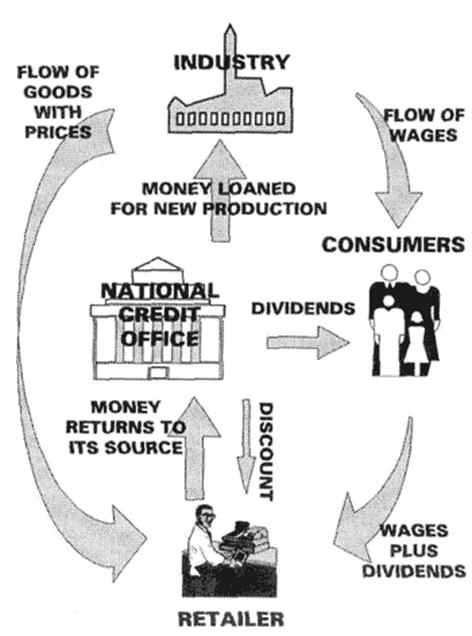 Money is
loaned to the producers (industry) by the National Credit Office, for the
production of new goods, which brings a flow of new goods with prices (left
arrow). Since wages are not sufficient to buy all of available goods and
services for sale, the National Credit Office fills the gap between the flow of
purchasing power and the flow of total prices by issuing a monthly dividend to
every citizen. Consumers and goods meet at the market place (retailer), and
when a product is purchased (consumed), the money that had originally been loaned
for producing this good returns to its source, the National Credit Office. At
any moment, there is always an equality between the total purchasing power
available in the hands of the population, and the total prices of consumable
goods for sale on the market.
Money is
loaned to the producers (industry) by the National Credit Office, for the
production of new goods, which brings a flow of new goods with prices (left
arrow). Since wages are not sufficient to buy all of available goods and
services for sale, the National Credit Office fills the gap between the flow of
purchasing power and the flow of total prices by issuing a monthly dividend to
every citizen. Consumers and goods meet at the market place (retailer), and
when a product is purchased (consumed), the money that had originally been loaned
for producing this good returns to its source, the National Credit Office. At
any moment, there is always an equality between the total purchasing power
available in the hands of the population, and the total prices of consumable
goods for sale on the market.
contents
LESSON
7 — THE HISTORY OF THE BANKING CONTROL IN THE
UNITED STATES
The bankers' dictatorship and their debt-money system
are not limited to one country, but exist in every country in the world. They are
working to keep their control tight, since one country freeing itself from this
dictatorship and issuing its own interest- and debt-free currency, setting the
example of what an honest system could be, would be enough to bring about the
worldwide collapse of the bankers’ swindling debt-money system.
 This fight of the International Financiers to install
their fraudulent debt-money system has been particularly vicious in the United
States of America since its very foundation, and historical facts show that
several American statesmen were well aware of the dishonest money system the
Financiers wanted to impose upon America, and of all of its harmful effects.
These statesmen were real patriots, who did all that they possibly could to
maintain for the U.S.A. an honest money system, free from the control of the
Financiers. The Financiers did everything in their power to keep in the dark
this facet of the history of the United States, for fear that the example of
these patriots might still be followed today. Here are these facts that the
Financiers would like the population not to know:
This fight of the International Financiers to install
their fraudulent debt-money system has been particularly vicious in the United
States of America since its very foundation, and historical facts show that
several American statesmen were well aware of the dishonest money system the
Financiers wanted to impose upon America, and of all of its harmful effects.
These statesmen were real patriots, who did all that they possibly could to
maintain for the U.S.A. an honest money system, free from the control of the
Financiers. The Financiers did everything in their power to keep in the dark
this facet of the history of the United States, for fear that the example of
these patriots might still be followed today. Here are these facts that the
Financiers would like the population not to know:
The happiest population
 We are in 1750. The United States of America does not
yet exist; it is the 13 Colonies of the American continent, forming “New England”,
a possession of the motherland, England. Benjamin Franklin wrote about the
population of that time: “Impossible to find a happier and more prosperous
population on all the surface of the globe.” Going over to England to
represent the interests of the Colonies, Franklin was asked how he accounted
for the prosperous conditions prevailing in the Colonies, while poverty was
rife in the motherland:
We are in 1750. The United States of America does not
yet exist; it is the 13 Colonies of the American continent, forming “New England”,
a possession of the motherland, England. Benjamin Franklin wrote about the
population of that time: “Impossible to find a happier and more prosperous
population on all the surface of the globe.” Going over to England to
represent the interests of the Colonies, Franklin was asked how he accounted
for the prosperous conditions prevailing in the Colonies, while poverty was
rife in the motherland:
“That is simple,”
Franklin replied. “In the Colonies we issue our own money. It is called
Colonial Scrip. We issue it in proper proportion to make the products pass
easily from the producers to the consumers. In this manner, creating ourselves
our own paper money, we control its purchasing power, and we have no interest
to pay to no one.”
The English bankers, being informed of that, had a law
passed by the British Parliament prohibiting the Colonies from issuing their
own money, and ordering them to use only the gold or silver debt-money that was
provided in insufficient quantity by the English bankers. The circulating
medium of exchange was thus reduced by half.
“In one year,” Franklin
stated, “the conditions were so reversed that the era of prosperity ended,
and a depression set in, to such an extent that the streets of the Colonies
were filled with unemployed.”
Then the Revolutionary War was launched against
England, and was followed by the Declaration of Independence in 1776. History
textbooks erroneously teach that it was the tax on tea that triggered the
American Revolution. But Franklin clearly stated:
“The Colonies would gladly have
borne the little tax on tea and other matters, had it not been the poverty
caused by the bad influence of the English bankers on the Parliament: which has
caused in the Colonies hatred of England, and the Revolutionary War.”
The Founding Fathers of the United States, bearing all
these facts in mind, and to protect themselves against the exploitation of the
International Bankers, took good care to expressly declare, in the American
Constitution, signed at Philadelphia, in 1787, Article 1, Section 8, paragraph
5:
“Congress
shall have the power to coin money and to regulate the value thereof.”
 The bank of the bankers
 But the bankers
did not give up. Their agent, Alexander Hamilton, was named Secretary of Treasury
in George Washington's cabinet, and advocated the establishment of a federal
bank to be owned by private interests, and the creation of debt-money with
false arguments like: “A national debt, if it is not excessive, will be to
us a national blessing... The wisdom of the Government will be shown in never
trusting itself with the use of so seducing and dangerous an expedient as
issuing its own money.” Hamilton also made them believe that only the
debt-money issued by private banks would be accepted in dealing abroad.
But the bankers
did not give up. Their agent, Alexander Hamilton, was named Secretary of Treasury
in George Washington's cabinet, and advocated the establishment of a federal
bank to be owned by private interests, and the creation of debt-money with
false arguments like: “A national debt, if it is not excessive, will be to
us a national blessing... The wisdom of the Government will be shown in never
trusting itself with the use of so seducing and dangerous an expedient as
issuing its own money.” Hamilton also made them believe that only the
debt-money issued by private banks would be accepted in dealing abroad.

 Thomas Jefferson,
the Secretary of State, was strongly opposed to that project, but President
Washington was finally won over by Hamilton's arguments. A federal bank was thus
created in 1791, the “Bank of the United States”, with a 20 years' charter.
Although it was termed “Bank of the United States”, it was actually the “bank
of the bankers”, since it was not owned by the nation, but by individuals
holding the bank's stocks, the private bankers. This name of “Bank of the
United States” was purposely chosen to deceive the American population and to
make them believe that they were the owners of the bank, which was not the
case. The charter for the Bank of the United States ran out in 1811, and
Congress voted against its renewal, thanks to the influence of Thomas Jefferson
and Andrew Jackson:
Thomas Jefferson,
the Secretary of State, was strongly opposed to that project, but President
Washington was finally won over by Hamilton's arguments. A federal bank was thus
created in 1791, the “Bank of the United States”, with a 20 years' charter.
Although it was termed “Bank of the United States”, it was actually the “bank
of the bankers”, since it was not owned by the nation, but by individuals
holding the bank's stocks, the private bankers. This name of “Bank of the
United States” was purposely chosen to deceive the American population and to
make them believe that they were the owners of the bank, which was not the
case. The charter for the Bank of the United States ran out in 1811, and
Congress voted against its renewal, thanks to the influence of Thomas Jefferson
and Andrew Jackson:
“If Congress,” Jackson said, “has a right under the Constitution
to issue paper money, it was given them to use by themselves, not to be
delegated to individuals or corporations.”
Thus ended the
history of the first Bank of the United States. But the bankers did not play
their last card.
The bankers launch the war
Nathan Rothschild, of the Bank of England, issued an
ultimatum: “Either the application for the renewal of the charter is
granted, or the United States will find itself involved in a most disastrous
war.” Jackson and the American patriots did not believe the power of the
international moneylenders could extend so far. “You are a den of
thieves-vipers,” Jackson told them. “I intend to rout you out, and by
the Eternal God, I will rout you out!” Nathan Rothschild issued orders: “Teach
these impudent Americans a lesson. Bring them back to Colonial status.”
The British
Government launched the War of 1812 against the United States. Rothschild's
plan was to impoverish the United States through this war to such an extent
that the legislators would have to seek financial aid... which, of course,
would be forthcoming only in return for the renewal of the charter for the Bank
of the United States. Thousands were killed, but what does that matter to
Rothschild? He had achieved his objective; the U.S. Congress granted the
renewal of the Charter in 1816.
Abraham Lincoln is assassinated
 Abraham Lincoln was elected President of the United
States in 1860, under the promise of abolishing the slavery of the blacks.
Eleven southern States, favourable to the human slavery of the black race, then
decided to secede from the Union, to withdraw from the United States of
America: that was the beginning of the Civil War (1861–1865). Lincoln, being
short of money to finance the North's war effort, went to the bankers of New
York, who agreed to lend him money at interest rates varying from 24 to 36
percent. Lincoln refused, knowing perfectly well that this was usury and that
it would lead the United States to ruin. But his money problem was still not
Abraham Lincoln was elected President of the United
States in 1860, under the promise of abolishing the slavery of the blacks.
Eleven southern States, favourable to the human slavery of the black race, then
decided to secede from the Union, to withdraw from the United States of
America: that was the beginning of the Civil War (1861–1865). Lincoln, being
short of money to finance the North's war effort, went to the bankers of New
York, who agreed to lend him money at interest rates varying from 24 to 36
percent. Lincoln refused, knowing perfectly well that this was usury and that
it would lead the United States to ruin. But his money problem was still not  settled!
His friend in Chicago, Colonel Dick Taylor, came to
his rescue and put the solution to him: “Just get Congress to pass a bill
authorizing the printing of full legal tender treasury notes, and pay your
soldiers with them, and go ahead and win your war with them also.”
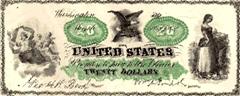 This is what Lincoln did, and he won the war: between
1862 and 1863, in full conformity with the provisions of the U.S. Constitution,
Lincoln caused $450 million of debt-free Greenbacks to be issued, to conduct
the Civil War. (These Treasury notes were called “Greenbacks” by the people
because they were printed with green ink on the back.)
This is what Lincoln did, and he won the war: between
1862 and 1863, in full conformity with the provisions of the U.S. Constitution,
Lincoln caused $450 million of debt-free Greenbacks to be issued, to conduct
the Civil War. (These Treasury notes were called “Greenbacks” by the people
because they were printed with green ink on the back.)
Lincoln said: “Government, possessing the power to
create and issue currency and credit as money, and enjoying the right to
withdraw both currency and credit from circulation by taxation and otherwise,
need not and should not borrow capital at interest as the means of financing
governmental work and public enterprise… The privilege of creating and issuing
money is not only the supreme prerogative of Government, but it is the
Government's greatest creative opportunity.”
Lincoln called the Greenbacks “the greatest
blessing the American people have ever had.” A blessing for all, except for
the bankers, since it was putting an end to their racket, to the stealing of
the nation's credit and issuing interest-bearing money. So they did everything
possible to destroy these Greenbacks and sabotage Lincoln's work. Lord Goschen, spokesman of the Financiers, wrote in the London
Times (Quote taken from Who Rules America by C. K. Howe, and
reproduced in Lincoln Money Martyred by Dr. R. E. Search):
“If this mischievous financial policy, which has its
origin in North America, shall become indurated down
to a fixture, then that Government will furnish its own money without cost. It
will pay off debts and be without a debt. It will have all the money necessary
to carry on its commerce. It will become prosperous without precedent in the
history of the world. That Government must be destroyed, or it will destroy
every monarchy on the globe.” (The
monarchy of the money lenders.)
First, in order to cast discredit on the Greenbacks,
the bankers persuaded Congress to vote, in February of 1862, the “Exception
Clause”, which said that the Greenbacks could not be used to pay the interest
on the national debt, nor to pay taxes, excises, or import duties. Then, in 1863,
having financed the election of enough Senators and Representatives, the
bankers got the Congress to revoke the Greenback Law in 1863, and enact in its
place the National Banking Act. (Money was then to be issued interest-bearing
by privately-owned banks.)
This Act also provided that the Greenbacks should be
retired from circulation as soon as they came back to the Treasury in payment
of taxes. Lincoln heatedly protested, but his most urgent objective was to win
the war and save the Union, which obliged him to put off till after the war the
veto he was planning against this Act and the action he was to take against the
bankers. Lincoln nevertheless declared:
“I have two great enemies, the
Southern army in front of me and the bankers in the rear. And of the two, the
bankers are my greatest foe.”
Lincoln was re-elected President in 1864, and he made
it quite clear that he would attack the power of the bankers, once the war was
over. The war ended on April 9, 1865, but Lincoln was assassinated five days later,
on April 14. A tremendous restriction of credit followed, organized by the
banks: the currency in circulation in the country, which was, in 1866, $1,907
million, representing $50.46 for each American citizen, had been reduced to
$605 million in 1876, representing $14.60 per capita. The result: in ten years,
56,446 business failures, representing a loss of $2 billion. And as if this was
not enough, the bankers reduced the per capita currency in circulation to $6.67
in 1887!
 William
Jennings Bryan: “The banks ought to get out”
William
Jennings Bryan: “The banks ought to get out”
 Lincoln's
example nevertheless remained in several minds, as far along as 1896. That
year, the Presidential candidate for the Democrats was William Jennings Bryan,
and once again, history textbooks tell us that it was a good thing that he did
not succeed in his bid for the Presidency, since he was against the bankers'
“sound money”, the money issued as a debt, and against the gold standard. Bryan
said:
Lincoln's
example nevertheless remained in several minds, as far along as 1896. That
year, the Presidential candidate for the Democrats was William Jennings Bryan,
and once again, history textbooks tell us that it was a good thing that he did
not succeed in his bid for the Presidency, since he was against the bankers'
“sound money”, the money issued as a debt, and against the gold standard. Bryan
said:
 “We
say in our platform that we believe that the right to coin and issue money is a
function of Government. We believe it. Those who are opposed to it tell us that
the issue of paper money is a function of the bank, and that the Government
ought to get out of the banking business. I tell them that the issue of money
is a function of Government, and that the banks ought to get out of the
Government business... When we have restored the money of the Constitution, all
other necessary reforms will be possible, but until this is done, there is no
other reform that can be accomplished.”
“We
say in our platform that we believe that the right to coin and issue money is a
function of Government. We believe it. Those who are opposed to it tell us that
the issue of paper money is a function of the bank, and that the Government
ought to get out of the banking business. I tell them that the issue of money
is a function of Government, and that the banks ought to get out of the
Government business... When we have restored the money of the Constitution, all
other necessary reforms will be possible, but until this is done, there is no
other reform that can be accomplished.”
The Fed: The most gigantic trust
 Finally, on December 23, 1913, the U.S. Congress voted
in the Federal Reserve Act, which took away from Congress the power to create
money, and which handed over this power to the Federal Reserve Corporation. One
of the rare Congressmen who had understood all the issue at stake in this Act,
Representative Charles A. Lindbergh Sr. (Rep-Minnesota), father of the famous
aviator, said:
Finally, on December 23, 1913, the U.S. Congress voted
in the Federal Reserve Act, which took away from Congress the power to create
money, and which handed over this power to the Federal Reserve Corporation. One
of the rare Congressmen who had understood all the issue at stake in this Act,
Representative Charles A. Lindbergh Sr. (Rep-Minnesota), father of the famous
aviator, said:
“This
Act establishes the most gigantic trust on earth. When the President (Wilson)
signs this bill, the invisible government of the Monetary Power will be
legalized... The worst legislative crime of the ages is perpetrated by this
banking and currency bill.”
The education of the people
What allowed the bankers to finally obtain the
complete monopoly of the control of credit in the United States? The ignorance
among the population of the money question. John Adams wrote to Thomas
Jefferson, in 1787:
 “All
the perplexities, confusion and distress in America arise, not from defects in
the Constitution, not from want of honor or virtue,
so much as downright ignorance of the nature of coin, credit, and circulation.”
“All
the perplexities, confusion and distress in America arise, not from defects in
the Constitution, not from want of honor or virtue,
so much as downright ignorance of the nature of coin, credit, and circulation.”
Lincoln's
Secretary of Treasury, Salmon P. Chase, stated publicly, shortly after the
passage of the National Banking Act, in 1863:
 “My
agency in promoting the passage of the National Banking Act was the greatest
financial mistake of my life. It has built up a monopoly which affects every
interest in the country. It should be repealed, but before that can be
accomplished, the people will be arrayed on one side, and the banks on the
other, in a contest such as we have never seen before in this country.”
“My
agency in promoting the passage of the National Banking Act was the greatest
financial mistake of my life. It has built up a monopoly which affects every
interest in the country. It should be repealed, but before that can be
accomplished, the people will be arrayed on one side, and the banks on the
other, in a contest such as we have never seen before in this country.”
Automobile manufacturer Henry Ford said:
“If
the people of the nation understood our banking and monetary system, I believe
there would be a revolution before tomorrow morning.”
The education of the people, that's the solution! It
is precisely the method advocated by the “Michael” Journal: to build a force in
the people through education, so that the sovereign government of each nation
will have the courage to stand up to the bankers and issue its own money, as
President Lincoln did. If only all those in favour of an honest money system
understood their responsibilities for spreading the “Michael” Journal! Social
Credit, which would establish an economy where everything is organized to serve
the human person, is precisely aiming to develop personal responsibility, to
create responsible people. Each mind won over to Social Credit is an advance.
Each person formed by Social Credit is a force, and each force acquired is a
step towards the victory. And for the last sixty years, how many forces have
been acquired!… If all of them were active, it is really before tomorrow
morning that we would obtain the implementation of the Social Credit proposals!
As Louis Even wrote in 1960: “The obstacle is neither
the financier, nor the politician, nor any avowed enemy. The obstacle lies in
the passivity of too many Social Crediters who hope
for the coming of the triumph of the Cause, but who leave it up to others to
promote it.”
In short, it is our refusal to
take on our responsibilities that delays the implementation of Social Credit,
of an honest money system. “Much will be asked of the man to whom much has been
given” (Luke 12:48). Examine your consciences, dear Social Crediters;
personal conversion, one more go, and let us take on our responsibilities: the
victory has never been so close! Our responsibility is to make Social Credit
known to others, by having them subscribe to the “Michael” Journal, the only
publication that makes this brilliant solution known.
Social Credit bill passed by the
US Congress in 1932
It is the education of the people that is necessary.
Once the pressure from the public is strong enough, all the parties will agree
with it. A fine example of this can be found in the Goldsborough
bill of 1932, which was described by an author as a “Social Credit bill” and
“the closest near-miss monetary reform for the establishment of a real sound
money system in the United States”:
“An overwhelming majority of the U.S. Congress (289 to
60) favored it as early as 1932, and in one form or
another it has persisted since. Only the futile hope that a confident new
President (Roosevelt) could restore prosperity without abandoning the
credit-money system America had inherited kept Social Credit from becoming the
law of the land. By 1936, when the New Deal (Roosevelt's solution) had proved
incapable of dealing effectively with the Depression, the proponents of Social
Credit were back again in strength. The last significant effort to gain its
adoption came in 1938.” (W.E. Turner, Stable Money, p. 167.)
Even the dividend
and the compensated discount, two essential parts of Social Credit, were
mentioned in this bill, which was the “Goldsborough
bill”, after the Democratic Representative of Maryland, T. Allan Goldsborough, who presented it in the House for the first
time on May 2, 1932.
Two persons who supported the bill especially hold our
attention: Robert L. Owen, Senator of Oklahoma from 1907 to 1925 (a national
bank director for 46 years), and Charles G. Binderup,
Representative of Nebraska. Owen published an article, in March of 1936, in J.
J. Harpell's publication, “The Instructor”, of which
Louis Even was the assistant editor. As for Binderup,
he gave several speeches on radio in the U.S.A. during the Depression,
explaining the damaging effects of the control of credit by private interests.
 Robert Owen testified in the House, April 28, 1936:
 “...the
bill which he (Goldsborough) then presented, with the
approval of the Committee on Banking and Currency of the House — and I believe
it was practically a unanimous report. It was debated for two days in the
House, a very simple bill, declaring it to be the policy of the United States
to restore and maintain the value of money, and directing the Secretary of the
Treasury, the officers of the Federal Reserve Board, and the Reserve banks to
make effective that policy. That was all, but enough, and it passed, not by a
partisan vote. There were 117 Republicans who voted for that bill (which was presented
by a Democrat) and it passed by 289 to 60, and of the 60 who voted against it,
only 12, by the will of the people, remain in the Congress.
“...the
bill which he (Goldsborough) then presented, with the
approval of the Committee on Banking and Currency of the House — and I believe
it was practically a unanimous report. It was debated for two days in the
House, a very simple bill, declaring it to be the policy of the United States
to restore and maintain the value of money, and directing the Secretary of the
Treasury, the officers of the Federal Reserve Board, and the Reserve banks to
make effective that policy. That was all, but enough, and it passed, not by a
partisan vote. There were 117 Republicans who voted for that bill (which was presented
by a Democrat) and it passed by 289 to 60, and of the 60 who voted against it,
only 12, by the will of the people, remain in the Congress.
“It
was defeated by the Senate, because it was not really understood. There had not
been sufficient discussion of it in public. There was not an organized public
opinion in support of it.”
Once
again, education is the main issue: Republicans and Democrats alike supported
it, so there was no need for a third party or any sort of “Social Credit” party. Moreover, Owen
admitted that the only thing that was lacking was the education of the
population, a force among the people. That confirms the method used by the
“Michael” Journal, advocated by Clifford Hugh Douglas and Louis Even.
The Goldsborough bill was
titled: “A bill to restore to Congress its Constitutional power to issue
money and regulate the value thereof, to provide monetary income to the people
of the United States at a fixed and equitable purchasing power of the dollar,
ample at all times to enable the people to buy wanted goods and services at
full capacity of the industries and commercial facilities of the United
States... The present system of issuing money through private initiative for
profit, resulting in recurrent disastrous inflations and deflations, shall
cease.”
The bill also made provision for a discount on prices to be compensated
to the retailer, and for a national dividend to be issued, beginning at $5 a
month (in 1932) to every citizen of the nation. Several groups testified in
support of the bill, stressing the bill provided the means of controlling
inflation.
Ignorance
among the population
The most ardent opponent in the Senate was Carter
Glass, a fierce partisan of the Federal Reserve (private control of money) and
a former Secretary of the Treasury. Besides, Henry Morgenthau,
then Roosevelt's Secretary of Treasury, who was strongly opposed to any
monetary reform, said that Roosevelt's New Deal should be given a trial first.
What mostly helped the opponents to the bill was the
near downright ignorance of the money question among the population... and even
in the Senate.
Some
Senators, knowing nothing about the creation of money (credit) by banks,
exclaimed: “The Government cannot create money like that! That will cause
runaway inflation!” And others, while admitting the necessity for debt-free
money, questioned the necessity for a dividend, or the compensated discount.
But all these objections actually disappear after a serious study of Social
Credit.
Quotes on
money

 "Let me
issue and control a nation's money and I care not who writes its laws." — Mayer Amschel Rothschild
(1744-1812), founding father of international finance
"Let me
issue and control a nation's money and I care not who writes its laws." — Mayer Amschel Rothschild
(1744-1812), founding father of international finance
“History records that the money changers have used
every form of abuse, intrigue, deceit, and violent means possible to maintain
their control over governments by controlling money and its issuance.” — US President James Madison
“The money power denounces, as public enemies, all who
question its methods or throw light upon its crimes.” — William Jennings Bryan.
"Whoever controls the volume of money in any
country is absolute master of all industry and commerce." — US President James A. Garfield

 “Banking was
conceived in iniquity and born in sin. Bankers own the earth. Take it away from
them, but leave them the power to create money and control credit, and with the
flick of a pen, they will create enough money to buy it back again. Take this
great power away from the bankers and all the great fortunes like mine will
disappear, and they ought to disappear, for this would be a better and happier
world to live in. But if you want to continue the slaves of bankers and pay the
cost of your own slavery, let them continue to create money and to control
credit." — Sir Josiah Stamp,
Director, Bank of England, 1940.
“Banking was
conceived in iniquity and born in sin. Bankers own the earth. Take it away from
them, but leave them the power to create money and control credit, and with the
flick of a pen, they will create enough money to buy it back again. Take this
great power away from the bankers and all the great fortunes like mine will
disappear, and they ought to disappear, for this would be a better and happier
world to live in. But if you want to continue the slaves of bankers and pay the
cost of your own slavery, let them continue to create money and to control
credit." — Sir Josiah Stamp,
Director, Bank of England, 1940.
“The process by which banks create money is so simple
that the mind is repelled.” — John K.
Galbraith, in “Money: Whence it came, where it went”, p. 29.
“The banks do create money. They have been doing it
for a long time, but they didn't quite realise it, and they did not admit it.
Very few did. You will find it in all sorts of documents, financial textbooks, etc.
But in the intervening years, and we must all be perfectly frank about these
things, there has been a development of thought, until today I doubt very much
whether you would get many prominent bankers to attempt to deny that banks
create credit.” — H. W. White, Chairman of
the Associated Banks of New Zealand, to the New Zealand Monetary Commission,
1955.
Thomas Edison and Henry Ford

 Let us bring an end to this lesson with the quotations
of two great American citizens.
Let us bring an end to this lesson with the quotations
of two great American citizens.
Thomas Edison: “Throughout our history some of
America's greatest men have sought to break the Hamiltonian imprint (Alexander
Hamilton's debt-money policy) on our monetary policy in order to substitute a
stable money supply measured to the nation's physical requirements. Lack of
public and official understanding, combined with the power of banking interests
who have imagined a vested interest in the present chaotic system, have so far
thwarted every effort.
“Don't allow them to confuse you with the cry of
`paper money.' The danger of paper money is precisely the danger of gold — if
you get too much it is no good. There is just one rule for money and that is to
have enough to carry on all the legitimate trade that is waiting to move. Too
little and too much are both bad. But enough to move trade, enough to prevent
stagnation, on the one hand, not enough to permit speculation, on the other
hand, is the proper ratio...
“If the United States will adopt this policy of increasing
its national wealth without contributing to the interest collector — for the
whole national debt is made up of interest charges — then you will see an era
of progress and prosperity in this country such as could never have come
otherwise.”
And a call from Henry Ford: “The youth who can
resolve the money question will do more for the world than all the professional
soldiers of history.”
Young people, have you understood? Join the ranks of
the apostles of the “Michael” Journal, for the sake of your country and fellow
citizens. The Pilgrims of Saint Michael need you; they are waiting for you!
LESSON 8 — Social Credit is
not a political party
Social Credit is a sound and
effective financial system
 To
rely on a party is a delusion
To
rely on a party is a delusion
(The
following text is taken from Louis Even'’ brochure “What Do We Mean By Real
Social Credit? — Above political parties)
The implementation of Social Credit would institute
true democracy: economic democracy, by making each consumer capable of ordering
from the country's production the basic necessities of life; political
democracy, as long as the people can make known to their elected
representatives, to their governments, what they expect of them and to demand
results. (Demos, people; kratein, to
reign. — Democracy: the people's sovereignty.)
Any
Social Crediter, even slightly informed, knows very
well that, today, supreme power is exercised neither by the people nor by their
governments, but by a financial clique. Statesmen like Gladstone, Wilson, and
many others, declared it explicitly. Mackenzie King was promising, in 1935, the
greatest battle of all times "between the financial powers and the
people." A battle in which he did not engage, no doubt because he considered
the financial powers too strong and the people too weak.

 The people
are weak indeed; and it is understandable that they are weak when, in the first
place, they know nothing about public matters and what goes on behind the
scenes; weak, secondly, when, instead of teaching them about these things,
those who are stirring in front of them divide them into political factions
that are fighting each other. It is not yet one more faction that will create
unity, a unity of strength. It is division and factions that serve merely to
increase their weakness.
The people
are weak indeed; and it is understandable that they are weak when, in the first
place, they know nothing about public matters and what goes on behind the
scenes; weak, secondly, when, instead of teaching them about these things,
those who are stirring in front of them divide them into political factions
that are fighting each other. It is not yet one more faction that will create
unity, a unity of strength. It is division and factions that serve merely to
increase their weakness.
It is a man of genius, C. H.
Douglas, who discovered the great truth that Social Credit is; it is he who
founded the Social Credit school. He most certainly knew better what Social
Credit meant, as far as democracy is concerned, than those little fellows of
our homeland who would like to make out of Social Credit the instrument of
their race to power, or at least a platform for their jigging about in search
of a seat in Parliament.
Now, Douglas declared, in a lecture given in
Newcastle-upon-Tyne, on March 19, 1937, that there are, in England, two major
obstacles to true democracy, and the first of these obstacles is the system of
parties.
The same goes for Canada, and the solution does not
consist in feeding the system of parties, but in weakening it. That is to say,
to neutralize the parties in existence, not by creating another division within
the people, but on the contrary, by uniting the citizens, all citizens, without
party distinctions, to express their common will to their Members of
Parliament, whoever these Members of Parliament are, and whatever their
political colours. To put the focus on what happens between elections, when the
fate of the citizens is at stake, more than during elections when the
politicians' fate is at stake.
To unite the citizens. And for this, to begin by
making them understand that they all want the same fundamental things; then to
convince them that by thus insisting together to get what they all want, they
would inevitably get it.
It is still Major Douglas who, on another occasion, in
Liverpool, October 30, 1936, said
“The people's sovereignty, i.e., their effective
ability to give orders, would increase with their unanimity, and if people all
wanted a uniform result there could be no possibility of parties, and there
could be no resistance to their demand.”
That is, it seems to us, a very good line of conduct,
perfectly in keeping with common sense.
You will never be able to get everybody in agreement
around a ballot box. But you could fairly well get everybody in agreement on
the results to be demanded from politics, if you make it a point to set these
results in the order of their universality and urgency: economic security, a
sufficient amount of goods today and guaranteed for tomorrow, the freedom for
each one to choose his occupation and lifestyle. Everybody wants these things;
and, as Douglas points out, even those who do not want them for others, want
them for themselves.
Why then centralize attention and turn activities
toward the ballot box, toward the thing that divides, instead of applying
oneself to effectively uniting everybody around demands over which everybody
can be in agreement?
Never was an important reform obtained by the
formation of a new political party. Most of the time, the party established
with the goal of a major reform dies because of electoral failure; and if, by
chance, it comes to power, it comes up against so many obstacles that it is
finally paralyzed and finds no other objective than to stay in power without
doing any more than the traditional parties. To overcome the obstacles, it
lacked a strength: that of a people sufficiently enlightened, and sufficiently
formed in the political field.
Besides, a reform cannot come out of an election. It
results from a natural and democratic process, from the maturation of a
well-cultivated key idea; it results from its acceptance, its demand, by a
sufficient number of people to create a general will, expressed without falling
victim to the hazards of electoral results.
Social Credit will enter into the country's
legislation when it will have become the object of a general will or demand,
asserted so much that all political parties will welcome it into their
programs. To confine it into a political party is to link its fate to the
electoral fate of that party. And it can mean moving backward instead of
forward.
A new idea is spread through propaganda, it takes
roots through study. The newer the idea and the greater its repercussions, the
more its propagation and implantation call for effort, usually for time also,
but always for perseverance. The cause that propagates this idea has much more
need of apostles than members of parliaments.
The instigators of new parties no doubt consider that
the people's political education would take too much time, if however they ever
even thought about it. A quick vote seems to be a more usual method and,
especially, a faster one to them. The result: tombstones, which are not even
visited by those who supported these defunct parties. A fair number of these
gentlemen have since contentedly settled down under the wings of traditional
parties that they had previously eloquently denounced.
People’s strength must be built up, so that their
pressure on governments exceeds the strength of the financial powers. It is not
in a parliament that people build up their strength. It is where the people are
— outside of parliaments. And that is the place of a true Social Credit Movement.
Douglas and electioneering
The Social Credit Secretariat, an organization founded
by Major Douglas himself, has republished an address given by the founder of
Social Credit, on March 7, 1936. That day, Douglas was not speaking to the
general public, but to Social Crediters.
In that address, Douglas recommends a policy of
pressure, and strongly condemns the formation of political parties, especially
that of a “Social Credit” party. He condemns this kind of effort, not only
because it is doomed to failure before it starts, but also because it imprisons
and obscures the beautiful thing that Social Credit is, in politics and the
ballot box. Douglas goes so far as to say:
“If you elect a Social
Credit party, supposing you could, I may say that I regard the election of a
Social Credit party in this country as one of the greatest catastrophes that
could happen.”
The proper function of a Member of Parliament,
explained Douglas, is to receive and pass on to the government the expression
of the legitimate will of its constituents. The proper function of a government
is to receive this demand and order the experts to follow it up (the experts,
therefore the financiers for financial matters). One must not tell these
experts how to go about it, but point out the result to be achieved and demand
this result.
And the people's role is to become aware of objectives
that they commonly want and to express this will to their representatives. It
is where it must begin, from where it must be launched, with the voters.
Therefore, instead of giving the importance to the elected representative, we
must give it to the voters.
In Douglas’s words: “If you agree that the object
of sending a set of men to Parliament is to get what you want, then why elect a
special set of men, a special party at all? The men who are there should get
you what you want — that is their business. It is not their business to say how
it is to be got. How things are done is the responsibility of the expert.”
The experts must be told what the citizens want, and
this demand must come from the citizens themselves.
Electioneering has perverted democracy. The only thing
political parties can achieve is to divide people, weaken their strength and
lead them to disappointments.  To add a new party can only add another disappointment
under another name. A disappointment all the more disastrous if the adventure
drags with it the name of an excellent cause like that of Social Credit.
To add a new party can only add another disappointment
under another name. A disappointment all the more disastrous if the adventure
drags with it the name of an excellent cause like that of Social Credit.
(The
following text is taken from Louis Even’s booklet A
Sound and Effective Financial System:)
At the root of evil
— Why criticize and denounce the present financial
system?
Because it does not fulfill its purpose.
— What is the purpose of a financial system?
The purpose of a financial system is to finance. To
finance the production of goods which answer needs, and to finance the
production of these goods for them to meet these needs.
If the financial system does this, it fulfills its
role. If it does not do it, it does not fulfill its role. If it does something
else, it goes beyond its role.
— Why do you say that the present financial system
does not fulfill its role?
Because there are goods – public goods and private
goods – that are required by the population, that are most certainly realizable
physically, but that stay in nothingness because the financial system does not
finance their production. Moreover, there are goods offered to a population
which is in need of them, but which some individuals or families cannot get,
because the financial system does not finance consumption. These are undeniable
facts.
— What is production or consumption financed with?
With means of payment (cash credits). These means of
payment (cash credits) can be made up of coins, paper money, or cheques drawn
on bank accounts.
All these means of payment (cash credits) can be
included under the term “financial credit”, because everybody accepts them with
confidence. The word credit implies confidence. You accept with the same
confidence four quarters, or a one-dollar note from the Bank of Canada, or a
one-dollar cheque on any bank where the maker of the cheque has a bank account.
You know, actually, that with either of these three means of payment (cash
credits), you can pay for labour or materials for the value of one dollar if
you are a producer, or consumer goods for the value of one dollar if you are a
consumer.
— Where does this “financial credit”, these means of
payment (cash credits) draw their value from?
Financial credit draws its value from “real credit”. That
is to say, from the country's production capacity. A dollar, of whatever form,
has value only because the country's production can supply goods to match it.
You can call this production capacity "real credit", because it is a
real factor of confidence. It is a country's real credit, its production
capacity, which causes you to have confidence in being able to live in that
country.
— To whom does this “real credit” belong?
It is a product, a benefit society. There is no doubt
that individual and group capacities of all kinds contribute to it. But without
the existence of natural resources, which are a gift from Providence and not
the result of an individual competence, without the existence of an organized
society which allows the division of labour, without services such as schools,
roads, means of transportation, etc., global production capacity would be much
weaker, very weak actually.
This is why we speak of national production, national
economy, which does not at all mean State-controlled production. It is in this
global production capacity that the citizens, each citizen, must be able to
find a base of confidence for the satisfaction of his material needs. Pius XII
said in his Whitsunday Broadcast in 1941:
“The national economy, the fruit from the activities
of men who work together in the national community, tends towards no other
thing than securing, without interruption, the material conditions in which the
individual life of the citizens will be able to fully develop.”
— To whom does “financial credit” belong?
At its source, financial credit belongs to the
community, in the same way as does real credit, where it draws its value from.
It is a product of the community from which must benefit, in one way or
another, all the members of the community.
Like “real credit”, financial credit is, by its very
nature, a social credit. (It belongs to all the members of society.)
The use of this community product must not be
subjected to conditions which hinder the production capacity, nor which divert
production from its proper purpose, which is to serve human needs: needs of a
private and public nature, in their order of urgency; the satisfaction of the
basic needs of all, before the luxury requests of a few; also before the
splendour and the pharaonic plans of the public
administrators, greedy for fame.
— Is it possible to make the general economy conform
to this hierarchy of needs, without a dictatorship that plans everything,
imposes production programs, and administers the distribution of goods?
It is certainly possible, with a financial system that
guarantees to each individual a share of the financial credit of the community.
A sufficient share, so that the individual can himself demand, from the
country's production, enough to satisfy at least his basic needs.
Such a financial system would not do any dictating.
Production would plan its programs from the orders coming in from consumers, as
far as private goods are concerned; and it would plan them from the orders
coming in from public administrations, as far as public goods are concerned.
The financial system would thus serve, on the one hand, to express the
consumers' will; and on the other hand, it would act in the producers’ service,
to mobilize the country's production capacity in step with the demands of
private and public consumers.
For this, of course, it is necessary to have a
financial system that conforms to reality, and not one that does violence to
it. A financial system that reflects facts, and not one that is at variance
with it. A financial system that distributes, and not one that rations. A
financial system that serves man, and not one that degrades him.
— Is such a financial system conceivable?
Yes. Its outline was given by Clifford Hugh Douglas,
the master and genius who expounded to the world what is called Social Credit
(not to be mixed up with the prostitution of political parties which invest
themselves with this name).
Douglas summarized in three propositions the basic
principles of a system that would fulfill these goals and, moreover, be
flexible enough to follow the economy in all its developments, up to any degree
of mechanization, motorization, or automation.
Douglas's three propositions
— What are Douglas's three propositions?
Douglas publicly set forth these three propositions on
three occasions: at Swanwick, in 1924; before the MacMillan Committee, in May 1930; and in a lecture given at
Caxton Hall, London, in October 1930. And he
reproduced them in some of his writings, among others, in The Monopoly of
Credit.
The first of these propositions relates to the
financing of consumption, by an adjustment between purchasing power and prices:
The cash credits of the population
of any country shall at any moment be collectively equal to the collective cash
prices for consumable goods for sale in that country, and such cash credits
shall be cancelled or depreciated only on the purchase or depreciation of goods
for consumption.
Douglas did not change anything in the terms of this proposition:
they were the same in 1930 as in 1924. In this proposition, to mention the
means of payment, in specie or scrip money, in the consumers' hands, Douglas
uses the term "cash credits", while, when he speaks about the
financing of production, he simply says "credits".
The difference between the two is that the money in
the consumers' hands is theirs: for them it is purchasing power that they use
as they so please in getting products of their own choosing. While the credits
to production are advances that the producer must pay back when his products
have been sold.
— What is the goal of this first proposition set
forth by Douglas?
The goal of this proposition is to achieve what can be
called the perfect purchasing power, by establishing an equilibrium between the
prices to be paid by the buyers and the money in the buyers' hands.
Social Credit makes a distinction between the cost
price and the price to be paid by the buyer (cash price). The buyer would not
have to pay the full cost price, but only this price reduced to a level
corresponding to the means of payment (cash credits) in the population's hands.
The cost price must always be recovered by the
producer if he wishes to remain in business. But the price to be paid must be at
the level of the purchasing power in the consumers’ hands, if you want
production to meet its purpose, which is consumption.
— How can this twofold condition be carried out?
By a price-adjustment mechanism. An adjustment, and
not a fixing of prices: the setting-up of cost prices is a matter for the
producers themselves; it is they who know what production costs them in
expenses.
The proposed adjustment would consist of a coefficient
that would be applied to all retail prices. This coefficient would be
periodically calculated (every three or six months, for example), according to
the ratio between total consumption and total production during a given period.
If, for example, during this given period, total
production was $40 billion, and total consumption was $30 billion, you can
conclude that, whatever the accounting cost prices may be, in reality, the
production of $40 billion has cost the country $30 billion. Therefore, $30
billion is the real cost of the total production of $40 billion. And if the producers
must recover $40 billion, the consumers, for their part, must pay only $30
billion. The missing $10 billion must be provided to the producers through
another source, not through the buyers. It is up to the monetary mechanism to
see to it.
In this case, a 3/4 coefficient will be applied to all
retail prices: the cost prices will be multiplied by this coefficient, by 3/4
or 0.75. The buyer will therefore pay only 75 percent of the cost price.
In other words, a general discount of 25 percent (the
opposite of a sales tax) will be decreed on all retail prices for the length of
the new term. At the end of each term, the general discount rate is thus
calculated according to the statistics of consumption in relation with the
statistics of production of the given period. Thus you get as close as possible
to the perfect purchasing power.
This operation is sometimes called a compensated price
or a compensated discount, because the money the seller does not get from the
buyer, because of this discount, is given to him afterwards by the National
Credit Office. This compensation allows the seller to recover his full cost
price. No one loses out. Everybody gains by the selling of goods made easier to
meet needs.
— And what is Douglas's second proposition?
Douglas's second proposition relates to the financing
of production. It was expressed as follows, by its author, at Swanwick, and before the MacMillan
Committee:
The credits
required to finance production shall be supplied not from savings, but be new
credits relating to new production.
At Caxton Hall, in October
1930, Douglas thus changed the end of his statement:
“new credits relating to production.”
He does not say “new production”, but only
“production”. Obviously both are synonymous. As production is made, it is a new
production. A new production to keep up the production flow where the consumer
shops.
Some have wrongly interpreted this proposition as
applying only to an increase in the volume of production, which is most
certainly not the case according to the context of the three propositions.
Douglas adds:
And these
credits shall be recalled only in ratio of general depreciation to general
appreciation, general enrichment.
Why finance production this way, with new credits, and
not with savings? Because savings come from money that has been distributed in
step with a realized production. Now all this money has gone into the cost
price of the realized production. If this money is not used to buy production,
the gap between the means of payment and prices will increase.
You can say that the savings used to finance a new
production flow, through investments or otherwise, come back into circulation
as purchasing power. It is true, but it is as expenses made by the producer,
therefore creating a new price. Now, the same amount of money cannot serve to
pay, at the same time, the corresponding price of the former production and the
corresponding price of the new production.
Each time saved money thus comes back to the
consumers, it is by creating a new price, without having paid a former price
left without corresponding purchasing power when this money becomes savings.
— And what about Douglas’s third financial
proposition?
The third proposition introduces a new element into
purchasing power: the distribution of a dividend to all, employed or not in
production. It is therefore a component factor of purchasing power, which
leaves no individual without a means of payment.
It is the recognition of the right of all to a share
in production, as co-capitalists, coheirs of the biggest modern production
factor: acquired progress, enlarged and transmitted from one generation to the
next. Also as co-owners of the natural resources, a free gift from God.
It is also the way to maintain a flow of purchasing
power in relation to the flow of production, even though production would
increasingly do without the use of employees. Therefore, it would be the
solution to the biggest present headache, which makes economists knock their
heads against the wall, and which dumbfounds governments in face of their
unsuccessful full-employment policy. The pursuit of full employment is
nonsense, difficult to justify on the part of intelligent beings, while
progress inexorably applies itself to freeing workmen, increasingly eliminating
the need for employees.
Here is how Douglas puts it:
The
distribution of cash to individuals shall be progressively less dependent upon
employment. That is to say that the dividend shall progressively displace the
wage and salary.
Progressively — as Douglas says it elsewhere — as
productivity increases per man-hour. This is perfectly in keeping with the role
taken by work and progress in the production flow.
Progress — a collective good — becomes more and more
important as a production factor, and human labour, less and less so. This
reality must be reflected in the distribution of incomes, through dividends to
all, on the one hand, and through reward for employment, on the other hand.
— But is this not turning everything upside down in the
financing of production and in the distribution of the claims on production?
It is, above all, and much more simply, a change in
philosophy, in the conception of the role of the economic and financial
systems, bringing them back to their proper purposes, and served by appropriate
means. It is time the ends and the means returned to their proper place. It is
time perversion gave way to rectification.
— But all this seems to imply that money, or financial credit, can come like this, forthwith, to finance production and consumption!
Certainly. The monetary system is essentially an
accounting system. Are the accountants short of figures to count, add,
subtract, multiply, divide, make rules of three, express percentages?
Moreover, the facts are there, to show that money is a
matter of figures: figures that monopolizers of the
system can cause to appear or disappear according to their whims, without any
more concrete items than a book, a pen, and a few drops of ink.
In a lecture given at Westminster, March 7, 1936, C
.H. Douglas said to his audience — a
Social Credit audience:
“We, Social Crediters, say
that the monetary system at present does not reflect facts. The opposition says
it does. Well, I put it to your common-sense. How was it that a world which was
apparently almost feverishly prosperous in 1929 — or alleged to be so, judged
by orthodox standards — and certainly capable of producing tremendous
quantities of goods and services and distributing a considerable proportion of
them, could be so impoverished by 1930, and so changed fundamentally, that
conditions were reversed and the world was wretchedly poor? Is it reasonable to suppose that between a single date in October,
1929, and a few months later, the world would change from a rich one to a poor
one? Of course it is not.”
Douglas made this remark three and a half years
before World War II broke out. Once it was declared, everybody could ask
themselves the same question as Douglas did, but in reverse:
How is it that after a ten-year money scarcity, all
of a sudden they found overnight all the money that was needed for a war that
lasted six years and which cost billions?
The same answer applies to both cases: The monetary
system is only a question of accounting, and requires only figures bearing a
legal seal. Therefore, if there is no money to oil the wheels of great
production facilities that can satisfy normal human needs, and if money
suddenly becomes plentiful when the producers and means of production are
requisitioned for battlefields and the production of war engines, it is because
the present monetary system imposes decisions, instead of faithfully reflecting
the facts resulting from free acts carried out by free producers and free
consumers.

LESSON 9 — Social Credit and
the social doctrine of the Church (Part I)
Clifford Hugh Douglas, the Scottish engineer who
founded Social Credit, once said that Social Credit could be defined in two
words: applied Christianity. A comparative study of Social Credit and the
social doctrine of the Roman Catholic Church shows indeed how wonderfully the
Social Credit financial proposals would apply the Church's teachings on social
justice.
The first issue of the “Vers
Demain” Journal, founded by Louis Even and Gilberte Côté, was published in
Canada in September, 1939. (Its English-language version, now called “Michael”,
was first published in 1953; a version in Polish appeared in 1999, and then one
in Spanish in 2003.) So the “White Berets” have been travelling all over Canada
and the world for the last 67 years, to bring to the population the message of
the “Vers Demain” and
“Michael” Journals.
What exactly is the message carried by this journal?
Why has this periodical been founded? What were the intentions, the objectives
of its founders? This message, this objective, is still the same in 2006 as in
the beginning, in 1939: to promote the development of a better world, a more
Christian society, through the diffusion and the implementation of the teaching
of the Roman Catholic Church, in every sector of society. The pursuit of a
better world: it is precisely for this reason that the founders of this paper
called it “Vers Demain”
(Towards Tomorrow); they wanted to build a future that is better than today.
 Louis Even was himself a great Catholic, and he was
convinced that a better world could be built only upon the eternal principles
of the Gospel and upon the teachings of His Church — the Roman Catholic Church
— whose visible head on earth is the Sovereign Pontiff, who is presently
Benedict XVI
Louis Even was himself a great Catholic, and he was
convinced that a better world could be built only upon the eternal principles
of the Gospel and upon the teachings of His Church — the Roman Catholic Church
— whose visible head on earth is the Sovereign Pontiff, who is presently
Benedict XVI
Moreover, the objectives of the “Michael” and “Vers Demain” Journals are clearly
set out on the front page of every issue, just below the logo. You can read, on
the left: “A Journal of Catholic Patriots, for the Kingship of Christ and
Mary, in the souls, families and countries.” And on the right: “For a
Social Credit Economy, in accordance with the teachings of the Church, through
the vigilant action of heads of families, and not through political parties”
(which means, among other things, that the “Social Credit” philosophy that is
referred to here has nothing to do with political parties, not even so-called
“Social Credit parties”, but is simply an economic reform that can be applied
by any political party in power).
“Michael” is therefore a journal of Catholic patriots, that also deals
with an economic reform, with “Social Credit.” Why? “What does this have to do
with religion?” some might ask. The “Social Credit” system is nothing but a
method, a way to apply the Church's social doctrine, which is an integral part
of the teaching of the Church. So in this, the “Michael” Journal does not
depart from its first objective, which is “to promote the development of a more
Christian society through the diffusion of the teaching of the Roman Catholic
Church.”
Why a social doctrine?
If the Church intervenes in social matters, and has
developed a set of principles that came to be called the “social doctrine of
the Church”, it is essentially because, as Pope Benedict XV said, “it is on
the economic field that the salvation of souls is at stake.” His immediate
successor, Pope Pius XI, also wrote:
“It may be said with all truth that nowadays the
conditions of social and economic life are such that vast multitudes of men can
only with great difficulty pay attention to that one thing necessary, namely
their eternal salvation.”
(Encyclical Letter Quadragesimo Anno, May 15, 1931.)
Pius
XII also used similar words, in his June 1, 1941 radio-broadcast: “How could
the Church — a so loving Mother who cares about the well-being of her sons — be
permitted to remain indifferent when she sees their hardships, to remain silent
or pretend not to see and not to understand social conditions which, voluntarily
or not, make it difficult and practically impossible a Christian conduct in
conformity with the Commandments of the Sovereign Lawgiver?” And thus all
of the Popes speak, including Benedict XVI today.
 Permeating
society with the Gospel
Permeating
society with the Gospel
On October 25, 2004, the Pontifical Council for Justice and
Peace published the long-awaited “Compendium of the Social Doctrine of the
Church,” which presents, in a systematic manner (330 pages of text plus a
200-page index), the principles of the Church's social doctrine in diverse
areas of public life. Work on that volume began five years before under the
presidency of the late Cardinal Francois Xavier Nguyen Van Thuan,
who died in September, 2002. The book is dedicated to the late Holy Father John
Paul II, “master of social doctrine and evangelical witness to justice and
peace” who, in the 1999 Post-synodal Apostolic
Exhortation Ecclesia in America recommended that "it would be very useful
to have a compendium or approved synthesis of Catholic social doctrine,
including a catechism which would show the connection between it and the new
evangelization." This Compendium states that:
“The Church's social doctrine is an integral part of
her evangelizing ministry.... Nothing that concerns the community of men and
women — situations and problems regarding justice, freedom, development,
relations between peoples, peace — is foreign to evangelization, and
evangelization would be incomplete if it did not take into account the mutual
demands continually made by the Gospel and by the concrete, personal and social
life of man. (Paragraph 66). With her social doctrine, the Church aims ‘at
helping man on the path of salvation.’ This is her primary and sole purpose.
(69) The Church has the right to be a teacher for mankind, a teacher of the
truth of faith: the truth not only of dogmas but also of the morals whose
source lies in human nature itself and in the Gospel. (70).
“On the one hand, religion must not be restricted ‘to
the purely private sphere’; on the other, the Christian message must not be
relegated to a purely other-worldly salvation incapable of shedding light on
our earthly existence. Because of the public relevance of the Gospel and faith,
because of the corrupting effects of injustice, that is, of sin, the Church
cannot remain indifferent to social matters. ‘To the Church belongs the right
always and everywhere to announce moral principles, including those pertaining
to the social order, and to make judgments on any human affairs to the extent
that they are required by the fundamental rights of the human person or the
salvation of souls.’ (Code of
Canon Law, canon 747, n. 2.) (71).”
The
Church cannot remain indifferent to situations like hunger in the world and
indebtedness, which jeopardize the salvation of souls, and this is why she
calls for a reform of the financial and economic systems, to put them at the
service of the human person. The Church therefore presents the moral principles
on which any financial or economic system must be judged. And so that these
principles may be applied in a practical way, the Church calls on the lay
faithful — whose proper role, according to the Second Vatican Council, is
precisely to renew the temporal order and bring it into line with God's plan —
to work for the search for concrete solutions and the establishment of an
economic system that conforms to the teachings of the Gospel and to the
principles of the Church’s social doctrine.
Social Credit
It is for these reasons that Louis Even decided to spread
the Social Credit doctrine — a set of principles and financial proposals that
were set forth for the first time in 1918 by the Scottish engineer, Clifford
Hugh Douglas, to solve the problem of the chronic shortage of purchasing power
in the hands of consumers. The words “social credit” mean social money, or
national money, money issued by society, as opposed to the present money that
is a “banking credit”, money issued by the banks.
When Louis Even discovered the great light of Social
Credit in 1935, he immediately understood how this solution would put into
application Christian principles of social justice in economics, especially
those regarding the right of all to the use of material goods, the distribution
of the daily bread to all, through the allocation of a social dividend to every
human being. This is why, as soon as he came across this light, Louis Even made
it his duty to make it known to all.
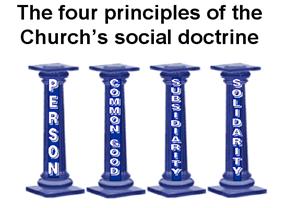 Four
basic principles
Four
basic principles
The social doctrine of the Church can be summarized in
four principles, or four “pillars”, upon which every system in society must be
founded. Paragraphs 160 and 161 of the Compendium of the Social Doctrine of the
Church state:
“The permanent principles of
the Church's social doctrine constitute the very heart of Catholic social teaching.
These are the principles of:
1.
The dignity of the human person, which is the foundation of all the
other principles and content of the Church's social doctrine;
2.
the common good;
3.
subsidiarity;
4.
solidarity.
These are principles of a general and fundamental
character, since they concern the reality of society in its entirety… Because
of their permanence in time and their universality of meaning, the Church
presents them as the primary and fundamental parameters of reference for
interpreting and evaluating social phenomena, which is the necessary source for
working out the criteria for the discernement and
orientation of social interactions in every area.”
Primacy of the human person
The social doctrine of the Church can be summarized in
this basic principle: the primacy of the human person:
“The Church's teaching on social matters has truth as
its guide, justice as its end, and love as its driving force... The cardinal
point of this teaching is that individual men are necessarily the foundation,
cause, and end of all social institutions.” (John XXIII, Encyclical Letter Mater et Magistra,
May 15, 1961, nn. 219 and 226.)
The
Compendium states: “The Church sees in men and women, in every person, the
living image of God Himself. This image finds, and must always find anew, an
ever deeper and fuller unfolding of itself in the mystery of Christ, the
Perfect Image of God, the One who reveals God to man and man to himself.” (105)
“All of social life is an expression of its
unmistakable protagonist: the human person: ‘The human person is, and must
always remain, the subject, foundation and goal of social life.’” (Pius XII,
Radio Message of December 24, 1944.) (106)
“A just society can become a reality only when it is based
on the respect of the transcendent dignity of the human person. The person
represents the ultimate end of society, by which it is ordered to the person:
‘Hence, the social order and its development must invariably work to the
benefit of the human person, since the order of things is to be subordinate to
the order of persons, and not the other way around.’” (Vatican II, Pastoral
Constitution Gaudium et Spes,
26.)
“Respect for human dignity can in no way be separated
from obedience to this principle. It is necessary to ‘consider every neighbour
without exception as another self, taking into account first of all his life
and the means necessary for living it with dignity.’ Every political, economic,
social, scientific and cultural programme must be inspired by the awareness of
the primacy of each human being over society.” (132)
Systems at the service of man
Social Credit shares the same philosophy. Clifford
Hugh Douglas wrote in the first chapter of his first book, Economic Democracy:
 “Systems are made
for men, and not men for systems, and the interest of man, which is
self-development, is above all systems.”
“Systems are made
for men, and not men for systems, and the interest of man, which is
self-development, is above all systems.”
In his first Encyclical Letter Redemptor
Hominis (The Redeemer of Man, March 4, 1979), Pope
John Paul II spoke of “the indispensable transformations of the structures
of economic life of poverty amidst plenty that brings into question the
financial and monetary mechanisms… (n. 15). Man cannot relinquish himself or
the place in the visible world that belongs to him; he cannot become the slave
of things, the slave of economic systems, the slave of production, the slave of
his own products.” (n .16)
All systems must be at the service of man, including
the financial and economic systems:
“Again, I want to tackle a very delicate and
painful issue. I mean the torment of the representatives of several countries,
who no longer know how to face the fearful problem of indebtedness. A
structural reform of the world financial system is, without doubt, one of the
initiatives that seem the most urgent and necessary.” (Message of the Holy
Father to the 6th United Nations Conference on Trade and Development, Geneva,
September 26, 1985.)
“As a democratic society, see carefully to all that is
happening in this powerful world of money! The world of finance is also a human
world, our world, submitted to the conscience of all of us; for it too exist
ethical principles. So see especially to it that you may bring a contribution
to world peace with your economy and your banks and not a contribution —
perhaps in an indirect way — to war and injustice!” (John Paul II, homily at Flueli, Switzerland,
June 14, 1984.)
In his encyclical letter Centesimus
Annus (issued in 1991 for the 100th
Anniversary of Leo XIII’s encyclical Rerum Novarum),
Pope John Paul II drew a list of the basic human rights (n. 47):
“The right to life, an integral part of which is the right of the child
to develop in the mother's womb from the moment of conception; the right to
live in a united family and in a moral environment conducive to the growth of
the child's personality; the right to develop one's intelligence and freedom in
seeking and knowing the truth; the right to share in the work which makes wise
use of the earth's material resources, and to derive from that work the means
to support oneself and one's dependents; and the right freely to establish a
family, to have and to rear children through the responsible exercise of one's
sexuality. In a certain sense, the source and synthesis of these rights is
religious freedom, understood as the right to live in the truth of one's faith
and in conformity with one's transcendent dignity as a person.”
No to Communism
The social doctrine of the Church stands above
existing economic systems, since it confines itself to the level of principles.
An economic system is good or not to the extent it applies these principles of
justice taught by the Church. For example, Pope John Paul II wrote in his
encyclical letter Sollicitudo Rei Socialis, in 1987: “The
tension between East and West is an opposition... between two concepts of the
development of individuals and peoples, both concepts being imperfect and in
need of radical correction... This is one of the reasons why the Church's
social doctrine adopts a critical attitude towards both liberal capitalism and
Marxist collectivism.”
 We may understand why the Church condemns Communism,
or Marxist collectivism, which, as Pope Pius XI wrote, is “intrinsically evil”
and anti-Christian, since its avowed goal is the complete destruction of
private property, the family and religion. But why would the Church condemn
capitalism? Would capitalism and Communism be two of a kind?
We may understand why the Church condemns Communism,
or Marxist collectivism, which, as Pope Pius XI wrote, is “intrinsically evil”
and anti-Christian, since its avowed goal is the complete destruction of
private property, the family and religion. But why would the Church condemn
capitalism? Would capitalism and Communism be two of a kind?
In the second chapter of his encyclical Centesium Annus, John
Paul II recalls the different events that have taken place in the world since
Leo XIII’s Rerum Novarum up to the present times, including the two
world wars and the establishment of Communism in Eastern Europe, and he
indicates how Leo XIII was right to denounce socialism which, far from solving
the social question, would turn out to be a huge failure, causing millions of
innocent victims to suffer:
 “Pope Leo foresaw the negative consequences — political,
social and economic — of the social order proposed by ‘socialism’… One must
emphasize here the clarity in recognizing the evil of a solution which, by
appearing to reverse the positions of the poor and the rich, was in reality
detrimental to the very people whom it was meant to help. The remedy would
prove worse than the sickness. By defining the nature of the socialism of his
day as the suppression of private property, Leo XIII arrived at the crux of the
problem.”
“Pope Leo foresaw the negative consequences — political,
social and economic — of the social order proposed by ‘socialism’… One must
emphasize here the clarity in recognizing the evil of a solution which, by
appearing to reverse the positions of the poor and the rich, was in reality
detrimental to the very people whom it was meant to help. The remedy would
prove worse than the sickness. By defining the nature of the socialism of his
day as the suppression of private property, Leo XIII arrived at the crux of the
problem.”
The fundamental error of socialism, said John Paul II,
is atheism, for by denying the existence of God, of a superior being who
created man, one also denies the existence of all moral law, all dignity and
rights of the human person; this leads to dictatorships, where the State
decides what is good for the individual, or to social disorder and anarchy,
where each individual makes up his own conception of good and evil.
Capitalism must be corrected
Even if Marxism has collapsed, this does not mean the triumph
of capitalism, for even after the fall of Communism, there are still millions
of poor people and situations of injustice in the world:
“The Marxist solution has failed, but the realities of
marginalization and exploitation remain in the world, especially the Third
World, as does the reality of human alienation, especially in the more advanced
countries. Against these phenomena the Church strongly raises her voice. Vast
multitudes are still living in conditions of great material and moral poverty. The
collapse of the Communist system in so many countries certainly removes an
obstacle to facing these problems in an appropriate and realistic way, but it
is not enough to bring about their solution. Indeed, there is a risk that a
radical capitalistic ideology could spread which refuses even to consider these
problems, in the a priori belief that any attempt to solve them is doomed to
failure, and which blindly entrusts their solution to the free development of
market forces.” (Centesium
Annus, 42.)
In
Centesimus Annus,
John Paul II recognizes the merits of
free enterprise, private initiative and profit: “It would appear that, on
the level of individual nations and of international relations, the free market
is the most efficient instrument for utilizing resources and effectively
responding to needs. But this is true only for those needs which are ‘solvent’,
insofar as they are endowed with purchasing power, and for those resources
which are ‘marketable’, insofar as they are capable of obtaining a satisfactory
price. But there are many human needs which find no place on the market. It is
a strict duty of justice and truth not to allow fundamental human needs to
remain unsatisfied, and not to allow those burdened by such needs to perish.”
(n. 34.)
The
fault that the Church finds with present capitalism is therefore neither
private property nor free enterprise. On the contrary, far from wishing the
disappearance of private property, the Church rather wishes its most widespread
availability to all, so that all may become real owners of a capital, and be
real “capitalists”:
“The dignity of the human person necessarily requires
the right of using external goods in order to live according to the right norm
of nature. And to this right corresponds a most serious obligation, which
requires that, so far as possible, there be given to all an opportunity of
possessing private property... Therefore, it is necessary to modify economic
and social life so that the way is made easier for widespread private
possession of such things as durable goods, homes, gardens, tools requisite for
artisan enterprises and family-type farms, investments in enterprises of medium
or large size.” (John XXIII, Encyclical
Letter Mater et Magistra, May 15, 1961, nn. 114-115.)
Social Credit, with its dividend to every individual,
would acknowledge every human being as a capitalist, co-heir of the natural
resources and progress (human inventions, technology).
Capitalism has been vitiated by
the financial system
The fault that the Church finds with the capitalist
system is that not each and every human being living on the planet has access
to a minimum of material goods, allowing a decent life, and that even in the
most advanced countries, there are thousands of people who do not eat their
fill. It is the principle of the destination of human goods that is not
fulfilled: there is plenty of production, it is the distribution that is
defective.
And in the present system, the instrument that makes
possible the distribution of goods and services, the symbol that allows people
to get products, is money. It is therefore the money system, the financial
system that is at fault in capitalism.
The faults that the Church finds in the capitalist
system do not come from the nature of that system (private property, free
enterprise), but from the financial system it uses, a financial system that
dominates rather than serves, a system that vitiates capitalism. Pope Pius XI
wrote in Quadragesimo Anno,
in 1931: “Capitalism itself is not to be condemned. And surely it is not
vicious of its very nature, but it has been vitiated.”
What the Church condemns is not capitalism as a
producing system, but, according to the words of Pope Paul VI, “the calamitous
system that accompanies it,” the financial system:
“This unchecked liberalism led to dictatorship rightly
denounced by Pope Pius XI as producing `the international imperialism of
money'. One cannot condemn such abuses too strongly, because — let us again
recall solemnly — the economy should be at the service of man. But if it is
true that a type of capitalism has been the source of excessive suffering,
injustices and fratricidal conflicts whose effects still persist, it would be
wrong to attribute to industrialization itself evils that belong to the
calamitous system that accompanied it. On the contrary, one must recognize in
all justice the irreplaceable contribution made by the organization and the
growth of industry to the task of development.” (Paul VI, Encyclical Letter Populorum
Progressio, on the development of peoples, March
26, 1967, n. 26.)
The defect of the system: money is
created by the banks as a debt
It is the financial system that does not accomplish
its purpose; it has been diverted from its end (which is to makes goods meet
needs). Money should be nothing but an instrument of distribution, a symbol
that gives a claim, a right to the products, a simple accounting system.
Money should be a servant, an instrument of service,
but the bankers, in appropriating the control over its creation, have made it
an instrument of domination: since people cannot live without money, everyone —
governments, corporations, individuals — must submit to the conditions imposed
upon them by the bankers to obtain money, which is the right to live in today’s
society. This establishes a real dictatorship over economic life, the bankers
have become the masters of our lives. As Pope Pius XI rightly put it in Quadragesimo Anno
(n. 106):
“This power becomes particularly irresistible when
exercised by those who, because they hold and control money, are able also to
govern credit and determine its allotment, for that reason supplying, so to
speak, the lifeblood to the entire economic body, and grasping, as it were, in
their hands the very soul of production, so that no one dare breathe against
their will.”
There is no way any country can get out of debt in
the present system, since — as we have seen in previous lessons — all money is
created as a debt: all the money that exists comes into circulation only when
it is lent by the banks, at interest. And when the loan is paid back to the
bank (this money being withdrawn from circulation), it ceases to exist. In
other words, new money is created every time banks make a loan, and this same
money is destroyed every time loans are paid back.
The fundamental flaw in this system is that when banks
create new money in the form of loans, they ask the borrowers to pay back more
money than what was created. (The banks create the principal, but not the
interest.) Since it is impossible to pay back money that does not exist, debts
must pile up, or you must borrow also the amount to pay the interest, which
does not solve your problem, but only worsens it, since you end up even deeper
in debt.
This creation of money as a debt by the bankers is the
means of imposing their will upon individuals, and of controlling the world:
“Among the actions and attitudes opposed to the will
of God, the good of neighbour and the ‘structures’ created by them, two are
very typical: on the one hand, the all-consuming desire for profit, and on the
other, the thirst for power, with the intention of imposing one's will upon
others.” (John Paul II, Encyclical
Letter Sollicitudo rei
socialis, n. 37.)
Since money is an instrument that is basically social,
the Social Credit doctrine proposes that money be issued by society, and not by
private bankers for their own profit:
“There are certain categories of goods for which one
can maintain with reason that they must be reserved to the community when they
come to confer such an economic power that it cannot, without danger to the
common good, be left to the care of private individuals.” (Pius XI, Quadragesimo
Anno.)
The effect of compound interest
Institutions like the International Monetary Fund and
the World Bank pretend to help countries in financial difficulties with their
loans, but because of the interest charges (compound interest) they have to pay
back, these countries end up even poorer than they were before the loans were
made. Here are some striking examples:
During the period 1980-1990, Latin American countries
paid $418 billion in interest on original loans of $80 billion... and they
still owed the capital, even though they paid it back more than five times! In
Canada, things are even worse: 93% of the national debt of $562 billion (in 2003)
was made up of interest charges: the original capital borrowed ($39 billion)
represents only 7% of the debt. The remaining $523 billion covers what it has
cost to borrow that $39 billion!
According to the Jubilee 2000 Coalition, for every
dollar flowing as aid to poor countries each year, $8 are sent back in debt
payments.
It is examples like these that brought Saint Leo to
write: “The avarice that claims to do its neighbour a good turn while it deceives
him is unjust and insolent... He who, among the other rules of a pious conduct,
will not have lent his money at usury, will enjoy eternal rest... whereas he
who gets richer to the detriment of others deserves, in return, eternal
damnation.” Saint John Chrysostom also wrote:
“Nothing is more shameful nor cruel than usury.”
Debts must be cancelled
Any sensible person will realize that it is criminal
to require nations to continue to pay interest on debts that have already been
paid several times. We can see now why the Church condemns usury (the loaning
of money at interest), and calls for the cancellation of debts. When you
understand that the money lent by banks is literally created out of nothing,
with a simple stroke of the pen (or entering digits in computers), then it is
easy to understand that debts can be cancelled, written off, forgiven, without
anyone being penalized.
On December 27, 1986, the Pontifical Justice and Peace
Commission issued a document entitled An Ethical Approach to the International
Debt Question. Here are some excerpts:
“Debtor countries, in fact, find themselves caught in
a vicious circle. In order to pay back their debts, they are obliged to
transfer ever greater amounts of money outside the country. These are resources
which should have been available for internal purposes and investment and
therefore for their own development.
“Debt servicing cannot be met at the price of the
asphyxiation of a country's economy, and no government can morally demand of
its people privations incompatible with human dignity... With the Gospel as the
source of inspiration, other types of action could also be contemplated such as
granting extensions, partial or even total remission of debts... In certain
cases, the creditor States could convert the loans into grants.
“The Church restates the priority to be granted to
people and their needs, above and beyond the constraints and financial
mechanisms often advanced as the only imperatives.”
Pope John Paul II wrote in his encyclical letter Centesimus Annus
(n. 35.): “The principle that debts must be paid is certainly just. (Note
of Michael: to pay the capital is just, but not to pay the interest.) It
is not right to demand or expect payment when the effect would be the imposition
of political choices leading to hunger and despair for entire peoples. It
cannot be expected that the debts which have been contracted should be paid at
the price of unbearable sacrifices. In such cases it is necessary to find — as
in fact is partly happening — ways to lighten, defer, or even cancel the debt,
compatible with the fundamental right of peoples to subsistence and progress.”
In preparation for the Great Jubilee of the Year
2000, Pope John Paul II mentioned several times the need to cancel all debts.
Here are excerpts from his weekly audience of November 3, 1999:
“In the jubilee years of Old Testament times, people
recovered family property lost through payment of debt, and those who had lost
their freedom through debt, were freed. This was because the land belonged to
God, who gave it to the whole community to use for its own benefit.
“The jubilee reminds us of the demands of the common
good and of the fact that the world’s resources are meant for everyone. It is
thus an appropriate time to give thought to reducing substantially, if not
cancelling outright, the international debt which seriously threatens the
future of many nations.”
Once debts are written off, the only way to stop debts
building up again, and allow nations to make a fresh start, is for each nation
to create its own debt-free and interest-free money, and stop borrowing at
interest from commercial banks and international institutions, like the
International Monetary Fund and the World Bank. If you leave to private bankers
the power to create money, debts will build up again. This reminds us of the
words of Sir Josiah Stamp, former head of the Bank of England:
“Banking was conceived in iniquity and born in
sin... Bankers own the earth. Take it away from them, but leave them the power
to create money, and, with a flick of a pen, they will create enough money to
buy it back again... Take this great power away from them, and all great
fortunes like mine will disappear, and they ought to disappear, for then this
would be a better and happier world to live in... But, if you want to continue
to be the slaves of the bankers and pay the cost of your own slavery, then let
bankers continue to create money and control credit.”
For those who do not understand how money is created
by banks, the only way a debt can be cancelled is to have someone, somewhere,
pay it back. But we, of the “Michael” Journal, know better. When we say
“cancel” the debt, we actually mean it: erase it! We do not ask anyone to pay
it, and above all, we certainly do not ask the Government to “print money” to
pay the debt.
What we propose is for the Government to stop
borrowing at interest money that it could create itself, interest free; this is
the only solution that goes to the root of the problem, and which solves it
once and for all. It would finally put money at the service of the human
person.

LESSON 10 — Social Credit and the
social doctrine of the Church (Part II)
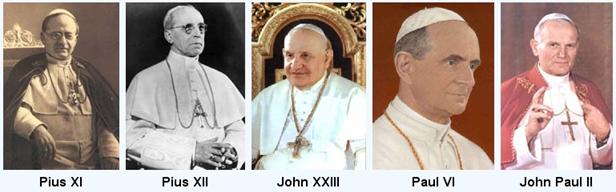
In
the previous lesson, we have developed the first of the four basic principles
of the social doctrine of the church, the primacy of the human person, which
means that all systems exist to serve the human person.
Therefore,
the aim of the economic and financial systems is also, according to the Church,
the service of man. The aim of the economic system is the satisfaction of human
needs, the production of the goods which man needs (the role of the producing
system), and the distribution of these goods so that they may reach the people
who need them (this is the role of the financial system). Social Credit
proposes a technique that would make the producing and financial systems serve
their purpose.
Pope Pius XI, in his Encyclical Quadragesimo
Anno, defined the aim of an economic system:
“For then only will the economic and social organism
be soundly established and attain its end, when it secures for all and each
those goods which the wealth and resources of nature, technical achievement,
and the social organization of economic affairs can give.
“These goods must be sufficient to supply all needs
and an honest livelihood, and to uplift men to that higher level of prosperity
and culture which, provided it be used with prudence, is not only no hindrance
but is of singular help to virtue.” (n. 75)
Now, let us develop the three other principles
mentioned in the Compendium of the social doctrine of the Church: the
common good, subsidiarity, and solidarity.
The common good
164. The principle of the common good, to which every
aspect of social life must be related if it is to attain its fullest meaning,
stems from the dignity, unity and equality of all people. According to its
primary and broadly accepted sense, the common good indicates “the sum total
of social conditions which allow people, either as groups or as individuals, to
reach their fulfilment more fully and more easily.” (Gaudium
et Spes, 26.)
167. The common good therefore involves all members of
society; no one is exempt from cooperating, according to each one's
possibilities, in attaining it and developing it. Everyone also has the right
to enjoy the conditions of social life that are brought about by the quest for
the common good. The teaching of Pope Pius XI is still relevant: “The
distribution of created goods, which, as every discerning person knows, is
labouring today under the gravest evils due to the huge disparity between the
few exceedingly rich and the unnumbered propertyless,
must be effectively called back to, and brought into conformity with, the norms
of the common good, that is, social justice.” (Encyclical Letter Quadragesimo Anno,
197.)
Tasks of the political community
168. The responsibility for attaining the common
good, besides falling to individual persons, belongs also to the State, since
the common good is the reason that the political authority exists. (Cf. Catechism
of the Catholic Church, n. 1910.) The State, in fact, must guarantee the
coherency, unity and organization of the civil society of which it is an
expression, in order that the common good may be attained with the contribution
of every citizen. The individual person, the family or intermediate groups are
not able to achieve their full development by themselves for living a truly
human life. Hence the necessity of political institutions, the purpose of which
is to make available to persons the necessary material, cultural, moral and
spiritual goods. The goal of life in society is in fact the historically
attainable common good.
170. The common good of society is not an end in itself; it has value
only in reference to attaining the ultimate ends of the person and the
universal common good of the whole of creation. God is the ultimate end of His
creatures, and for no reason may the common good be deprived of its
transcendent dimension, which moves beyond the historical dimension while at
the same time fulfilling it.
The universal destination of goods
171. Among the numerous implications of the common
good, immediate significance is taken on by the principle of the universal
destination of goods: “God destined the earth and all it contains for all men
and all peoples so that all created things would be shared fairly by all
mankind under the guidance of justice tempered by charity.” (Gaudium et Spes,
69.) This principle is based on the fact that “the original source of all that
is good is the very act of God, who created both the earth and man, and who
gave the earth to man so that he might have dominion over it by his work and
enjoy its fruits (Gen 1:28-29).
God gave the earth to the whole human race for the
sustenance of all its members, without excluding or favouring anyone. This is
the foundation of the universal destination of the earth's goods. The earth, by reason of its fruitfulness and its
capacity to satisfy human needs, is God's first gift for the sustenance of
human life.” (John Paul II, Centesimus Annus, 31.) The human person cannot do without the
material goods that correspond to his primary needs and constitute the basic
conditions for his existence; these goods are absolutely indispensable if he is
to feed himself, grow, communicate, associate with others, and attain the
highest purposes to which he is called. (Cf. Pius XI, Radio Message of June 1,
1941.)
172. The universal right to use the goods of the earth
is based on the principle of the universal destination of goods. Each person
must have access to the level of well-being necessary for his full development.
The right to the common use of goods is the “first principle of the whole
ethical and social order” and “the characteristic principle of Christian social
doctrine.” (John Paul II, Encyclical Letter Sollicitudo
Rei Socialis, 42.)
For this reason the Church feels bound in duty to
specify the nature and characteristics of this principle. It is first of all a
natural right, inscribed in human nature, and not merely a positive right
connected with changing historical circumstances; moreover it is an “inherent”
right. It is innate in individual persons, and has priority with regard to any
human intervention concerning goods, to any legal system concerning the same,
to any economic or social system or method: “All other rights, whatever they
are, including property rights and the right of free trade, must be subordinated
to this norm [the universal destination of goods]; they must not hinder it, but
must rather expedite its application. It must be considered a serious and
urgent social obligation to refer these rights to their original purpose.”
(Paul VI, Encyclical Letter Populorum Progressio, 22.)
Private property
176. By means of work and making use of the gift of
intelligence, people are able to exercise dominion over the earth and make it a
fitting home: “In this way, he makes part of the earth his own, precisely the
part which he has acquired through work; this is the origin of individual
property.” (John Paul II, Centesimus Annus, 31.)
Private property and other forms of private ownership
of goods “assure a person a highly necessary sphere for the exercise of his
personal and family autonomy, and ought to be considered as an extension of
human freedom... stimulating exercise of responsibility, it constitutes one of
the conditions for civil liberty.” (Gaudium
et Spes, 71.) Private property is an essential
element of an authentically social and democratic economic policy, and it is
the guarantee of a correct social order. The Church's social doctrine requires
that ownership of goods be equally accessible to all, so that all may become,
at least in some measure, owners, and it excludes recourse to forms of “common
and promiscuous dominion.” (Leo XIII, Rerum
Novarum, 11.)
The heritage of progress
179. The present historical period has placed at the
disposal of society new goods that were completely unknown until recent times.
This calls for a fresh reading of the principle of the universal destination of
the goods, the earth, and makes it necessary to extend this principle so that
it includes the latest developments brought about by economic and technological
progress. The ownership of these new goods — the results of knowledge,
technology and know-how — becomes ever more decisive, because “the wealth of
the industrialized nations is based much more on this kind of ownership than on
natural resources.” (John
Paul II, Centesimus Annus,
32.)
New technological and scientific knowledge must be
placed at the service of mankind's primary needs, gradually increasing
humanity's common patrimony. Putting the principle of the universal destination
of goods into full effect therefore requires action at the international level
and planned programmes on the part of all countries. “It is necessary to break
down the barriers and monopolies which leave so many countries on the margins
of development, and to provide all individuals and nations with the basic
conditions which will enable them to share in development.”
It would be possible for everyone
to be a real “capitalist” and to have access to earthly goods with the Social
Credit dividend. As stated in previous lessons, this dividend is based on two
things: the inheritance of natural resources, and the inventions from past
generations. This is exactly what is said by Pope John Paul II in his
Encyclical letter Laborem Exercens on Human Work (n. 13):
“Through his work man enters into two inheritances:
the inheritance of what is given to the whole of humanity in the resources of
nature, and the inheritance of what others have already developed on the basis
of those resources, primarily by developing technology, that is to say, by
producing a whole collection of increasingly perfect instruments for work. In
working, man also “enters into the labor of others”.
Poverty amidst plenty
God put on earth all that is needed to feed everyone.
But because of the lack of money, goods cannot meet the hungry; mountains of
goods pile up in front of millions of starving people. It is the paradox of
poverty amidst plenty:
“It is a cruel paradox that many of you who could be
engaged in the production of food are in financial distress here, while at the same
time hunger, chronic malnutrition and the threat of starvation afflict millions
of people elsewhere in the world.”
(John Paul II to the fishermen of St. John's, Newfoundland, Sept. 12, 1984.)
“No more hunger, hunger never again! Ladies and
gentlemen, this objective can be achieved. The threat of starvation and the
weight of malnutrition are not an inescapable fate. Nature is not, in this
crisis, unfaithful to man. According to a generally accepted opinion, while 50%
of cultivable land is not yet developed, a great scandal catches the eye from
the huge amount of surplus food that certain countries periodically destroy for
lack of a sound economy which could have ensured a useful consumption of this
food.
“Here we are broaching the paradox
of the present situation: Mankind has an incomparable control over the
universe; it possesses instruments capable of exploiting its natural resources
at full capacity. Will the owners of these instruments remain paralyzed and
stuck in front of the absurdity of a situation where the wealth of the few
tolerates the persistent extreme poverty of the many?... We cannot arrive at
such a situation without having committed serious errors of orientation, be it
sometimes through negligence or omission; it is high time we discovered how the
mechanisms are defective, in order to correct, put the whole situation right.”
(Paul VI at the World Conference of Food, Rome, Nov. 9, 1974.)
“It is obvious that a fundamental defect, or rather a
series of defects, indeed a defective machinery is at the root of contemporary
economics and materialistic civilization, which does not allow the human family
to break free from such radically unjust situations.” (John Paul II, Encyclical Dives in Misericordia on Divine Mercy, November 30, 1980, n. 11.)
“So widespread is this phenomenon (poverty amidst
plenty) that it brings into question the financial, monetary, production and
commercial mechanisms that, resting on various political pressures, support the
world economy. These are proving incapable either of remedying the unjust
social conditions inherited from the past or of dealing with the urgent
challenges and ethical demands of the present... We have before us here a great
drama that can leave nobody indifferent.” (John Paul II, Encyclical Redemptor
Hominis, n. 16.)
Reforming the financial system
The Popes denounce the tight-money dictatorship, and
call for a reform of the financial and economic systems, the establishment of
an economic system at the service of man:
“One must denounce the existence of economic,
financial and social mechanisms which, although they are manipulated by people,
often function almost automatically, thus accentuating the situation of wealth
for some and poverty for the rest.” (John Paul II, Sollicitudo Rei Socialis, n. 16.)
“I appeal to those in positions of responsibility, and
to all involved, to work together to find appropriate solutions to the problems
at hand, including a restructuring of the economy, so that human needs be put
before mere financial gain.” (John
Paul II to the fishermen of St. John's, Newfoundland, Sept. 12, 1984.)
“An essential condition is to provide the economy with
a human meaning and logic. It is necessary to free the various fields of
existence from the dominion of subjugating economism.
Economic requirements must be put in their right place and a multiform social
fabric must be created, which will prevent standardization. No one is dispensed
from collaborating in this task... Christians, wherever you are, assume your
share of responsibility in this immense effort for the human restructuring of
the city. Faith makes it a duty for you.” (John Paul II to the workers of Sao Paulo, Brazil, June 3, 1980.)
The principle of subsidiarity
This leads to one of the most interesting principles
of the social doctrine of the Church, subsidiarity:
higher levels of government must not do what families and lesser associations,
closer to the individual, can do. This is the opposite of centralization (and
of world government): Governments exist to help families and lesser
organizations, and not to destroy or absorb them. The Compendium of the
Social Doctrine of the Church states:
185. Subsidiarity is among
the most constant and characteristic directives of the Church's social
doctrine, and has been present since the first great social encyclical. (Cf.
Leo XIII, Encyclical Letter Rerum Novarum, 11.) It is impossible to promote the dignity
of the person without showing concern for the family, groups, associations,
local territorial realities; in short, for that aggregate of economic, social,
cultural, sports-oriented, recreational, professional and political expressions
to which people spontaneously give life and which make it possible for them to
achieve effective social growth.
This is the realm of civil society, understood as the
sum of the relationships between individuals and intermediate social groupings,
which are the first relationships to arise and which come about thanks to
"the creative subjectivity of the citizen." This network of relationships
strengthens the social fabric and constitutes the basis of a true community of
persons, making possible the recognition of higher forms of social activity.
186. The necessity of defending and promoting the
original expressions of social life is emphasized by the Church in the
Encyclical Quadragesimo Anno,
in which the principle of subsidiarity is indicated
as a most important principle of “social philosophy”. “Just as it is gravely
wrong to take from individuals what they can accomplish by their own initiative
and industry and give it to the community, so also it is an injustice, and at
the same time a grave evil and disturbance of right order, to assign to a
greater and higher association what lesser and subordinate organizations can
do. For every social activity ought of its very nature to furnish help to the
members of the social body, and never destroy and absorb them.”
On the basis of this principle, all societies of a
superior order must adopt attitudes of help (“subsidium”)
— therefore of support, promotion, development — with respect to lower-order
societies. In this way, intermediate social entities can properly perform the
functions that fall to them without being required to hand them over unjustly
to other social entities of a higher level, by which they would end up being
absorbed and substituted, in the end seeing themselves denied their dignity and
essential place.
Subsidiarity, understood in the positive sense as economic,
institutional or juridical assistance offered to lesser social entities, entails
a corresponding series of negative implications that require the State to
refrain from anything that would de facto restrict the existential space of the
smaller essential cells of society. Their initiative, freedom and
responsibility must not be supplanted.

 187. The principle of subsidiarity
protects people from abuses by higher-level social authority, and calls on
these same authorities to help individuals and intermediate groups to fulfil
their duties. This principle is imperative because every person, family and
intermediate group has something original to offer to the community. Experience
shows that the denial of subsidiarity, or its
limitation in the name of an alleged democratization or equality of all members
of society, limits and sometimes even destroys the spirit of freedom and
initiative. The principle of subsidiarity is opposed
to certain forms of centralization, bureaucratization, and welfare assistance,
and to the unjustified and excessive presence of the State in public
mechanisms.
187. The principle of subsidiarity
protects people from abuses by higher-level social authority, and calls on
these same authorities to help individuals and intermediate groups to fulfil
their duties. This principle is imperative because every person, family and
intermediate group has something original to offer to the community. Experience
shows that the denial of subsidiarity, or its
limitation in the name of an alleged democratization or equality of all members
of society, limits and sometimes even destroys the spirit of freedom and
initiative. The principle of subsidiarity is opposed
to certain forms of centralization, bureaucratization, and welfare assistance,
and to the unjustified and excessive presence of the State in public
mechanisms.
The “Welfare State”
As Louis Even wrote: “Because Caesar (the State)
does not correct the financial system that only he can correct, Caesar then
goes beyond his proper role and accumulates new functions, using them as a
pretext for levying new taxes — sometimes ruinous ones — on citizens and
families. Caesar thus becomes the tool of a financial dictatorship that he
should destroy, and the oppressor of citizens and families that he should
protect.”
These new functions create a burdensome bureaucracy
that harasses people instead of helping them. Pope John Paul II wrote in his
Encyclical Letter Centesimus Annus (n. 48):
“In recent years the range of such
intervention (of the State) has vastly expanded, to the point of creating a new
type of State, the so-called `Welfare State'. This has happened in some
countries in order to respond better to many needs and demands, by remedying
forms of poverty and deprivation unworthy of the human person. However, excesses
and abuses, especially in recent years, have provoked very harsh criticisms of
the Welfare State, dubbed the `Social Assistance State'. Malfunctions and
defects in the Social Assistance State are the result of an inadequate
understanding of the tasks proper to the State. Here again the principle of subsidiarity must be respected: a community of a higher
order should not interfere in the internal life of a community of a lower
order, depriving the latter of its functions, but rather should support it in
case of need and help to coordinate its activity with the activities of the
rest of society, always with a view to the common good.
“By intervening directly and depriving society of its
responsibility, the Social Assistance State leads to a loss of human energies
and an inordinate increase of public agencies, which are dominated more by
bureaucratic ways of thinking than by concern for serving their clients, and
which are accompanied by an enormous increase in spending.”
Most of the taxes today are unjust and useless, and
could be eliminated in a Social Credit system. One thing that has no reason for
existing is debt service — the interest charges the nation has to pay every
year on its national debt, to borrow at interest from private bankers money that
the State could create itself, interest free.
The Compendium of the social doctrine of the Church
continues (n. 187):
In order for the principle of subsidiarity
to be put into practice, there is a corresponding need for: respect and
effective promotion of the human person and the family; ever greater
appreciation of associations and intermediate organizations in their
fundamental choices and in those that cannot be delegated to or exercised by
others; the encouragement of private initiative so that every social entity
remains at the service of the common good, each with its own distinctive
characteristics; the presence of pluralism in society and due representation of
its vital components; safeguarding human rights and the rights of minorities;
bringing about bureaucratic and administrative decentralization; striking a
balance between the public and private spheres, with the resulting recognition
of the social function of the private sphere; appropriate methods for making
citizens more responsible in actively “being a part” of the political and
social reality of their country.
188. Various circumstances may make it advisable that
the State step in to supply certain functions. One may think, for example, of
situations in which it is necessary for the State itself to stimulate the
economy because it is impossible for civil society to support initiatives on
its own. One may also envision the reality of serious social imbalance or
injustice where only the intervention of the public authority can create
conditions of greater equality, justice and peace.
As we have seen in previous lessons, to correct the
financial system is certainly one of the duties of the State, that is to say,
money be issued by society, and not by private bankers for their own profit. As
Pope Pius XI wrote in his Encyclical Quadragesimo
Anno:
“There are certain categories of goods for which one
can maintain with reason that they must be reserved to the community when they
come to confer such an economic power that it cannot, without danger to the
common good, be left to the care of private individuals.”
Families first
This same principle of subsidiarity
means that families, the first cell of society, come first, before the State,
and that governments must not destroy families and the authority of parents. As
the Church states, children belong to their parents, and not to the State:
“Hence we have the family, the `society' of a man's
house — a society very small, one must admit, but none the less a true society,
and one older than any State. Consequently, it has rights and duties peculiar
to itself which are quite independent of the State...
“The contention, then, that the civil government
should at its option intrude into and exercise intimate control over the family
and the household is a great and pernicious error... Paternal authority can be
neither abolished nor absorbed by the State... The socialists, therefore, in
setting aside the parent and setting up a State supervision, act against
natural justice, and destroy the structure of the home.” (Leo XIII, Rerum Novarum, nn. 12-14.)
A salary to housewives
As a matter of fact, in its social doctrine, the
Church also stresses the importance of recognizing the work of the mothers in
the home, by giving them an income. This would be perfectly accomplished by the
Social Credit dividend:
“Experience confirms that there must be a social
re-evaluation of the mother's role, of the toil connected with it, and of the
need that children have for care, love and affection in order that they may
develop into responsible, morally and religiously mature and psychologically
stable persons. It will redound to the credit of society to make it possible
for a mother — without inhibiting her freedom, without psychological or
practical discrimination, and without penalizing her as compared with other
women — to devote herself to taking care of her children and educating them in
accordance with their needs, which vary with age. Having to abandon these tasks
in order to take up paid work outside the home is wrong from the point of view
of the good of society and of the family when it contradicts or hinders these
primary goals of the mission of a mother.” (John Paul II, Encyclical Laborem Exercens, n. 19.)
“It is an intolerable abuse, and
to be abolished at all cost, for mothers on account of the father's low wage to
be forced to engage in gainful occupations outside the home to the neglect of
their proper cares and duties, especially the training of children.”
(Pius XI, Encyclical Quadragesimo Anno, n. 71.)
In October, 1983, the Holy See issued the “Charter of
the Rights of the Family”, in which it called for “the remuneration of the
work in the home of one of the parents; it should be such that mothers will not
be obliged to work outside the home to the detriment of family life and
especially of the education of the children. The work of the mother in the home
must be recognized and respected because of its value for the family and for
society.” (Article 10.)
The principle of solidarity
Solidarity is
another word for the love of neighbour. As Christians, we must care about the
fate of all our brothers and sisters in Christ, for it is on this love of our
neighbour that we will be judged at the end of our lives on this earth:
It is by what
they have done for the poor that Jesus Christ will recognize His chosen ones...
the poor remain entrusted to us, and it is this responsibility upon which we
shall be judged at the end of time (cf. Mt 25:31-46): “Our Lord warns us that
we shall be separated from Him if we fail to meet the serious needs of the poor
and the little ones who are His brethren.” (Compendium of the social doctrine of the Church, n.
183)
The Compendium
continues:
192. Solidarity highlights in a particular way the
intrinsic social nature of the human person, the equality of all in dignity and
rights, and the common path of individuals and peoples towards an ever
committed unity. Never before has there been such a widespread awareness of the
bond of interdependence between individuals and peoples, which is found at
every level. The very rapid expansion in ways and means of communication “in
real time”, such as those offered by information technology, the extraordinary
advances in computer technology, the increased volume of commerce and
information exchange all bear witness to the fact that, for the first time
since the beginning of human history, it is now possible — at least technically
— to establish relationships between people who are separated by great
distances and are unknown to each other.
In
the presence of the phenomenon of interdependence and its constant expansion,
however, there persist in every part of the world stark inequalities between
developed and developing countries, inequalities stoked also by various forms
of exploitation, oppression and corruption that have a negative influence on
the internal and international life of many States. The acceleration of
interdependence between persons and peoples needs to be accompanied by equally
intense efforts on the ethical-social plane, in order to avoid the dangerous
consequences of perpetrating injustice on a global scale. This would have very
negative repercussions even in the very countries that are presently more
advantaged.
The duty of every Christian
It is therefore a duty and obligation for every
Christian to work for the establishment of justice and of a better economic
system:
“Anyone wishing to renounce the difficult yet noble
task of improving the lot of man in his totality, and of all people, with the excuse
that the struggle is difficult and that constant effort is required, or simply
because of the experience of defeat and the need to begin again, that person
would be betraying the will of God the Creator.” (John Paul II, Sollicitudo Rei Socialis, n. 30.)
“Such a task is not an impossible one. The principle
of solidarity, in a wide sense, must inspire the effective search for
appropriate institutions and mechanisms... This difficult road of the
indispensable transformations of the structures of economic life is one on
which it will not be easy to go forward without the intervention of a true
conversion of mind, will and heart. The task requires resolute commitments by
individuals and peoples that are free and linked in solidarity.” (John Paul II, Encyclical Redemptor
Hominis, n. 16.)
There are, of course, many ways to
help our brothers in need: feeding the hungry, giving drink to the thirsty,
sheltering the homeless, visiting the imprisoned and the sick, etc. Some will
send donations to charitable organizations, whether to help the poor of our
country or of the Third World. But if these donations can relieve a few poor
people for a few days or weeks, they nevertheless do not suppress the causes of
poverty.

 What is much better is to correct the problem at its
root, to attack the very causes of poverty, and to re-establish every human
being in his rights and dignity of a person created in the image of God, and
being entitled to a minimum of earthly goods:
What is much better is to correct the problem at its
root, to attack the very causes of poverty, and to re-establish every human
being in his rights and dignity of a person created in the image of God, and
being entitled to a minimum of earthly goods:
“More than any other, the individual who is animated
by true charity labors skillfully
to discover the causes of misery, to find the means to combat it, and to
overcome it resolutely. A creator of peace, he will follow his path, lighting
the lamps of joy and playing their brilliance and loveliness on the hearts of
men across the surface of the globe, leading them to recognize, across all
frontiers, the faces of their brothers, the faces of their friends.”” (Paul VI, encyclical Populorum
Progressio, n. 75.)
What is needed is apostles to educate the population
on the social doctrine of the Church, and practical solutions to apply it (like
the Social Credit financial proposals). Pope Paul VI wrote, also in Populorum Progressio
(n. 86):
“All of you who have heard the appeal of suffering
peoples, all of you who are working to answer their cries, you are the apostles
of a development which is good and genuine, which is not wealth that is
self-centered and sought for its own sake, but rather an economy which is put
at the service of man, the bread which is daily distributed to all, as a source
of brotherhood and a sign of providence.”
And in his encyclical Sollicitudo
Rei Socialis, Pope John Paul II wrote (n. 38.):
“These attitudes and ‘structures of sin’ (the thirst for money and power) are only conquered — presupposing the help of divine
grace — by a diametrically opposed attitude: a commitment to the good of one's
neighbour...”
Principles and implementation
Some will say that the Popes never publicly approved
Social Credit. In fact, the Popes will never approve officially any economic
system, since it is not part of their mission: they do not give technical
solutions, but only set up the principles upon which any economic system that
is truly at the service of the human person must be based. The Popes leave the
faithful free to apply the system that would implement these principles in the
best way.
To our knowledge, no other solution than Social Credit
would apply the social doctrine of the Church so perfectly. That is why Louis
Even, a great Catholic gifted with an extraordinary logical mind, did not
hesitate to bring out the links between Social Credit and the Church's social
doctrine.
Another one who was convinced that Social Credit is
applied Christianity, that it would apply wonderfully the Church's teachings on
social justice, is Father Peter Coffey, a Doctor in Philosophy and a professor
at Maynooth College, Ireland. He wrote the following
to a Canadian Jesuit, Father Richard, in March, 1932:
“The
difficulties raised by your questions can be met only by the reform of the
financial system of capitalism along the lines suggested by Major Douglas and
the Social Credit school of credit reform. It is the accepted financing system
that is at the root of the evils of capitalism. The accuracy of the analysis
carried out by Douglas has never been refuted. I believe that, with their
famous price-regulation formula, the Douglas reform proposals are the only
reform that will go to the root of the evil...”
A study by nine theologians
As soon as C. H. Douglas published his first writings
on Social Credit, the Financiers did everything they could to silence or
distort Douglas's doctrine, for they knew that Social Credit would put an end
to their control over the creation of money. When Louis Even began spreading
Social Credit in French Canada in 1935, one of the accusations peddled by the
Financiers was that Social Credit was Socialism, or Communism. But in 1939, the
Roman Catholic Bishops of the Province of Quebec appointed nine theologians to
examine the Social Credit system in the eyes of the social doctrine of the
Catholic Church, and give an opinion as to whether it was tainted with
Socialism or Communism. After considerable deliberation, the nine theologians
found that Social Credit was not tainted with Socialism nor Communism, that
there was nothing in the Social Credit doctrine contrary to the teachings of
the Church, and that any Catholic was free to support it without danger.
Here are excerpts from this study of the theologians
on the Social Credit monetary system:
1. The Commission first delimited the field of its
study.
(a) There is no question here of the economic or
political aspect, that is to say, of the value of this theory from the economic
viewpoint, and of the practical application of the Social Credit system in a
country. The members of the Commission recognize they do not have any
competence in these fields; besides, the Church does not have to pronounce
herself in favour or against matters “for which she has neither the equipment
nor the mission”, as Pope Pius XI wrote. (Cf. Encyclical Quadragesimo
Anno.)
(b) There is no question here either of approving this
doctrine on behalf of the Church, since the Church “has never, on the social
and economic field, presented any specific technical system, which besides is
not her role.” (Cf. Encyclical Divini Redemptoris, n. 34.)
(c) The only question studied here is the following:
Is the Social Credit doctrine, in its basic principles, tainted with the
Socialism and Communism condemned by the Catholic Church? And if so, should
this doctrine be regarded by Catholics as a doctrine that cannot be admitted
and spread?
(d) The State, as is mentioned in the present report,
is considered in abstracto, regardless of the
contingencies it may entail.
2. The Commission defines Socialism, and notes what
characterizes this doctrine in the light of Quadragesimo
Anno: materialism; class struggle; suppression of
private property; control of economic life by the State, in defiance of freedom
and personal initiative.
3. The Commission then worded in propositions the
basic principles of Social Credit.
“The aim of the Social Credit monetary doctrine is to
give to all and each member of society freedom and economic security which the
economic and social organism can secure. To that end, instead of reducing
production to the level of purchasing power through the destruction of goods or
restrictions on work, Social Credit wants to increase purchasing power to the
level of the productive capacity of goods.”
It proposes to that end:
I. The State must take back the control of the
issuance of money and credit. It will exercise it through an independent
commission possessing the authority required for this purpose.
II. The material resources of the nation, represented
by production, constitute the base of money and credit.
III. At any time, the issue of money and credit must
be based on the movement of production, in such a way that a sound balance is
constantly kept between production and consumption. This balance is ensured, at
least partly, through a discount, the rate of which would necessarily vary with
the fluctuations of production.
IV. The present economic system, thanks to the many
discoveries and inventions that favour it, produces an unexpected abundance of
goods, while at the same time reducing the need for human labour, therefore
creating permanent unemployment. An important part of the population is thus
deprived of any power to purchase goods made for it, and not only for a few
individuals or groups. So that all may have a share of the cultural inheritance
bequeathed by their forefathers, Social Credit proposes a dividend, of which
the amount is determined by the quantity of goods to be consumed. This dividend
will be given to every citizen, whether he has other sources of income or not.
4. Now, we must see if there is any taint of Socialism
in the propositions mentioned above.
Concerning Paragraph I: This proposition does not seem
to include any Socialist principle, nor consequently be contrary to the social
doctrine of the Church. This affirmation is based on the following passages of
the Encyclical Letter Quadragesimo Anno:
“There are certain categories of goods for which one
can maintain with reason that they must be reserved to the community when they
come to confer such an economic power that it cannot, without danger to the
common good, be left to the care of private individuals.”

 And the Encyclical goes on: “In the first place,
then, it is patent that in our days not alone is wealth accumulated, but
immense power and despotic economic domination is concentrated in the hands of
a few, and that those few are frequently not the owners, but only the trustees
and directors of invested funds, who administer them at their good pleasure.
And the Encyclical goes on: “In the first place,
then, it is patent that in our days not alone is wealth accumulated, but
immense power and despotic economic domination is concentrated in the hands of
a few, and that those few are frequently not the owners, but only the trustees
and directors of invested funds, who administer them at their good pleasure.
“This power becomes particularly irresistible when
exercised by those who, because they hold and control money, are able also to
govern credit and determine its allotment, for that reason supplying, so to
speak, the lifeblood to the entire economic body, and grasping, as it were, in
their hands the very soul of production, so that no one dare breathe against
their will.”
To want to change such a situation is therefore not
contrary to the social doctrine of the Church. It is true though that by
entrusting to the State the control of money and credit, the State is given
considerable influence over the economic life of the nation, an influence equal
to that presently exercised by the banks, for their own profit, but this way of
doing things does not entail, in itself, any Socialism.
Money being, in the Social Credit system, only a means
of exchange, of which the issuance is strictly regulated by the statistics of
production, private property therefore remains intact; moreover, the allotment
of money and credit could even perhaps be less determined by those who control
it. To reserve for the community (the control of) money and credit is therefore
not against the social doctrine of the Church.
Saint Thomas Aquinas says it implicitly, in his Summa
Theologica (Ethica,
Volume 5, Lesson 4), when he asserts that it belongs to distributive justice —
which, as is known, is the business of the State — to distribute common goods,
including money, to all those who are part of the civil community.
In fact, money and credit have been, in the past,
under the control of the State in several countries, including the Pontifical
States; and they are still so in the Vatican. So it would be difficult to see
in this proposition a Socialist principle.
Concerning Paragraph II: The fact that money and
credit are based on production, on national material resources, seems to entail
no Socialist character. The base of money is a purely conventional and
technical matter.
In the present discussion, this point is agreed to in
principle by several opponents.
Concerning Paragraph III: The principle of a balance
to be kept between production and consumption is sound. In a truly humane and
well-ordered economy, the aim of production is consumption, and the latter must
ordinarily use up the former — at least when production is made, as it should
be, to answer human needs.
As for the discount, of which the principle is
admitted and even currently practised in industry and trade, it is only a means
to realize this balance; it allows the consumers to get the goods they need at
a lower cost, without any loss for the producers.
Note that the Commission does not express an opinion
on the necessity of a discount caused by a gap which, according to the Social
Credit system, exists between production and consumption. But if such a gap
does exist, to want to fill it through a discount cannot be considered as a
measure tainted with Socialism.
Concerning Paragraph IV: The principle of the dividend
is also reconcilable with the social doctrine of the Church; besides, it can be
compared to the State's power to grant money. The Commission does not see why
it would be necessary for the State to own capital goods to pay this dividend;
presently — although in an opposite sense — the power to tax, which the State
possesses in view of the common good, entails this note even more so, and yet
it is admitted. The same affirmation applies to the Social Credit discount:
both are based on the principle of the discount in a cooperative system.
Besides, cooperation is held in high esteem in Social Credit.
The only control of production and consumption that is
necessary for the implementation of Social Credit is the control of statistics,
which determines the issue of money and credit. Statistics cannot be considered
as a real control or a constraint upon individual freedom; it is only a method
of collecting information. The Commission cannot admit that statistical control
requires the socialization of production, or that it is tainted with Socialism
or Communism.
The Commission therefore answers in the negative to
the question: “Is Social Credit tainted with Socialism?” The Commission cannot see
how the basic principles of the Social Credit system, as explained above, could
be condemned on behalf of the Church and of her social doctrine.
The Financiers were not pleased with this report of
the theologians, and in 1950, a group of businessmen asked a Bishop of
Quebec (Most Rev. Albertus
Martin of Nicolet) to go to Rome and get from Pope
Pius XII a condemnation of Social Credit. Once back to Quebec, this Bishop said
to the businessmen: “If you want to get a condemnation of Social Credit, it
is not to Rome that you must go. Pius XII said to me: ‘Social Credit would
create, in the world, a climate that would allow the blossoming of family and
Christianity’.”
We need Heaven’s help
In this fight for a just financial system based on
Christian principles, divine assistance is especially needed when we know that
the real aim of the Financiers is the establishment of a world government —
which includes the destruction of Christianity and of the family — and that the
promoters of this “New World Order” are actually led by Satan himself, whose
sole aim is the ruin of souls. Back in 1946, C.H.
Douglas wrote the following, in the Liverpool periodical The Social Crediter:
“We are engaged in a battle for Christianity. And it
is surprising to see in how many ways this is true in practice. One of these
ways goes almost unnoticed — except in its deviations — the emphasis put by the
Roman Catholic Church on the family, against the implacable and continuous
effort of the Communists and Socialists — who, together with the International
Financiers, form the true body of the Antichrist — to destroy the very idea of
the family and substitute the State for it.”
And Louis Even wrote on the same subject, in 1973:
“Yes, the Pilgrims of St. Michael are patriots, and
they wish, as much as anyone else, a regime of order and justice, of peace, of
bread and of joy, for every family in their country. But since they are
Catholics too, they know very well that order, peace and joy are incompatible
with the rejection of God, the violation of His Commandments, the denial of
faith, the paganization of life, the scandals given
to children in schools where the parents are, by law, constrained to send them.
“The Pilgrims of St. Michael, relying on the help of
the celestial powers, swore to use all of the physical and moral forces, all of
the propaganda and educational tools they have, to replace the Kingdom of Satan
by the Kingdom of the Immaculate and Jesus Christ.
“In an engagement against the financial dictatorship,
we do not deal only with terrestrial powers. Like the Communist dictatorship,
like the powerful organization of Freemasonry, the financial dictatorship is
under the command of Satan. Simple human weapons will never be able to overcome
that power. What is needed are the weapons chosen and recommended by She who
vanquishes all heresies, She who must definitely crush the head of Satan, She
who declared Herself, at Fatima, that Her Immaculate Heart will triumph in the
end. And these weapons are: the consecration to Her Immaculate Heart, marked by
the wearing of the Scapular, the Rosary, and penance.
“The Pilgrims of St. Michael are assured that, by
embracing Mary’s program, every act they perform, every ‘Hail Mary’ they
address to the Queen of the World, and every sacrifice they offer up, not only
contribute to their personal sanctification, but also to the coming of a
sounder, more humane and more Christian social order, like Social Credit. In
such a program received from Mary, everything counts, and nothing is lost.”
To sum up, the battle of the “Michael” Journal, of the
Louis Even Institute, is the battle for the salvation of souls. The Pilgrims of
St. Michael only repeat what the Pope and the Church demand: a new
evangelization — to remind basic Christian principles to Christians who
unfortunately forget them or cease to put them into practice — and a
restructuring of the economic system. To be a Pilgrim of St. Michael in the
Work of the “Michael” Journal is therefore one of the most urgent and necessary
vocations for our times. Who, among those who hear or read these words, will
have the grace to respond to this call, to this vocation? How great and
important the Work of Louis Even is! All those who thirst for justice should
start to study and spread Social Credit, by soliciting subscriptions to the
Michael Journal!
Appendix — The last text of
Jacques Maritain
 Jacques Maritain, whom Louis
Even quoted several times in his articles, is a French philosopher who died in
1973, at the age of 91, and who specialized in the study of the writings of
Saint Thomas Aquinas, and their implementation in today's society. Having
authored many books, he was held in high esteem in ecclesiastical circles —
Pope Paul VI had even chosen him to represent men of science at the closing
ceremony of the Second Vatican Council in 1966.
Jacques Maritain, whom Louis
Even quoted several times in his articles, is a French philosopher who died in
1973, at the age of 91, and who specialized in the study of the writings of
Saint Thomas Aquinas, and their implementation in today's society. Having
authored many books, he was held in high esteem in ecclesiastical circles —
Pope Paul VI had even chosen him to represent men of science at the closing
ceremony of the Second Vatican Council in 1966.
The night before his death, April 29, 1973, he
finished writing a text aimed at summarizing all of his thoughts on the topic
that he considered the most important for today's society. What is very
interesting for the members of the Louis Even Institute and those who are
sympathetic to the Social Credit idea, is that this topic was money, and
especially the denunciation of money lending at interest, which creates unpayable debts.
 In his text, Maritain speaks
of a society where the State would create “tokens” to represent money, and
these tokens would be issued as much as needed to be used by every citizen:
“Each citizen would
In his text, Maritain speaks
of a society where the State would create “tokens” to represent money, and
these tokens would be issued as much as needed to be used by every citizen:
“Each citizen would  receive enough tokens to allow every individual to
live comfortably, with the guarantee of a standard of living that is high
enough to enjoy an existence worthy of a human being, and cover the basic needs
(shelter, clothing, food, medical care, etc.) of a family, and its intellectual
life. It goes without saying that all taxes to be paid to the State would
disappear in this new system.”
receive enough tokens to allow every individual to
live comfortably, with the guarantee of a standard of living that is high
enough to enjoy an existence worthy of a human being, and cover the basic needs
(shelter, clothing, food, medical care, etc.) of a family, and its intellectual
life. It goes without saying that all taxes to be paid to the State would
disappear in this new system.”
Without having all of their technique and perfection,
it is close to the Social Credit principles of C. H. Douglas and Louis Even.
But what we want to stress here is Chapter 5 of this text of Maritain, that condemns straightforwardly money lending at
interest, recalling the centuries-old teaching of the Church that usury
consists of any interest that is exacted by the lender from the borrower solely
as the price of the loan. Here is this chapter:
In our society every kind of loan at interest would
lose its reason for being, since the State would supply on demand, to anyone
who wants to start a business or an institution, all the tokens he needs
It is since the 16th century, when it carried the day
legally, that lending at interest took for the present civilization an
absolutely decisive importance, so it is this practice of money lending at
interest in the present days that I have in mind with the following thoughts,
without forgetting that the whole story of money lending is highly revealing.
In fact, this story is the most humiliating one that can be found in human
affairs. For while the human spirit condemned this practice on behalf of the
truth and of the nature of things, it made its way into our practical behavior, and finally established its authority in
accordance with our material needs taken as an end in itself, but separated
from the total good of the human person.
As a result, our field of action was split in two
parts, and now we imagine that the business world constitutes a separated
world, with its own absolute values, being independent from the superior values
and standards that make life worthy of man
The truth about money lending is told by Aristotle, in
a decisive way, when he declares false and pernicious the idea of the fecundity
of money, and asserts that, of all social activities, the worst is that of the
money lender, which forces money — a thing that is naturally sterile — to
produce gains, whereas the sole property of money is to be used as a unit of
measurement of things.
To use the money one owns to support one's life, to
satisfy one's desires, or to get new goods by spending it, to improve our
existence, is normal and good. But to use money to make breed more money, as though
money was fecund, and yield interest (in Greek, it was called the “offspring of
money”), is, of all the means of getting richer, the “most contrary to nature”,
and can only take place by exploiting the work of other people. One is
therefore perfectly right to hate money lending at interest..
The Church, in her pure doctrinal teaching, condemned
lending money at interest as firmly as Aristotle did. For a long time, civil
legislation was in keeping with the teaching of the Church, and said that any
loan must be free. All those (and they were many) who infringed this law were
punished.
It was not long before the middle of the 17th century
that civil law broke away from the doctrinal teaching of the Church, thus
allowing the business world to consider as normal and legitimate the practice
of lending money at interest. But the pure doctrinal teaching of the Church,
that condemned purely and simply money-lending at interest, was still there
It is much to the credit of the Papacy that, at a time
when the market civilization, which had begun in the 12th century, was
triumphant, Pope Benedict XIV published in 1745 the famous encyclical letter Vix Pervenit, which
prohibited money lending at interest, saying that it is a sin to admit that in
a loan, the lender must receive more than the sum he lent.
And later, when 19th-century capitalism flourished,
Pope Leo XIII denounced, in his encyclical letter Rerum
Novarum, “rapacious usury” as being a scourge of
the present economic system.
But the business world could not care less about the
Church's prohibitions, and in modern times, money-lending at interest
eventually imposed itself with irresistible force, and it has become the
essential sinews, the motor nerve of the present economic system, which cannot
exist without it
To think that money can breed money is just an
illusion. Money is not fertile… Once the principle of money lending at interest
is accepted, even if theoretical studies and essays are accumulated to remedy
all of its vices, they will never succeed, because the whole system is based on
a false principle, that of the fecundity of money.
Jacques Maritain
Contents
Home
Cartoons
by VD
Website
of Michael Journal